Contract dispute statistics show one thing again and again: very few contract cases are ever decided by a judge or jury. Most end in an agreed judgment, a default, a dismissal or a settlement, and the ones that reach trial can take years.
This page pulls its numbers from federal court tables, state court reports, small claims courts, arbitration bodies and one city that counts freelancer pay complaints. Each figure comes from the group that produced it, with the date of the data.
The page reports what each source says. It does not give legal advice and it does not say what a contract means in any state. Court counts use the label “contract actions” or “contract cases” as each court system defines it.
Key Takeaways
- Federal courts received 30,492 contract filings out of 359,059 civil filings in the 12 months to June 2026. (U.S. Courts, Jun 2026)
- State contract filings grew from about 762,000 in 2021 to more than 1.3 million in 2025 in the states that report. (NCSC, Aug 2026)
- Seller-plaintiff cases, mostly debt collection, grew from about 86,000 in 2022 to more than 234,000 in early 2025. (NCSC, Aug 2026)
- Only 0.3 percent of federal civil cases ended at trial in the year to March 2025. (U.S. Courts, Mar 2025)
- The median federal civil case takes 33.7 months to reach trial. (U.S. Courts, Jun 2026)
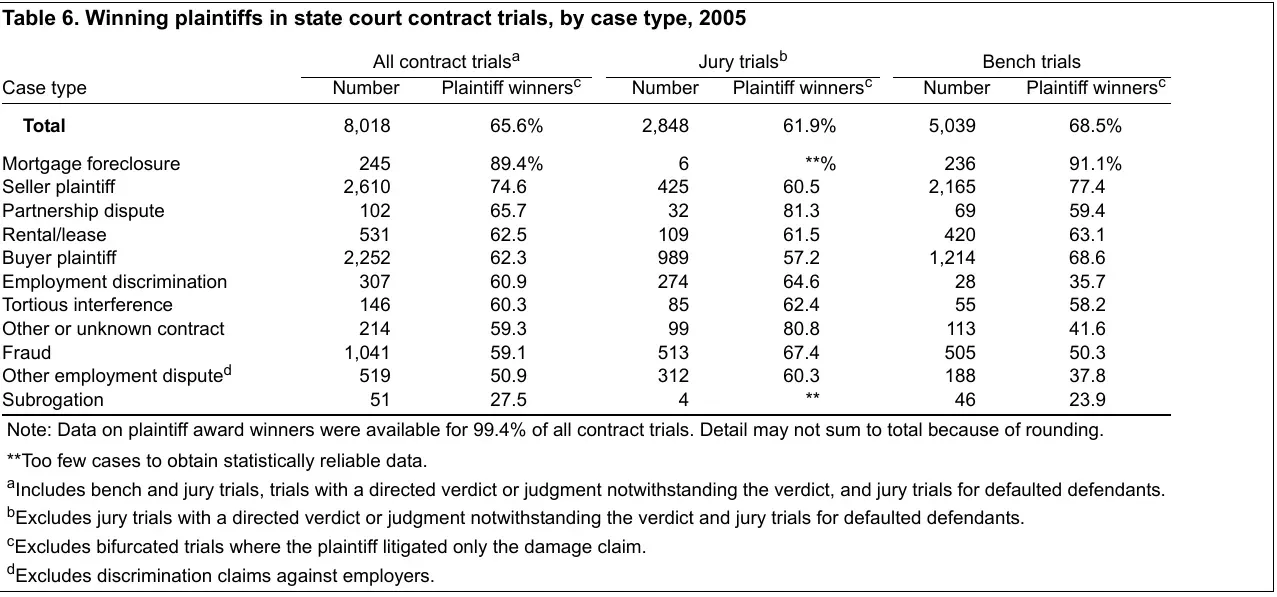
- Plaintiffs won 66 percent of state court contract trials in 2005, with a median award of $35,000. (Bureau of Justice Statistics, Sep 2009)
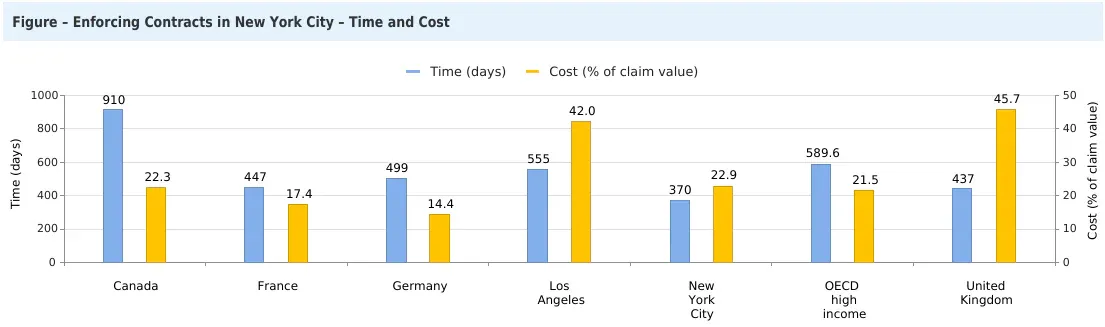
- Enforcing a standard sales contract in the US took 444 days and cost 30.5 percent of the claim value. (World Bank, Oct 2019)
- Kentucky caps small claims at $2,500, the lowest cap among the states checked here. (Kentucky Court of Justice, Oct 2026)
- Minnesota allows small claims up to $20,000, tied with Texas for the highest cap among the states checked here. (Minnesota Judicial Branch, Oct 2026)
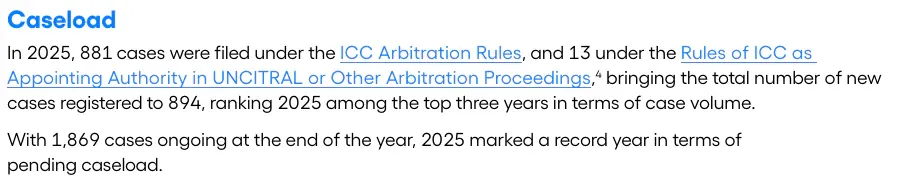
- The ICC received 881 arbitration cases in 2025 and ended the year with a record 1,869 pending. (ICC, Jun 2026)
- AAA large business cases, over $1 million, reached an award in a median of 18.7 months, against about 34 months to trial in US district courts. (AAA, Oct 2026)
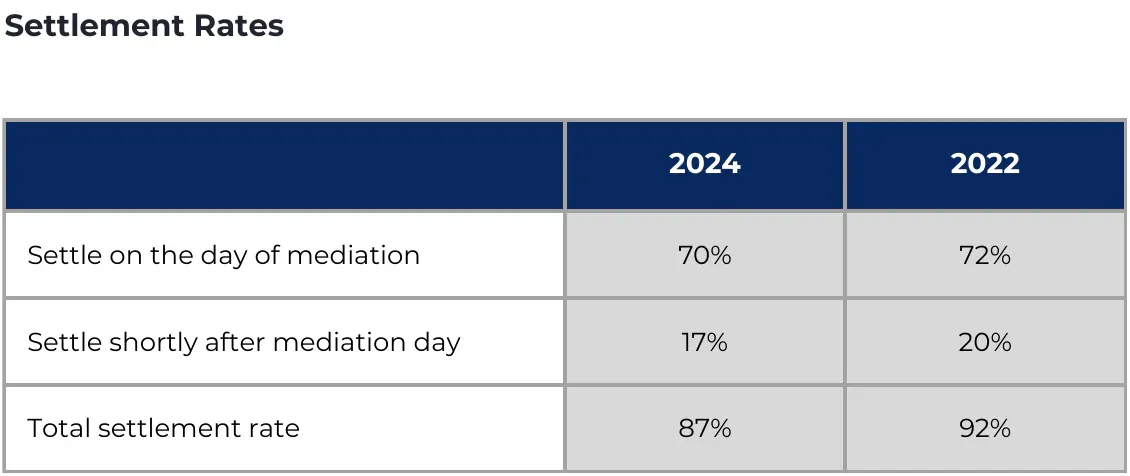
- UK mediators in the CEDR audit reported that 87 percent of mediations ended in a settlement. (CEDR, Aug 2025)
- Overdue invoices touch 43 percent of credit-based B2B sales for US companies. (Atradius, Sep 2025)
- New York City has taken 4,832 freelancer pay complaints since 2017 and helped recover over $3.5 million. (NYC DCWP, Feb 2026)
What do breach of contract statistics show for federal courts?
Most federal contract cases are insurance claims or other contract claims between parties from different states. The volume moves with a few large categories, not with every business that signs a contract. The federal tables count “contract actions” and do not split out breach claims.
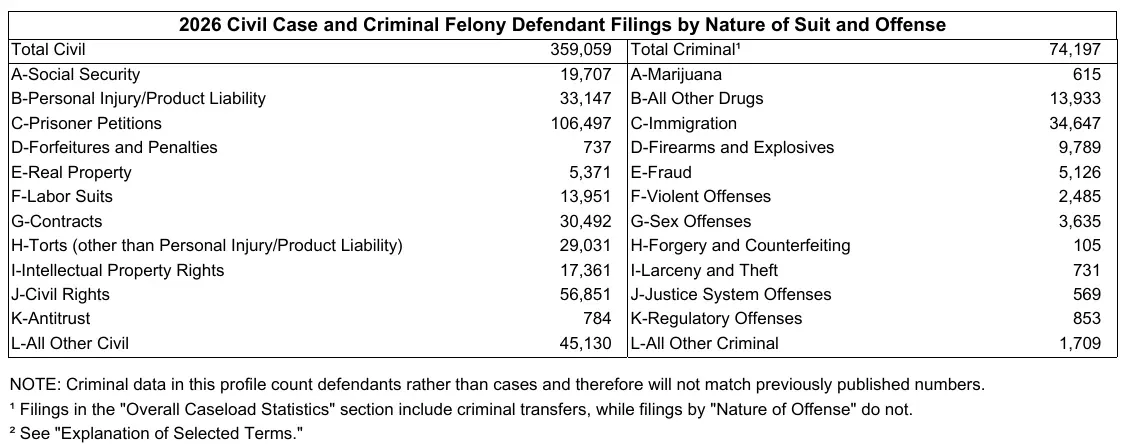
How many contract cases were filed in federal court?
- Contract actions totaled 28,613 in the 12 months ending March 2025. (U.S. Courts, Mar 2025)
- That was a 13 percent drop (3,426 fewer cases) as insurance cases fell 28 percent. (U.S. Courts, Mar 2025)
- Total civil filings fell 22 percent to 271,802, largely because fewer multidistrict cases were filed. (U.S. Courts, Mar 2025)
- Pending civil cases dropped 37 percent to 398,121 as terminations jumped 70 percent. (U.S. Courts, Mar 2025)
What kinds of contract actions does the federal court count?
- Insurance cases were the biggest group, at 12,383. (U.S. Courts, Mar 2025)
- “Other contract actions” came to 14,087. (U.S. Courts, Mar 2025)
- Marine contract cases numbered 561 and negotiable instrument cases 523. (U.S. Courts, Mar 2025)
- Franchise cases were 196 and Miller Act cases, which involve federal construction bonds, were 160. (U.S. Courts, Mar 2025)
- Recovery of overpayments and enforcement of judgments added 703. (U.S. Courts, Mar 2025)
On what basis are federal contract cases filed?
- Diversity of citizenship, meaning the parties live in different states, was the basis for 23,704 contract actions. (U.S. Courts, Mar 2025)
- Federal question jurisdiction was the basis for 4,346. (U.S. Courts, Mar 2025)
- The United States was the plaintiff in 293 contract actions and the defendant in 270. (U.S. Courts, Mar 2025)
- Contract actions with the United States as plaintiff rose 79 percent. (U.S. Courts, Mar 2025)
How many contract and small claims cases do state courts see?
State courts hold the bulk of contract fights, and the growth is in money owed, not in complex business suits. Small claims and contract filings now drive most of the rise in civil dockets.
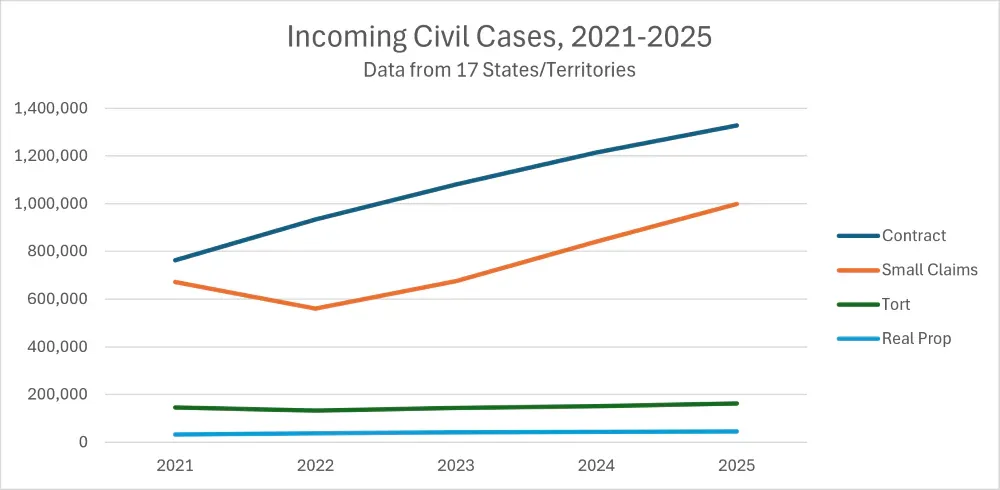
How fast are state contract filings growing?
- Small claims filings rose from about 671,000 in 2021 to nearly 1 million in 2025 across reporting jurisdictions. (NCSC, Aug 2026)
- Contract, small claims, tort and real property cases make up about 80 percent of civil filings. (NCSC, Aug 2026)
- Civil filings have grown faster than criminal filings for the fourth year in a row. (NCSC, Aug 2026)
What does a large state show?
- Texas justice courts took in 358,598 new debt claim cases in 2024. (Texas Office of Court Administration, Sep 2024)
- Landlord and tenant cases came to 309,172 in the same courts. (Texas Office of Court Administration, Sep 2024)
- Small claims cases came to 60,556. (Texas Office of Court Administration, Sep 2024)
- Justice court debt filings rose 20 percent to an all-time high, while small claims filings fell 1 percent. (Texas Office of Court Administration, Sep 2024)
- The justice court clearance rate slipped to 93 percent from 96 percent. (Texas Office of Court Administration, Sep 2024)
What did the last national sample of large counties find?
- Contract cases made up 48 percent of civil cases disposed in the 75 largest counties in 1992, or 366,336 cases. (Bureau of Justice Statistics, Feb 1996)
- Sellers suing for payment were 51.7 percent of those contract cases. (Bureau of Justice Statistics, Feb 1996)
- About half of the cases ended in an agreed judgment, and another quarter in a default judgment. (Bureau of Justice Statistics, Feb 1996)
- Less than 3 percent were decided by a jury or bench trial. (Bureau of Justice Statistics, Feb 1996)
- Businesses were the plaintiff in 68 percent of cases and individuals in 26 percent. (Bureau of Justice Statistics, Feb 1996)
What are the small claims court statistics on limits and fees by state?
The dollar cap on a small claim is a state choice, and it varies by a factor of eight. A claim that fits in one state’s small claims court may need a regular civil court in the next.

Which states set the highest small claims limits?
- Texas allows small claims up to $20,000, including attorney fees and excluding interest and costs. (Supreme Court of Texas, Nov 2025)
- California allows $12,500 for individuals and $6,250 for businesses. (California Courts, Oct 2026)
- New York City Civil Court hears small claims up to $10,000. (New York Courts, Oct 2026)
- Illinois small claims cover amounts of $10,000 or less. (Illinois Courts, Oct 2026)
- Washington lets a person sue for up to $10,000 in small claims court. (Washington Courts, Oct 2026)
- Wisconsin small claims cover money claims up to $10,000, with a $5,000 cap on tort claims. (Wisconsin Court System, Oct 2026)
- Indiana lists money owed for services or accounts receivable at $10,000 or less. (Indiana Courts, Dec 2025)
- Minnesota caps consumer credit claims in conciliation court at $4,000. (Minnesota Judicial Branch, Oct 2026)
- North Carolina’s cap varies by county, from $5,000 to $10,000. (North Carolina Judicial Branch, Oct 2026)
Which states set the lowest limits?
- Arizona justice courts hear small claims up to $3,500. (Arizona Courts, Oct 2026)
- Virginia’s general district court hears small claims of up to $5,000. (Virginia Judicial System, Oct 2026)
- Maryland’s District Court handles small claims of $5,000 or less. (Maryland Courts, Oct 2026)
- New Jersey raised its small claims cap from $3,000 to $5,000 in 2022, and its Special Civil Part cap from $15,000 to $20,000. (New Jersey Courts, May 2022)
- Massachusetts small claims cover disputes of $7,000 or less. (Mass.gov, Oct 2026)
- Colorado allows $7,500 and says a larger claim can be filed but only $7,500 can be collected. (Colorado Judicial Branch, Oct 2026)
- Florida small claims rules apply to claims of $8,000 or less, excluding costs, interest and attorney fees. (Florida Courts, Oct 2026)
- Outside New York City, City Courts hear small claims up to $5,000 and Town and Village Courts up to $3,000. (New York Courts, Oct 2026)
What does a small claims case cost and how fast is it?
- A small claims filing fee in California runs from $30 to $100. (California Courts, Oct 2026)
- A California small claims trial date usually comes in about 1 to 2 months. (California Courts, Oct 2026)
- New York small claims cost $10 to $20 to file, and commercial small claims cost $25 per claim. (New York Courts, Oct 2026)
- Illinois dropped appearance fees in small claims cases from October 1, 2025. (Illinois Courts, Apr 2025)
How often do contract cases reach trial, and who wins?
Trials are rare, and that is the main fact about contract litigation. The cases that do reach a verdict lean toward the plaintiff, and the money at stake is usually modest.
How many federal contract cases end at trial?
- Of 507,184 federal civil cases ended in the year to March 2025, 0.3 percent reached trial. (U.S. Courts, Mar 2025)
- Of 11,023 diversity “other contract” cases ended, 181 reached trial, or 1.6 percent. (U.S. Courts, Mar 2025)
- 2,426 of those cases ended with no court action at all. (U.S. Courts, Mar 2025)
- Insurance contract cases reached trial in 0.4 percent of 15,216 terminations. (U.S. Courts, Mar 2025)
- Federal question “other contract” cases reached trial in 0.5 percent of 3,548 terminations. (U.S. Courts, Mar 2025)
Who wins when a state contract case goes to trial?
- State general jurisdiction courts decided 8,917 contract cases by bench or jury trial in 2005, about a third of the tort, contract and real property trials in the study. (Bureau of Justice Statistics, Sep 2009)
- Judges decided 64 percent of those trials and juries 36 percent. (Bureau of Justice Statistics, Sep 2009)
- Mortgage foreclosure plaintiffs won 89.4 percent of their trials and seller plaintiffs won 74.6 percent. (Bureau of Justice Statistics, Sep 2009)
- Subrogation plaintiffs, who sue to recover what an insurer paid, won only 27.5 percent. (Bureau of Justice Statistics, Sep 2009)
- Juries awarded a median of $75,000 and judges a median of $25,000. (Bureau of Justice Statistics, Sep 2009)
Who sues whom, and who has a lawyer?
- An individual suing a business was the most common pairing at 33 percent, followed by business against business at 25 percent. (Bureau of Justice Statistics, Sep 2009)
- Seller plaintiffs brought 32 percent of contract trials and buyer plaintiffs 29 percent. (Bureau of Justice Statistics, Sep 2009)
- Defendants appeared without a lawyer in 10 percent of contract trials, plaintiffs in 3 percent. (Bureau of Justice Statistics, Sep 2009)
- Contract trials in the 75 most populous counties fell by more than a quarter from 1996 to 2005. (Bureau of Justice Statistics, Sep 2009)
How long and how costly is enforcing a contract in court?
Time and fees are why most people settle. A winning claim can still take more than a year and cost a large share of what it recovers.
How long do federal civil cases take?
- The median federal civil case ended in 6.9 months in the 12 months to June 2026. (U.S. Courts, Jun 2026)
- The median time from filing to trial was 28.3 months in 2021. (U.S. Courts, Jun 2026)
- 125,478 civil cases, or 26.2 percent, were more than three years old. (U.S. Courts, Jun 2026)
What did the World Bank find for the United States?
- The United States ranked 17th of 190 economies for enforcing contracts, with a score of 73.4 out of 100. (World Bank, Oct 2019)
- Its quality of judicial processes index was 14.6 out of 18. (World Bank, Oct 2019)
- The OECD high income average was 589.6 days. (World Bank, Oct 2019)
What did the New York City test case cost?
- The test claim was worth $120,392 and ran through the New York State Supreme Court. (World Bank, Oct 2019)
- Trial and judgment took 240 of the 370 days. (World Bank, Oct 2019)
- Attorney fees were 14.4 percent of the claim, court fees 5 percent and enforcement fees 3.5 percent. (World Bank, Oct 2019)
- Germany needed 499 days at a cost of 14.4 percent, and the United Kingdom 437 days at 45.7 percent. (World Bank, Oct 2019)
What do ICC dispute resolution statistics show?
The ICC is the large end of the market: big claims, many countries, and a record backlog. Its numbers are a useful contrast with small claims court.
How many cases does the ICC receive?
- Cases filed under the ICC Rules and the ICC Appointing Authority Rules totaled 894 in 2025. (ICC, Jun 2026)
- The ICC Court has administered more than 30,000 arbitrations since 1923. (ICC, Jun 2026)
- 69.4 percent of cases were cross-border and 30.6 percent involved parties of the same nationality. (ICC, Jun 2026)
- Among same-nationality cases, Brazil led with 38 and the United States followed with 29. (ICC, Jun 2026)
What kinds of contracts and claims reach the ICC?
- Construction and engineering produced 246 cases, or 28 percent, and energy 128 cases, or 15 percent. (ICC, Jun 2026)
- Construction and engineering contracts were 21.5 percent of filings and goods contracts 20.6 percent. (ICC, Jun 2026)
- Services contracts were 16.2 percent and corporate contracts 12.4 percent. (ICC, Jun 2026)
- 95 percent of new cases carried a choice-of-law clause, covering the laws of 121 nations, states, provinces and territories. (ICC, Jun 2026)
- English law and the laws of US states were each chosen in 113 cases, and New York was picked in over half of the US ones. (ICC, Jun 2026)
How big are ICC claims?
- The median amount in dispute in new cases was US$5 million, and the average was just over US$50 million. (ICC, Jun 2026)
- Claims ranged from just below US$2,500 to US$31 billion. (ICC, Jun 2026)
- 36 percent of new cases were worth US$3 million or less. (ICC, Jun 2026)
- New cases carried close to US$41 billion in dispute, and the pending caseload close to US$299 billion. (ICC, Jun 2026)
How do ICC cases end, and how long do they take?
- The ICC Court approved 607 draft awards in 2025: 444 final, 118 partial and 45 by consent. (ICC, Jun 2026)
- Cases that ended in a final award took an average of 27 months and a median of 23 months. (ICC, Jun 2026)
- 346 cases were withdrawn before a final award, and 89 percent of withdrawals followed a joint request or one with no objection. (ICC, Jun 2026)
- 53 percent of withdrawals came before the tribunal was appointed. (ICC, Jun 2026)
- 14 percent of awards by three-member tribunals were decided by majority rather than unanimously. (ICC, Jun 2026)
What do the ICC’s faster options show?
- 169 cases ran under the Expedited Procedure Provisions, and 158 of them applied automatically. (ICC, Jun 2026)
- Of 130 final awards under that procedure, 65 percent arrived on or around the six-month limit. (ICC, Jun 2026)
- 30 emergency arbitrator applications were filed, and of 25 orders, 15 were dismissed. (ICC, Jun 2026)
- ICC mediation drew 36 requests involving 81 parties from 33 countries. (ICC, Jun 2026)
- The average mediation claim was about US$71 million. (ICC, Jun 2026)
How do AAA, LCIA, HKIAC and mediation providers compare?
Other arbitration and mediation providers report smaller claims, faster timelines and high settlement rates. The pattern across them is that most disputes settle before a final decision.
What does the AAA report for business cases?
- AAA business cases carried more than $29 billion in claims and counterclaims in 2025. (AAA, Oct 2026)
- 52 percent of closed business cases settled before an award in 2025. (AAA, Oct 2026)
- Large complex cases filed in 2025 had a median claim of $3 million and an average of almost $9.9 million. (AAA, Oct 2026)
- AAA mediations involved $2.4 billion in dispute in 2025, with parties from 50 states and 31 countries. (AAA, Oct 2026)
- A commercial mediation filing fee is $350 per party, and expedited cases are those with no more than $100,000 in issue. (AAA, Oct 2026)
How do LCIA and HKIAC compare?
- The LCIA received 365 referrals in 2025, including 320 arbitrations under its rules. (LCIA, Oct 2026)
- Parties came from 103 jurisdictions, and 96 percent of cases had at least one non-UK party. (LCIA, Oct 2026)
- A Brattle Group verified analysis found a median LCIA arbitration cost of USD 117,653 and a median of 20 months to a final award. (LCIA, Oct 2026)
- Sale of goods agreements were 30 percent of LCIA cases and services agreements 26 percent. (LCIA, Oct 2026)
- HKIAC received 582 cases in 2025, of which 388 were arbitrations. (HKIAC, Oct 2026)
- The total amount in dispute in HKIAC arbitrations was HK$126.2 billion, about US$16.2 billion. (HKIAC, Oct 2026)
- Sale of goods made up 14.2 percent of HKIAC cases and construction 9.2 percent. (HKIAC, Oct 2026)
What do surveys say about arbitration and mediation?
- 87 percent of respondents prefer international arbitration for cross-border disputes, 39 percent on its own and 48 percent with other ADR. (Queen Mary University and White & Case, Jun 2025)
- Expedited procedures were named most effective for efficiency by 50 percent and early determination by 49 percent. (Queen Mary University and White & Case, Jun 2025)
- 65 percent of those choosing expedited steps said they want to minimize cost. (Queen Mary University and White & Case, Jun 2025)
- UK mediators handled about 21,000 civil and commercial cases in the year to September 2024, up 24 percent from 17,000 in 2022. (CEDR, Aug 2025)
- 70 percent of mediations settled on the day and 17 percent shortly after. (CEDR, Aug 2025)
- 63 percent of ad hoc mediations went through service providers. (CEDR, Aug 2025)
How often do unpaid invoices turn into disputes?
Late payment is common between businesses, and the reasons buyers give often involve the invoice itself. The terms that decide when an invoice is late sit in the contract, for example a payment plan contract or a simple service agreement. See the related page on freelance statistics for pay data on the freelance side.

How common are late B2B invoices?
- Bad debts were 5 percent of the value of US B2B invoices in 2025. (Atradius, Sep 2025)
- 23 percent of US suppliers named invoice disputes as a top reason customers pay late. (Atradius, Sep 2025)
- 45 percent named customer liquidity problems, the top reason. (Atradius, Sep 2025)
- Average payment terms were 45 days, and nearly half of B2B sales were made on credit. (Atradius, Sep 2025)
- Nearly half of US businesses delayed paying their own suppliers to protect cash. (Atradius, Sep 2025)
- A year earlier, bad debts averaged 8 percent of US B2B invoices. (Atradius, Sep 2024)
- In the 2024 survey, overdue invoices were paid on average 20 days past due. (Atradius, Sep 2024)
What happens when a freelancer files a pay complaint?
- New York City’s freelancer pay law unit has closed 4,394 cases since 2017. (NYC DCWP, Feb 2026)
- A production company agreed to pay $528,817 to 350 freelancers over late and missing payments. (NYC DCWP, Feb 2026)
- Complaints reached 848 in fiscal 2026, up 3 percent from 821. (NYC DCWP, Sep 2026)
- Complaints were 332 in fiscal 2022. (NYC DCWP, Sep 2026)
- Cases opened rose 20 percent to 856, and 788 cases closed. (NYC DCWP, Sep 2026)
- Complainants reported recovering $297,012, down 19 percent from $365,973. (NYC DCWP, Sep 2026)
- In fiscal 2022 complainants reported recovering $604,521. (NYC DCWP, Sep 2026)
- In calendar 2024 the city logged 763 freelance complaints and opened 2 investigations. (NYC DCWP, Dec 2024)
Methodology and Sources
Every figure comes from the body that produced it: courts, regulators, arbitration institutions, researchers and survey firms. Each link points to the report, table or page itself, and each page was opened and checked on 20 October 2026. Where a source page carries no publication date, the citation shows the month it was checked and the text names the year the data covers. Court and arbitration numbers are reported as the source states them, using each source’s own definitions of a contract case, and the page offers no legal conclusions. Some figures are old, such as the 2005 state trial study, because no newer national sample exists. The page is refreshed monthly.
Glossary
- AAA: American Arbitration Association.
- ADR: alternative dispute resolution, such as mediation and arbitration.
- B2B: business to business.
- CEDR: Centre for Effective Dispute Resolution, a UK mediation body.
- DCWP: New York City Department of Consumer and Worker Protection.
- EPP: Expedited Procedure Provisions of the ICC Rules.
- HKIAC: Hong Kong International Arbitration Centre.
- ICC: International Chamber of Commerce.
- LCIA: London Court of International Arbitration.
- MDL: multidistrict litigation, many similar cases grouped before one judge.
- NCSC: National Center for State Courts.
- OECD: Organisation for Economic Co-operation and Development.
Sources
- AAA
- AAA
- Arizona Courts
- Atradius
- Atradius
- Bureau of Justice Statistics
- Bureau of Justice Statistics
- California Courts
- CEDR
- Colorado Judicial Branch
- Florida Courts
- HKIAC
- ICC
- Illinois Courts
- Illinois Courts
- Indiana Courts
- Kentucky Court of Justice
- LCIA
- Maryland Courts
- Mass.gov
- Minnesota Judicial Branch
- NCSC
- New Jersey Courts
- New York Courts
- New York Courts
- North Carolina Judicial Branch
- NYC DCWP
- NYC DCWP
- NYC DCWP
- Queen Mary University and White & Case
- Supreme Court of Texas
- Texas Office of Court Administration
- U.S. Courts
- U.S. Courts
- U.S. Courts
- U.S. Courts
- Virginia Judicial System
- Washington Courts
- Wisconsin Court System
- World Bank