Legal AI statistics now point one way: most lawyers use AI, and many firms still have no written rules for it. Individual use jumped fast, while policy, training and pricing models stayed where they were.
The money followed the use. Venture funding for legal tech hit a record in 2025, and the biggest AI legal companies now carry valuations in the billions. The courts have started to push back, with sanctions for fake citations and new rules for judges and filers.
Every figure below comes from the group that ran the study, the court that wrote the order, or the company that made the announcement. Each one has a date. We checked each link before it went in, and we refresh the page monthly.
Key Takeaways
- 69% of legal professionals now use general-purpose AI tools for work, up from 31% a year earlier (8am, Mar 2026).
- 41% of law firms and 47% of corporate legal departments say their organization uses generative AI (Thomson Reuters Institute, Feb 2026).
- 34% of law firm professionals use AI tools their firm has not approved (Thomson Reuters Institute, Jun 2026).
- 77% of clients say AI-enabled quality gains are very important or essential, and 5% say most of their providers deliver them (Thomson Reuters Institute, Jun 2026).
- Legal and legal tech startups raised a record $4.6 billion in 2025 (Crunchbase News, Aug 2026).
- Harvey raised $550 million at a $15.5 billion valuation (Harvey, Sep 2026).
- 62% of legal professionals save between 6% and 20% of their work week with AI (Wolters Kluwer, Mar 2026).
- Fewer than 33% of solo and small firms raised revenue with AI, against nearly 60% of enterprise firms (Clio, May 2026).
- In one study, an AI reviewed contracts for 99.97% less cost than traditional reviewers (arXiv, Jan 2024).
- Lexis+ AI and Ask Practical Law AI gave incorrect information more than 17% of the time, and Westlaw AI-Assisted Research more than 34% (Stanford HAI, May 2024).
- A public database lists 2,202 court decisions that address AI-hallucinated content (Damien Charlotin, Oct 2026).
- More than 60% of federal judges who answered a random-sample survey use at least one AI tool in their work (Northwestern University, Mar 2026).
- About one in six people with a recent legal problem used an AI chatbot for help (JUSTICE, Jan 2026).
Law Firm and Lawyer AI Adoption
Lawyers did not wait for their firms. Individual use came first, and the firm-level plans are still catching up.
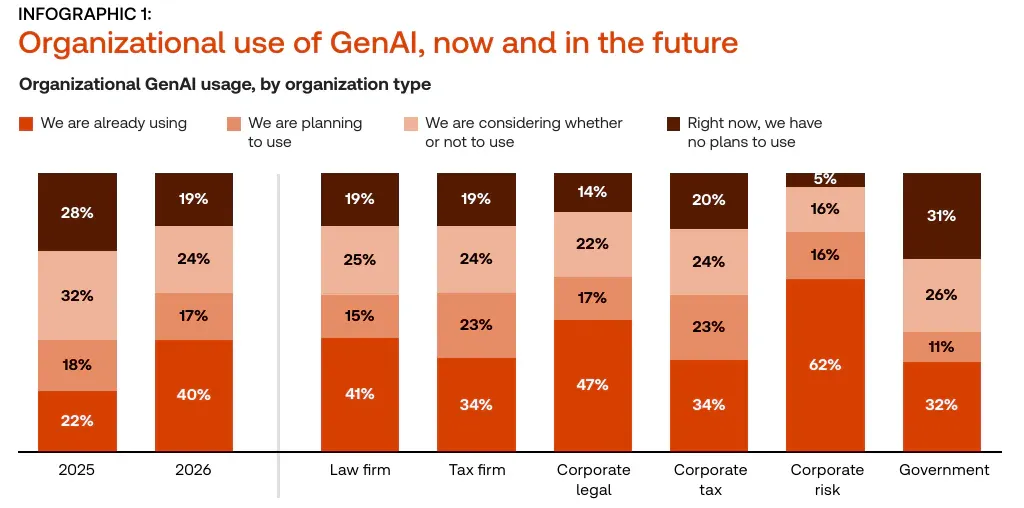
How many lawyers use AI at work?
Most do, and the share is highest in small firms and in the UK and Ireland.
- 71% of solo practitioners and 75% of small firms use AI to complete legal work (Clio, May 2026).
- 89% of UK and Ireland legal professionals use AI tools in some capacity (Clio, Apr 2026).
- 70% report making the shift to AI within the past year (Clio, Apr 2026).
- 61% of UK lawyers use generative AI in daily work, up from 46% in January 2025 (LexisNexis, Sep 2025).
- 6% of UK lawyers have no plans to adopt AI, down from 15% (LexisNexis, Sep 2025).
- 92% of surveyed lawyers use at least one AI tool in their daily workflow (Wolters Kluwer, Mar 2026).
How many firms use AI as a firm?
Firm-level use trails personal use, and legal-specific tools trail general ones.
- 42% of legal professionals use legal-specific AI tools, double the 21% of a year earlier (8am, Mar 2026).
- 34% of firms use legal-specific AI as a firm, up from 21% (8am, Mar 2026).
- 46% of firms use general-purpose AI as a firm, and 58% of firms with 20 or more lawyers do (8am, Mar 2026).
- 27% of UK and Ireland firms have embedded AI widely across the organisation (Clio, Apr 2026).
- 28% of legal professionals use AI every day (8am, Mar 2026).
What do lawyers use AI for?
Research and document work lead the list. Drafting comes next.
- 80% of legal professionals using generative AI use it for legal research (Thomson Reuters Institute, Feb 2026).
- 74% use it for document review (Thomson Reuters Institute, Feb 2026).
- 59% use it to draft briefs or memos (Thomson Reuters Institute, Feb 2026).
- 49% of legal professionals using generative AI use it for contract drafting (Thomson Reuters Institute, Feb 2026).
- 58% of users of legal-specific tools use them for research and 49% for document drafting (8am, Mar 2026).
In-House Legal Teams and AI
Corporate legal teams are adopting fast and measuring little. They are also leaning on their own tools to do work they once sent out.
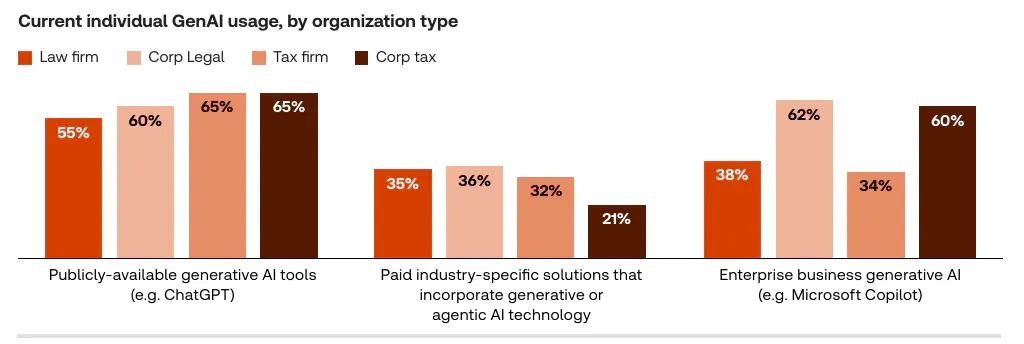
How many in-house teams use generative AI?
Use more than doubled in a year, and few companies still ban it.
- 52% of in-house legal respondents report using generative AI, up from 23% the year before (ACC and Everlaw, Oct 2025).
- 61% of European respondents already use it, the highest regional rate (ACC and Everlaw, Oct 2025).
- 9% say company policy prohibits generative AI, down from 29% (ACC and Everlaw, Oct 2025).
- 2% have no plans to use it (ACC and Everlaw, Oct 2025).
- 62% of corporate legal professionals use enterprise business AI such as Microsoft Copilot, against 38% of law firm professionals (Thomson Reuters Institute, Feb 2026).
- 7% of in-house legal teams have scaled AI across the organization (Axiom, Jun 2026).
What do in-house teams expect from outside counsel?
They expect to buy less, and to pay differently for what they still buy.
- 64% expect to rely less on outside counsel, up from 58% (ACC and Everlaw, Oct 2025).
- 78% see a chance to bring drafting in house, 71% contract management and 62% research (ACC and Everlaw, Oct 2025).
- 59% report no generative AI savings from their law firms yet, and 24% are satisfied with how firms adopt AI for cost effectiveness (ACC and Everlaw, Oct 2025).
- 61% plan to push for change in how legal services are delivered and priced (ACC and Everlaw, Oct 2025).
- 71% of in-house legal professionals expect outside firms to change their commercial model as AI use grows (Thomson Reuters Institute, Jun 2026).
- 68% of corporate legal professionals do not know whether their outside firms use AI (Thomson Reuters Institute, Mar 2026).
- Fewer than 20% of corporate respondents require outside firms to use AI, though two-thirds want them to (Thomson Reuters Institute, Feb 2026).
Do in-house teams measure what AI delivers?
Mostly not. Teams track spend, not results.
- 83% of in-house legal teams cannot tell whether their AI spending is working (Axiom, Jun 2026).
- 98% of teams using AI say outside guidance would help (Axiom, Jun 2026).
- 12% of legal teams track technology return on investment (ACC and Everlaw, Nov 2025).
- 96% of in-house respondents say generative AI can help them show the legal team’s value to the business (ACC and Everlaw, Nov 2025).
- 85% of law firm respondents are not collecting AI return-on-investment data or are unsure whether they do (Thomson Reuters Institute, Mar 2026).
Legal Tech Statistics: Funding and Spending
Money moved first and fastest at the top. A handful of AI companies took most of the new capital, while ordinary law firms raised their technology budgets.
How much venture money goes into legal tech?
More than $7 billion in two years, and still rising.
- Venture investors put more than $7 billion into legal and legal tech startups over the past two years (Crunchbase News, Aug 2026).
- Legal tech startups had pulled in more than $2.2 billion so far in 2026 (Crunchbase News, Aug 2026).
- At least 12 legal tech startups raised rounds of $50 million or more in 2026, and eight of those were Series A or Series B (Crunchbase News, Aug 2026).
- There were more than 50 legal and legal tech seed rounds of $1 million or more in 2026 (Crunchbase News, Aug 2026).
- Filevine closed two rounds worth $400 million in total (Crunchbase News, Sep 2025).
Which legal AI companies raised the most?
A few names, each at a multi-billion valuation.
- Harvey has raised $1.2 billion to date (Crunchbase News, Aug 2026).
- Harvey raised $200 million at an $11 billion valuation in March 2026 (Harvey, Mar 2026).
- Customers run more than 25,000 custom agents on Harvey (Harvey, Mar 2026).
- 80% of Am Law 100 firms use Harvey (Harvey, Sep 2026).
- Legora raised $550 million at a $5.55 billion valuation (Legora, Mar 2026).
- Legora serves 800 customers in more than 50 markets (Legora, Mar 2026).
- Legora’s valuation was $1.8 billion the previous October (Crunchbase News, Apr 2026).
- Clio closed its $1 billion vLex purchase and a $500 million Series G at a $5 billion valuation (Clio, Nov 2025).
- Clio’s earlier Series F was $900 million at a $3 billion valuation (Clio, Jul 2024).
- EvenUp raised $150 million in Series E at a valuation above $2 billion (Crunchbase News, Oct 2025).
- More than 1,000 law firms used EvenUp when it raised its Series D (EvenUp, Oct 2024).
- Thomson Reuters paid $650 million in cash for Casetext, maker of CoCounsel (Thomson Reuters, Aug 2023).
- Wolters Kluwer paid $500 million for Brightflag and $105 million for Libra (Crunchbase News, Aug 2026).
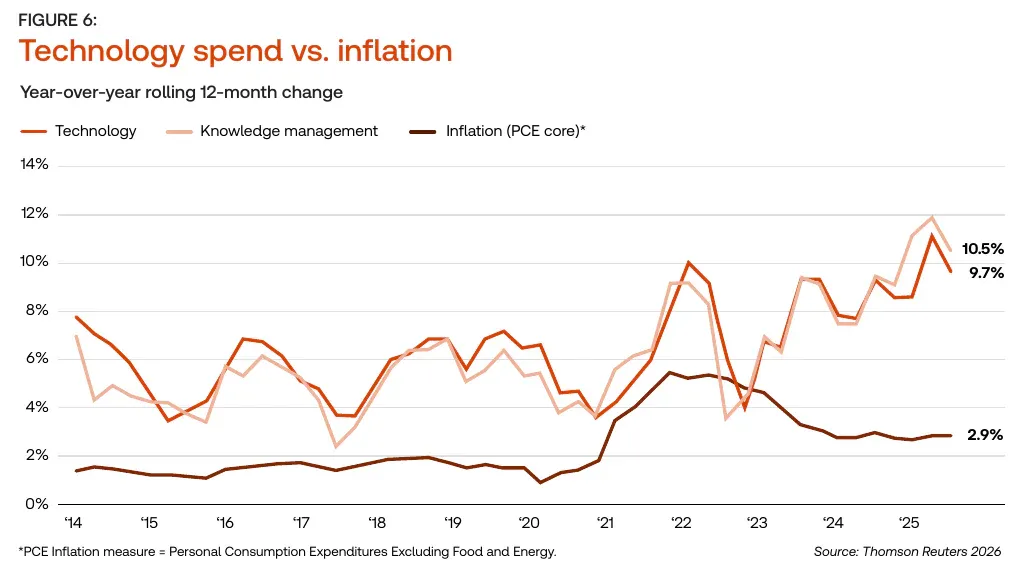
How much do law firms spend on technology?
More every year, and faster than prices rise.
- The average firm’s technology spending grew 9.7% in 2025 (Thomson Reuters Institute, Jan 2026).
- Knowledge management spending grew 10.5% (Thomson Reuters Institute, Jan 2026).
- Firms raised technology spending by 39.3% between 2021 and 2025 (Thomson Reuters Institute, Jan 2026).
- Firms with a visible AI strategy are 3.9 times as likely to see at least one form of return on investment (Thomson Reuters Institute, Jan 2026).
- 90% of legal dollars still flow through hourly rate arrangements (Thomson Reuters Institute, Jan 2026).
- Goldman Sachs estimated that 44% of work tasks in legal professions could be automated by AI (Goldman Sachs, Mar 2023).
Time Saved and Productivity
Saved hours are real, and they are modest for most people. The harder question is who keeps the value.
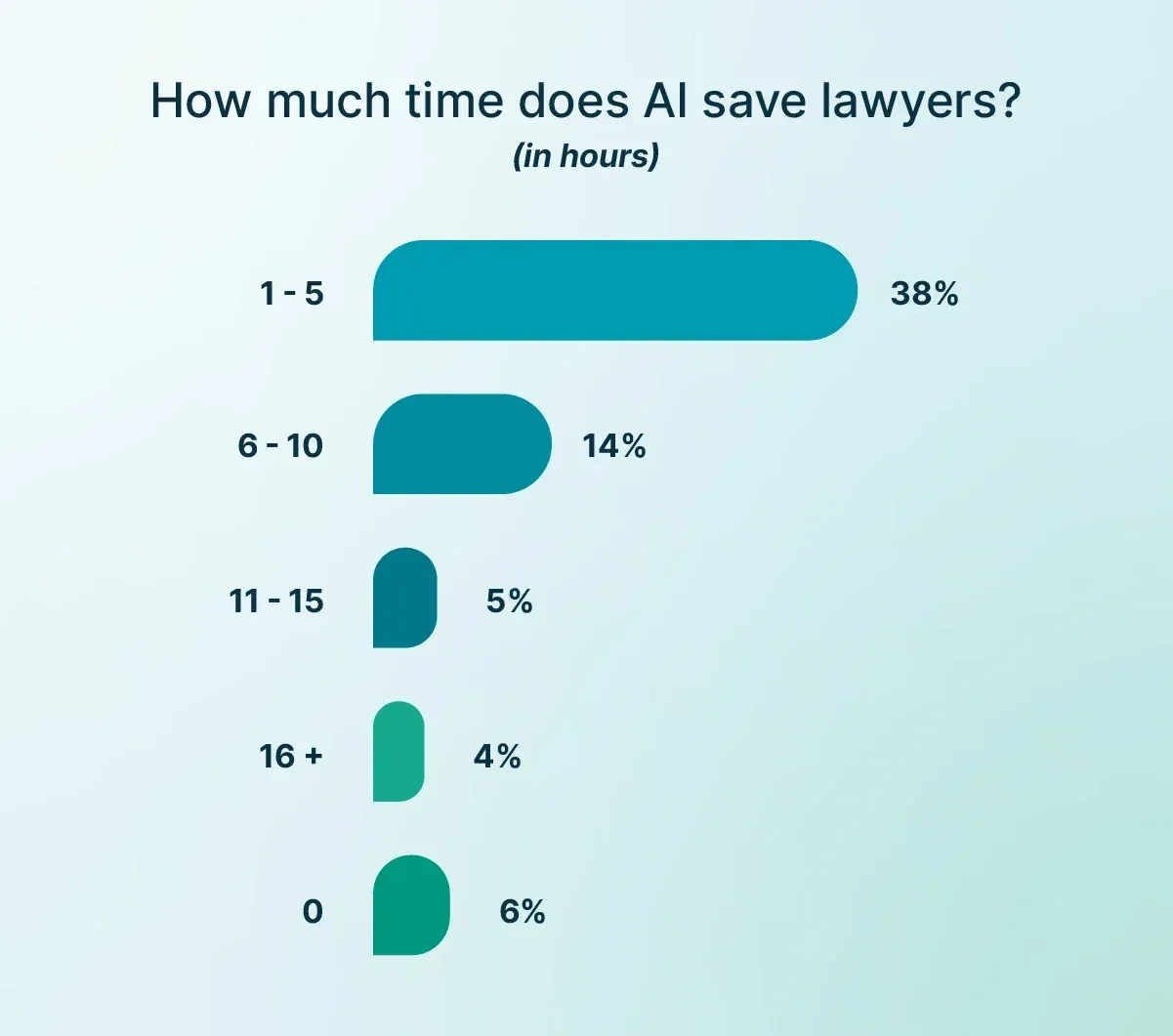
How many hours does AI save lawyers each week?
One to five hours for the largest group.
- 38% of respondents save one to five hours a week with AI (8am, Mar 2026).
- 14% save six to ten hours a week (8am, Mar 2026).
- 6% report no productivity gain, down from 17% a year earlier (8am, Mar 2026).
- 33% report no time savings but say AI improves the quality of their work (8am, Mar 2026).
- In 2024, professionals predicted AI would save them four hours a week within a year and 12 hours a week within five years (Thomson Reuters, Jul 2024).
What do lawyers do with the saved time?
Some bill more. Some go home earlier.
- 56% of UK private practice lawyers used saved time to increase billable work (LexisNexis, Sep 2025).
- 53% used it for a better work-life balance (LexisNexis, Sep 2025).
- 54% of respondents expect law firms to use AI efficiency to serve more clients or price more competitively (Wolters Kluwer, Mar 2026).
Does saved time turn into revenue?
Often it does not, because pricing has not moved.
- 86% of solo firms and 78% of small firms have made no pricing changes, against 51% of mid-market firms and 46% of enterprise firms (Clio, May 2026).
- Fixed or flat fees account for 53% of matters in the UK and Ireland, and hourly billing for 32% (Clio, Apr 2026).
- 62% of law firm professionals say their firm’s pricing structure is unchanged in response to AI (Thomson Reuters Institute, Jun 2026).
- Half of legal professionals call AI a major or somewhat of a threat to billings and law firm revenue (Thomson Reuters Institute, Mar 2026).
- 47% of UK lawyers agree AI will transform how firms bill for legal services, up from 40% earlier in 2025 (LexisNexis, Sep 2025).
AI Contract Review Statistics: Speed and Accuracy
Contract review is where AI has the cleanest tests. On speed and cost it wins by a wide margin. On accuracy it ties or beats humans on some jobs and loses on others, with redlining the clearest gap.
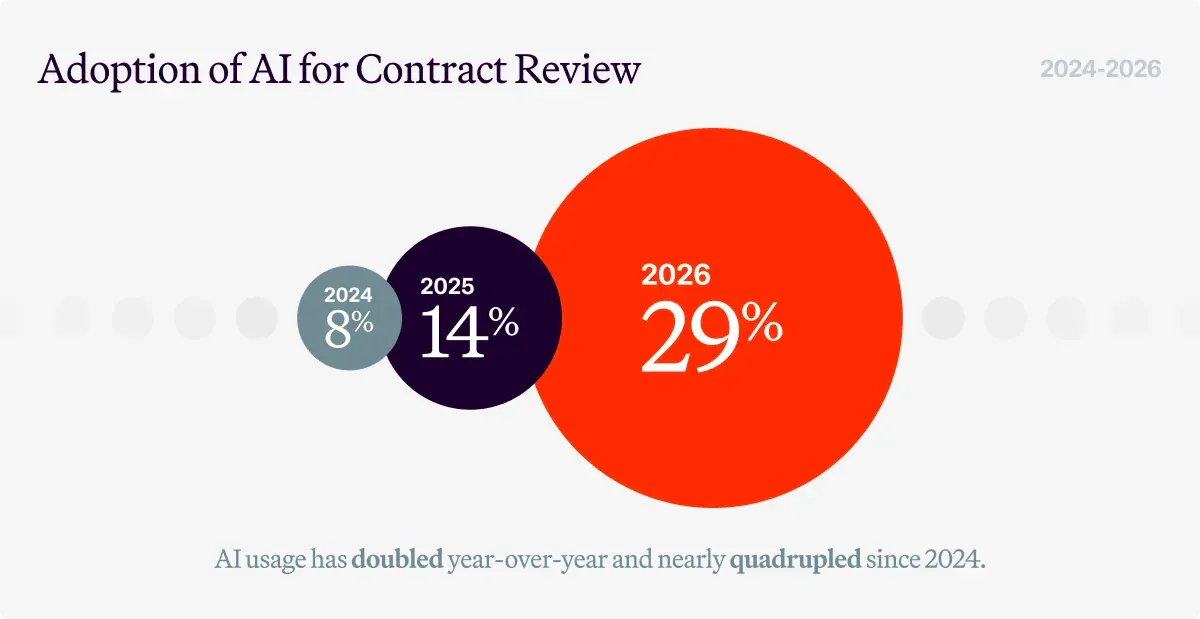
How many legal teams use AI for contract review?
Active use is a minority, and interest is close to universal.
- 52% of in-house legal teams already use or are evaluating AI for contract review (LegalOn, Jan 2026).
- 5% say they are not interested in AI for contract review (LegalOn, Jan 2026).
- 87% say AI would help with pre-signature contract review and redlining (LegalOn, Jan 2026).
- Legal teams spend 3.1 hours on average reviewing a single contract (LegalOn, Jan 2026).
- 79% report less time spent on routine legal tasks, and 67% report faster business response times (LegalOn, Jan 2026).
- 78% are comfortable letting an AI agent do a first-pass contract review under attorney supervision (LegalOn, Jan 2026).
How fast is AI at reviewing contracts?
Minutes against hours.
- A LawGeex AI finished a five-NDA test in 26 seconds, and the 20 lawyers averaged 92 minutes (LawGeex, Feb 2018).
- Junior lawyers took an average of 56.17 minutes per contract, and senior lawyers took 43.46 (arXiv, Jan 2024).
- Legal process outsourcers took 201 minutes per contract (arXiv, Jan 2024).
- The slowest model took 4.7 minutes per contract and the fastest took 0.73 minutes (arXiv, Jan 2024).
- A junior lawyer’s review cost $74.26 per contract, while model costs ran from $0.02 to $1.24 (arXiv, Jan 2024).
How accurate is AI at reviewing contracts?
Close to humans on spotting issues, and weaker at fixing them.
- LawGeex’s AI averaged 94% accuracy on NDA risks, against 85% for the lawyers (LawGeex, Feb 2018).
- The weakest lawyer in that test scored 67% (LawGeex, Feb 2018).
- On ten procurement contracts, GPT-4 and the outsourcers both scored an F-score of 0.87 at determining legal issues, and junior lawyers scored 0.86 (arXiv, Jan 2024).
- At locating the issue in the text, outsourcers scored 0.77 and the best model 0.74 (arXiv, Jan 2024).
- Harvey Assistant scored 75.1% on data extraction and CoCounsel 73.2%, against 71.1% for the lawyer baseline (Vals AI, Feb 2025).
- On redlining, the lawyer baseline scored 79.7%, Harvey Assistant 65.0% and Vincent AI 53.6% (Vals AI, Feb 2025).
- Harvey Assistant scored 94.8% on document question answering, and the lawyer baseline scored 70.1% (Vals AI, Feb 2025).
- On the hardest extraction question, 40 fields across three credit agreements, CoCounsel extracted 61.7% correctly and the lawyers 39.2% (Vals AI, Feb 2025).
What benchmarks test contract AI?
Two public datasets set most of the bar.
- The Contract Understanding Atticus Dataset holds 13,000+ labels across 510 commercial contracts and 41 clause types (The Atticus Project, Mar 2021).
- LegalBench is a benchmark of 162 tasks covering six types of legal reasoning (arXiv, Aug 2023).
Errors and Hallucinations in Legal Research Tools
Specialist tools hallucinate less than general chatbots, but they still do it. A lawyer has to check every cite.
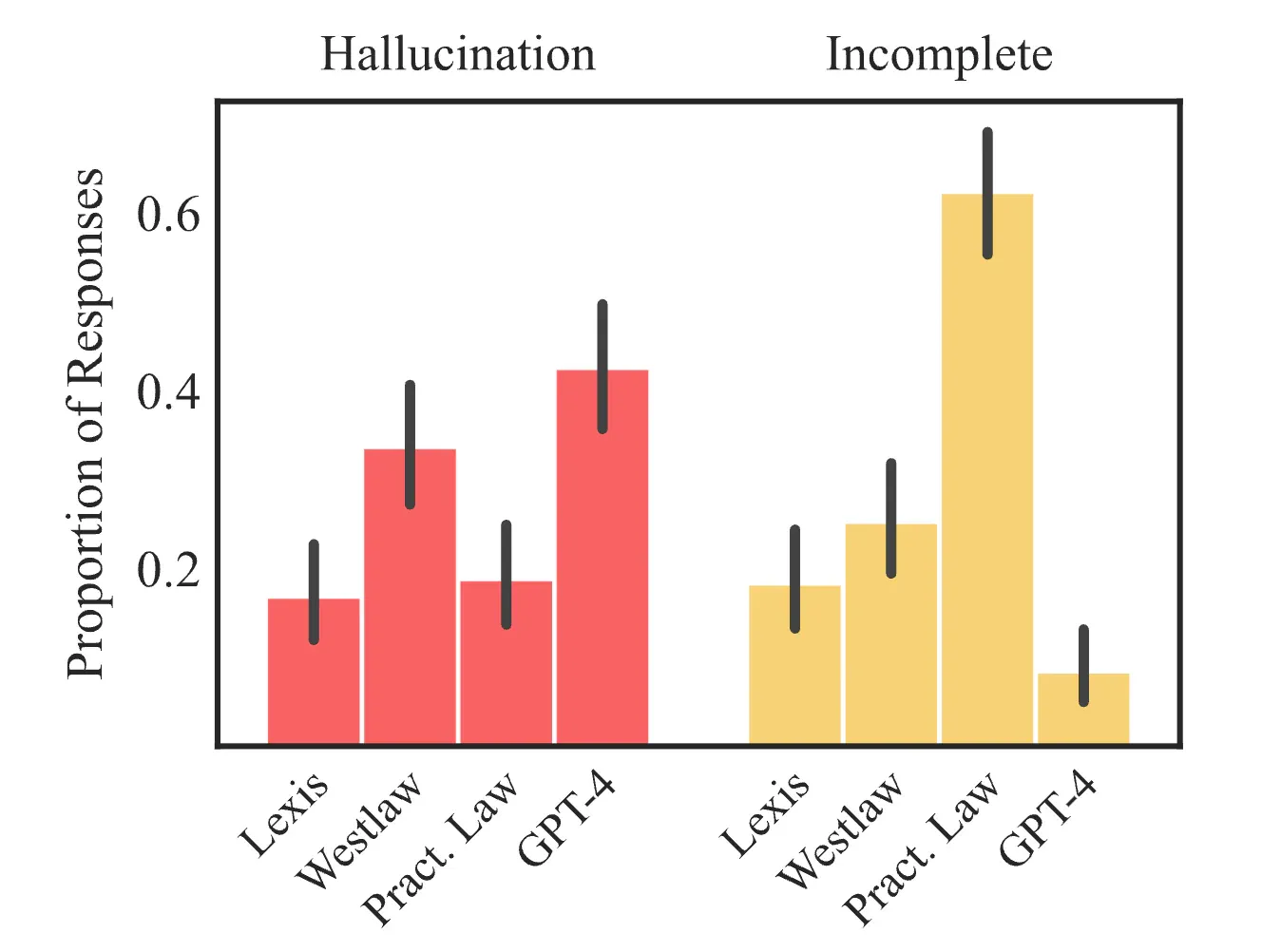
How often do general chatbots invent law?
Often, when asked about specific cases.
- Legal hallucinations ran from 69% with ChatGPT 3.5 to 88% with Llama 2 on specific, checkable questions about random federal court cases (Stanford Law School, Jan 2024).
How do legal AI tools compare with lawyers on research?
Close, with gaps in context and judgment.
- Four AI products scored 74% to 78% on weighted legal research, and the lawyer baseline scored 69% (Vals AI, Oct 2025).
- Accuracy ran 78% to 81% for legal AI products and 80% for ChatGPT (Vals AI, Oct 2025).
- AI beat the lawyer baseline on 150 questions, which is 75% of the study (Vals AI, Oct 2025).
- Where AI won a question, it won by an average of 31 percentage points (Vals AI, Oct 2025).
- Lawyers beat AI on four of ten question types, by an average of 9 points (Vals AI, Oct 2025).
What worries legal professionals most?
Confidentiality and reliability.
- 96% of professionals say their AI must safeguard confidential data, 94% want verified authoritative content and 90% want outputs they can explain and defend (Thomson Reuters Institute, Jun 2026).
- 41% of professionals lack access to tools that meet those standards (Thomson Reuters Institute, Jun 2026).
- 59% of in-house teams cite data privacy and confidentiality as a barrier (LegalOn, Jan 2026).
- Only 17% of legal professionals felt ethically comfortable with AI giving legal advice (Thomson Reuters Institute, Feb 2026).
- 88% of UK lawyers using only legal AI feel more confident in its output (LexisNexis, Sep 2025).
- 43% of legal-specific tool users trust those tools more than general-purpose ones (8am, Mar 2026).
Court Sanctions for Fake Citations
Courts now see AI errors weekly. Most of the cases come from people without a lawyer, but a large share come from lawyers who should know better.
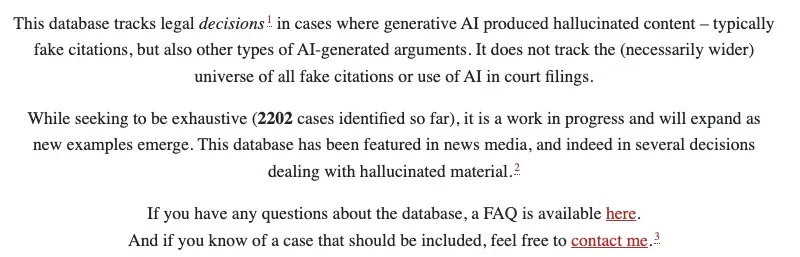
Who files the fake citations?
Self-represented litigants lead, and lawyers are close behind.
- 1,267 of the listed cases involve a self-represented litigant (Damien Charlotin, Oct 2026).
- 872 involve a lawyer (Damien Charlotin, Oct 2026).
- 32 involve a judge, and 17 involve an expert (Damien Charlotin, Oct 2026).
- 1,501 of the cases come from the USA, 234 from Canada, 112 from Australia and 76 from the UK (Damien Charlotin, Oct 2026).
- 1,806 entries record fabricated material, 933 record misrepresented material and 587 record false quotes (Damien Charlotin, Oct 2026).
- 458 of the cases arise in contract disputes, the largest legal field in the database (Damien Charlotin, Oct 2026).
What do courts do about fake citations?
They fine, warn and refer.
- In Mata v. Avianca, a New York federal court imposed a $5,000 penalty on the lawyers who filed AI-invented cases (S.D.N.Y., Jun 2023).
- In the English High Court, one claim cited five fake cases (Judiciary of England and Wales, Jun 2025).
- In a second claim, 45 citations were put before the court, and 18 of the cited cases did not exist (Judiciary of England and Wales, Jun 2025).
- Two federal judges replaced or withdrew rulings after parties flagged errors, and the Senate Judiciary Committee chairman asked both to explain any AI use (Senate Judiciary Committee, Oct 2025).
- One Mississippi order named four people who were not in the case (Senate Judiciary Committee, Oct 2025).
Ethics Rules and Court Policies on Legal AI
Rules are arriving, but unevenly. Judges and regulators moved faster than many firms.
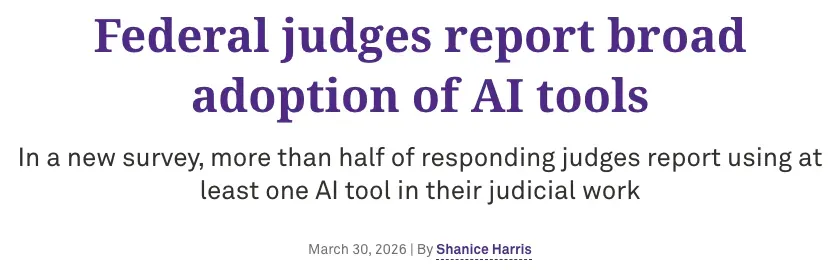
Are judges using AI?
Yes, but rarely every day.
- 22.4% of responding federal judges use AI tools weekly or daily (Northwestern University, Mar 2026).
- The survey sampled 502 federal judges and received 112 responses (Northwestern University, Mar 2026).
- The federal judiciary’s AI task force has identified more than 60 distinct issues and formed seven subgroups (U.S. Courts, Sep 2026).
- California courts that allow generative AI had to adopt a use policy by December 15, 2025 (Judicial Council of California, Sep 2025).
- England’s Civil Justice Council proposed that legal representatives declare certain AI use in court documents (Judiciary of England and Wales, Mar 2026).
What do professional bodies require?
Guidance exists. Written, enforced policy at firms does not.
- The ABA issued Formal Opinion 512, its first ethics guidance on generative AI tools, on July 29, 2024 (ABA, Jul 2024).
- England’s Solicitors Regulation Authority authorised the first purely AI-based law firm on May 6, 2025 (SRA, May 2025).
- 43% of legal professionals say their firm has no AI policy and no plans to make one (8am, Mar 2026).
- 9% say their firm has a policy and enforces it (8am, Mar 2026).
- 54% say their firm offers no AI training and has no plans to (8am, Mar 2026).
- 17% of UK and Ireland firms have no formal AI policy (Clio, Apr 2026).
- 81% of UK and Ireland firms say they disclose AI use to clients at least occasionally, but 7% of clients recall their lawyer proactively sharing it (Clio, Apr 2026).
- 50% of lawyers now call AI a major threat to the unauthorized practice of law, up from 36% (Thomson Reuters Institute, Feb 2026).
What are law students learning?
Not enough, by their own account.
- 72% of law students call AI literacy an essential professional skill (Thomson Reuters Institute, May 2026).
- 74% say over-reliance on AI could undermine their core legal skills (Thomson Reuters Institute, May 2026).
- 48% say AI policies vary by professor, and 32% say their schools do not teach the AI skills they need (Thomson Reuters Institute, May 2026).
Clients and the Public
Clients want AI-driven value and are not yet getting it. Meanwhile, people with legal problems are already asking chatbots for help.

Do clients push law firms to use AI?
Clients expect it, but few ask for it in writing.
- 22% of in-house legal professionals will reconsider firm relationships within 12 months if they do not see AI-enabled value, on top of the 11% already doing so (Thomson Reuters Institute, Jun 2026).
- 61% of in-house teams feel some or significant pressure from internal stakeholders to adopt AI faster (Thomson Reuters Institute, Jun 2026).
- 41% of law firms have received conflicting instructions from clients on whether to use AI (Thomson Reuters Institute, Feb 2026).
- Only 25% of stand-out lawyers strongly agree their firm has a plan for earning money from AI (Thomson Reuters Institute, Aug 2026).
How many people ask chatbots for legal help?
A growing minority, mostly younger.
- 3,287 people took part in the survey, and 1,428 of them reported a legal dispute in the past two years (JUSTICE, Jan 2026).
- 26% of 18 to 24-year-olds with a recent legal problem used a chatbot, against 10% of those aged 55 to 64 (JUSTICE, Jan 2026).
- Only 6% of chatbot users relied on the chatbot alone (JUSTICE, Jan 2026).
- Chatbot users drew on 3.7 sources of help on average, against 1.9 for everyone else (JUSTICE, Jan 2026).
- 33.9% of chatbot users sought a solicitor, against 44.6% of non-users (JUSTICE, Jan 2026).
- 76% of legal professionals believe AI could narrow the access-to-justice gap (8am, Mar 2026).
Will AI replace lawyers?
The data so far says lawyers are still being hired, and the junior path is the open question.
- Firms grew lawyer headcount by 2.9% in 2025 (Thomson Reuters Institute, Jan 2026).
- 78% of law firm professionals believe early-career lawyers depend on mentorship to build the skills AI is displacing (Thomson Reuters Institute, Jun 2026).
- 24% of law firm professionals say they would turn down a job offer with no access to professional-grade AI tools (Thomson Reuters Institute, Jun 2026).
Methodology and Sources
We kept only statistics that trace to the body that produced them: researchers, courts, regulators, companies announcing their own deals, and survey publishers reporting their own surveys. Some surveys come from vendors, and each one is named in the text. Roundups and listicles were not used. We opened every link and confirmed the figure, the date and the publisher before it went in. Market and funding figures differ by source, so each is tied to a named publisher. This page covers AI and technology in law. It does not cover lawyer headcount, legal market size, law firm marketing or contract management software. We refresh it monthly.
This page reports what the sources say. It is not legal advice.
Sources
- 8am, Mar 2026
- 8am, Mar 2026
- ABA, Jul 2024
- ACC and Everlaw, Oct 2025
- ACC and Everlaw, Nov 2025
- arXiv, Aug 2023
- arXiv, Jan 2024
- Axiom, Jun 2026
- Clio, May 2026
- Clio, Nov 2025
- Clio, Jul 2024
- Clio, Apr 2026
- Crunchbase News, Sep 2025
- Crunchbase News, Apr 2026
- Crunchbase News, Oct 2025
- Crunchbase News, Aug 2026
- Damien Charlotin, Oct 2026
- EvenUp, Oct 2024
- Goldman Sachs, Mar 2023
- Harvey, Mar 2026
- Harvey, Sep 2026
- Judicial Council of California, Sep 2025
- Judiciary of England and Wales, Jun 2025
- Judiciary of England and Wales, Mar 2026
- JUSTICE, Jan 2026
- LawGeex, Feb 2018
- LegalOn, Jan 2026
- Legora, Mar 2026
- LexisNexis, Sep 2025
- Northwestern University, Mar 2026
- S.D.N.Y., Jun 2023
- Senate Judiciary Committee, Oct 2025
- SRA, May 2025
- Stanford HAI, May 2024
- Stanford Law School, Jan 2024
- The Atticus Project, Mar 2021
- Thomson Reuters, Aug 2023
- Thomson Reuters, Jul 2024
- Thomson Reuters Institute, Feb 2026
- Thomson Reuters Institute, Jan 2026
- Thomson Reuters Institute, Feb 2026
- Thomson Reuters Institute, Mar 2026
- Thomson Reuters Institute, Jan 2026
- Thomson Reuters Institute, Jun 2026
- Thomson Reuters Institute, May 2026
- Thomson Reuters Institute, Aug 2026
- Thomson Reuters Institute, Jun 2026
- U.S. Courts, Sep 2026
- Vals AI, Oct 2025
- Vals AI, Feb 2025
- Wolters Kluwer, Mar 2026