Creator economy statistics describe a market that is large and growing fast, with pay that is spread very unevenly. Ad buyers, platforms and banks report billions of dollars. Surveys of working creators keep finding that most of them earn little from content.
This page covers content creators and influencers: how many there are, market size and growth, what creators earn, how platforms pay them, what brands spend, full-time versus part-time work, and the paperwork behind brand deals. General freelancer pay is on the freelance statistics page, and app-based work is on the gig economy statistics page.
Every figure links to the group that produced it, with the date of the data. Many sources are platforms reporting on their own programs, and survey samples differ, so numbers from different sources should not be added together. Items about law and tax are reported as the source states them. This page is not legal advice.
Key Takeaways
- Goldman Sachs Research expects the creator economy to roughly double to $480 billion by 2027 from $250 billion in 2023 (Goldman Sachs Research, Apr 2023).
- Only about 4% of the 50 million global creators are professionals who earn more than $100,000 a year (Goldman Sachs Research, Apr 2023).
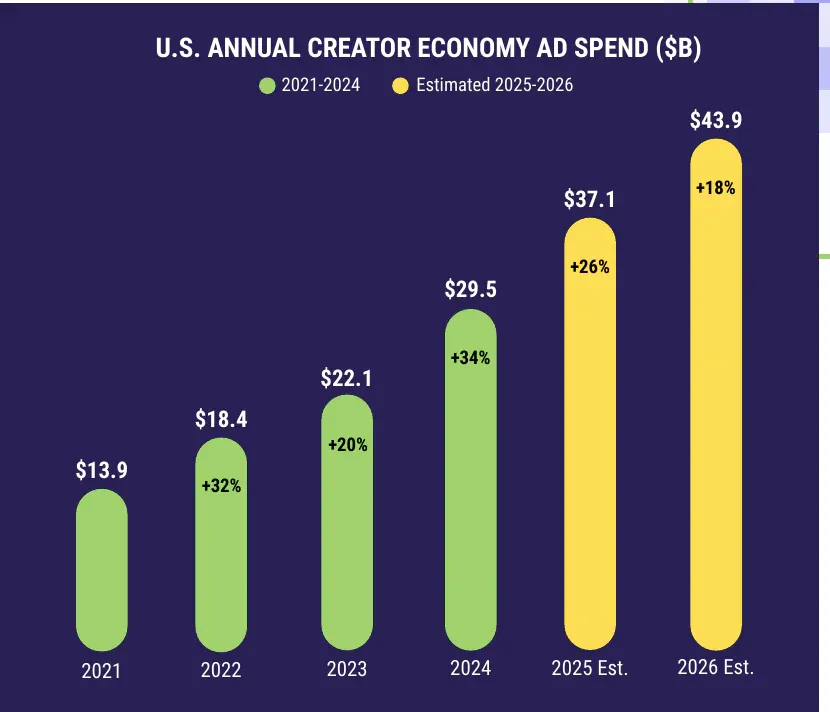
- U.S. brands were projected to spend $37.1 billion on creator advertising in 2025 (IAB, Nov 2025).
- 48% of ad spenders call creators a “must buy,” behind only social media and paid search (IAB, Nov 2025).
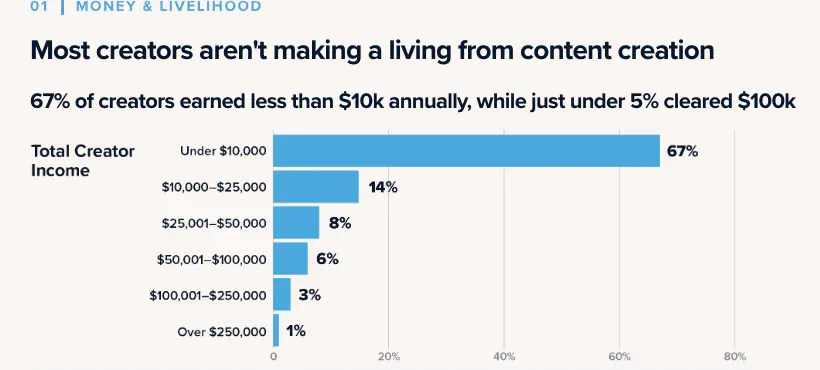
- 67% of 5,095 surveyed creators earned under $10,000 in creator income in the last year (CreatorIQ, Jun 2026).
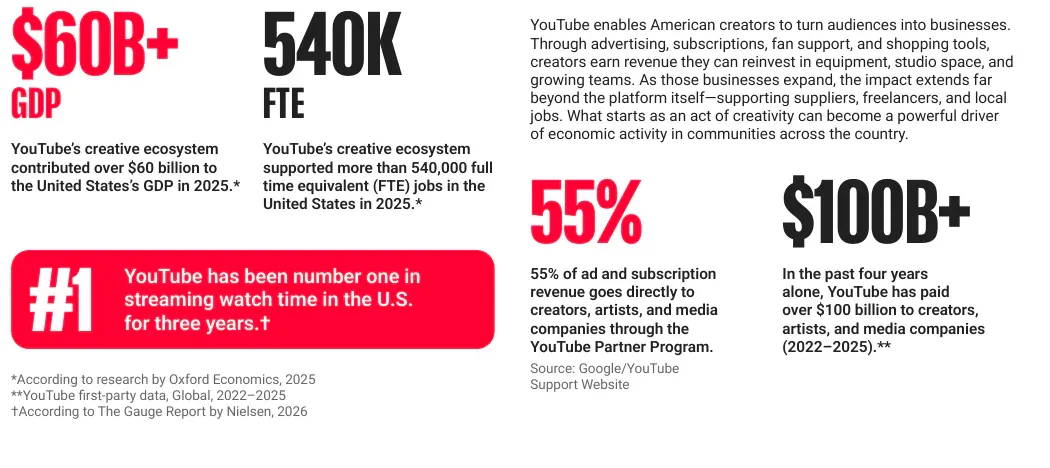
- YouTube says it paid more than $100 billion to creators, artists and media companies from 2022 to 2025 (YouTube, Jul 2026).
- Facebook paid creators nearly $3 billion in 2025, up 35% from the year before (Meta, Mar 2026).
- Roblox’s top 1,000 creators earned an average of $1.3 million in 2025 (Roblox, Feb 2026).
- 34% of creators on Stan’s platform call themselves full-time (Stan, Jul 2026).
- 87.49% of marketers surveyed expect their influencer budget to rise in 2026 (Influencer Marketing Hub, May 2026).
- 21% of U.S. adults regularly get news from news influencers on social media (Pew Research Center, Nov 2025).
- YouTube held 13.8% of all U.S. TV viewing time in May 2026, the largest share of any media distributor (Nielsen, Jul 2026).
- Minnesota law bars a minor under 14 from the work of content creation as the statute defines it (Minnesota Revisor of Statutes, Oct 2026).
How big is the market, and what do creator economy growth statistics show?
No one counts the whole market the same way. Banks model total spend, ad bodies count brand budgets, and platforms report their own payouts, so treat each figure below as one slice and not as a total.
What do analysts expect for the number of creators?
- Goldman Sachs Research expects the 50 million global creators to grow at a 10% to 20% compound annual rate over five years (Goldman Sachs Research, Apr 2023).
- Brand deals are the main source of creator revenue, at about 70% according to the survey data Goldman used (Goldman Sachs Research, Apr 2023).
How fast is U.S. ad spend with creators growing?
- Creator ad spend was $13.9 billion in 2021 (IAB, Nov 2025).
- It reached $22.1 billion in 2023, a 20% rise on the year before (IAB, Nov 2025).
- The 2024 total was $29.5 billion, up 34% (IAB, Nov 2025).
- The 2025 projection is 26% growth, about four times the 5.7% growth IAB forecast for the media industry overall (IAB, Nov 2025).
- IAB’s estimate for 2026 is $43.9 billion, an 18% rise (IAB, Nov 2025).
How large is the wider ad market that creators sit inside?
- U.S. social media ad revenue was $117.7 billion in 2025, up 32.6%, which IAB and PwC tie to creator growth and commerce (IAB/PwC, Apr 2026).
- Total U.S. internet ad revenue reached $294.6 billion in 2025, up 13.9% (IAB/PwC, Apr 2026).
- Kepios counted 5.66 billion social media user identities worldwide in October 2025, or 68.7% of the global population (DataReportal, Oct 2025).
How much does one platform add to the U.S. economy?
- YouTube’s creative ecosystem added over $60 billion to U.S. GDP in 2025, per Oxford Economics (YouTube, Jul 2026).
- Oxford Economics put the same ecosystem at more than 540,000 full-time-equivalent U.S. jobs in 2025 (YouTube, Jul 2026).
- A year earlier the figures were $55 billion of GDP and 490,000 full-time jobs for 2024 (YouTube Blog, Jun 2025).
- Oxford Economics counts one full-time-equivalent job as one creator working 35 hours a week on YouTube, or two creators working 17.5 hours each (Oxford Economics, May 2026).
How many creators are there, and who watches them?
Counts of creators swing widely because the word means different things in different studies. A person who posts for fun and a person who earns a salary from posting are both “creators” in most surveys.
How many creators exist worldwide?
- Linktree counted 139 million creators with 1,000 to 10,000 followers (Linktree, Apr 2022).
- It counted 41 million creators with 10,000 to 100,000 followers (Linktree, Apr 2022).
- Only 2 million creators had more than 1 million followers (Linktree, Apr 2022).
- More than 165 million people joined the global creator economy between 2020 and 2022, per Adobe’s study of nine countries (Adobe, Aug 2022).
- In the U.S. alone, 34 million new creators joined, a 40% rise (Adobe, Aug 2022).
- Adobe found that 23% of people, or one in four, were creators posting photos, video or writing online (Adobe, Aug 2022).
- Influencers made up only 14% of that global group (Adobe, Aug 2022).
How many creators does a single platform pay?
- Over 35,500 Roblox creators were registered for its Developer Exchange at the end of 2025, up from 24,500 a year earlier (Roblox, Feb 2026).
- Over 23,500 Roblox creators were paid in cash through that program during 2025 (Roblox, Feb 2026).
- Every U.S. state has at least 10 YouTube channels with more than 1 million monthly views (YouTube, Jul 2026).
- 48% of YouTube creators live in suburbs, 30% in cities and 21% in rural areas, per research by Public First (YouTube, Jul 2026).
- 40% of creators on Stan’s platform have between 1,000 and 10,000 followers (Stan, Jul 2026).
Which platforms do audiences use?
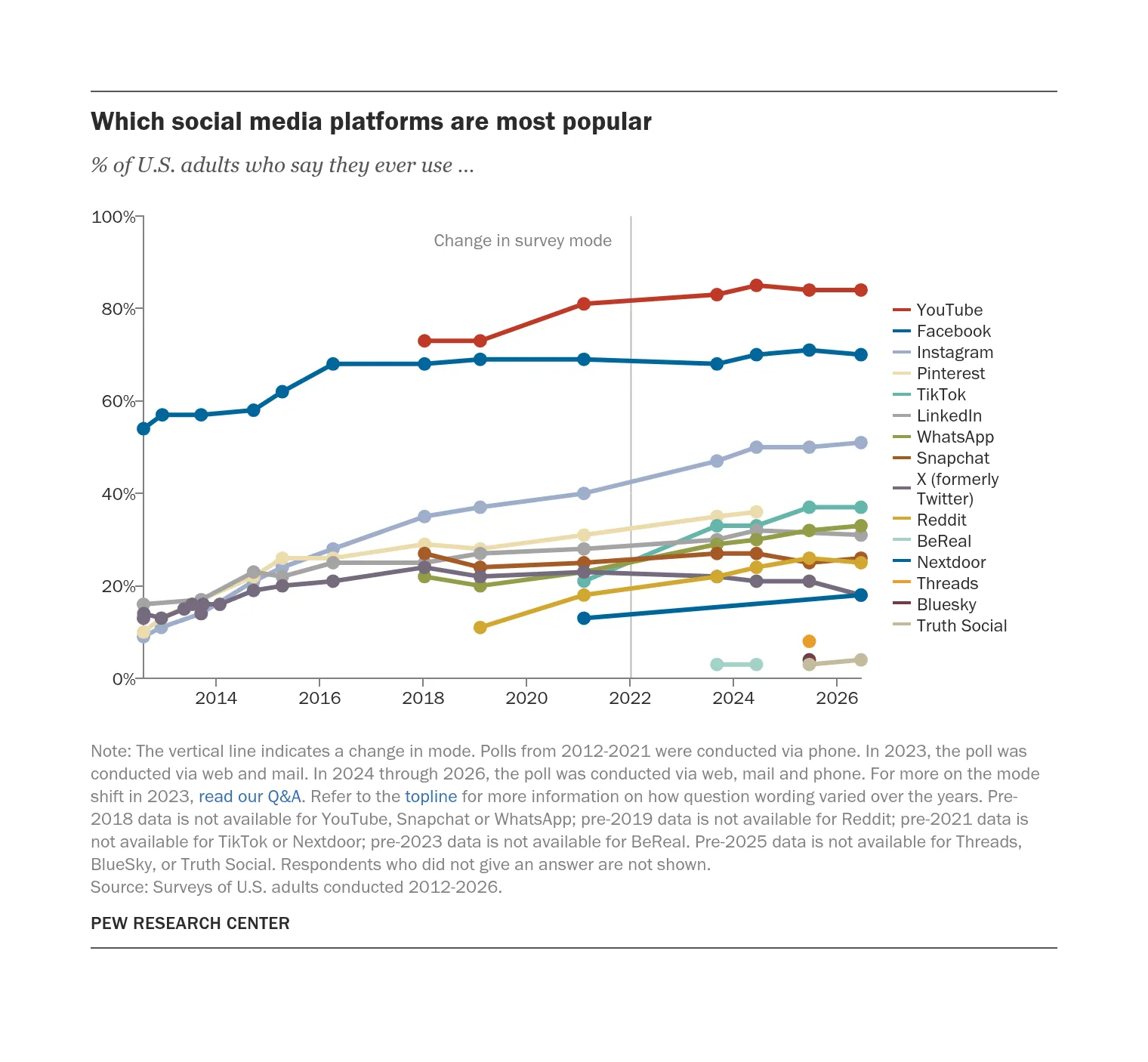
- 84% of U.S. adults say they use YouTube (Pew Research Center, Oct 2026).
- 51% use Instagram (Pew Research Center, Oct 2026).
- 37% use TikTok (Pew Research Center, Oct 2026).
- Among adults 18 to 29, 95% use YouTube and 65% use TikTok (Pew Research Center, Oct 2026).
- Nine in ten U.S. teens say they use YouTube (Pew Research Center, Dec 2024).
Who are news influencers?
- Pew sampled 500 news influencers from a review of 28,266 accounts that had over 100,000 followers (Pew Research Center, Nov 2024).
- Men were 63% of that sample (Pew Research Center, Nov 2024).
- 77% had no current or past tie to a news organization (Pew Research Center, Nov 2024).
- 38% of adults under 30 regularly get news from news influencers, against 8% of those 65 and older (Pew Research Center, Nov 2025).
- Among people who get news this way, 52% say most of the influencers they follow are independent (Pew Research Center, Nov 2025).
How much do creators earn?
The typical creator earns little, and a thin top tier earns a lot. Averages hide this, so the spread matters more than any single mean.
What does the income spread look like?
- 14% of surveyed creators earned $10,000 to $25,000 (CreatorIQ, Jun 2026).
- 8% earned $25,001 to $50,000 (CreatorIQ, Jun 2026).
- 6% earned $50,001 to $100,000 (CreatorIQ, Jun 2026).
- 3% earned $100,001 to $250,000, and 1% earned more than $250,000 (CreatorIQ, Jun 2026).
- Over half of creators with 100,001 to 500,000 followers say content is their main income, and a majority of those with over 1 million followers earn $50,000 to $250,000 or more (CreatorIQ, Jun 2026).
What did earlier surveys find?
- 12% of full-time creators made more than $50,000 a year (Linktree, Apr 2022).
- 46% of full-time creators made less than $1,000 (Linktree, Apr 2022).
- Only 3% of part-time creators made more than $50,000, and 68% made less than $1,000 (Linktree, Apr 2022).
- 59% of beginner creators had not yet earned anything from their content (Linktree, Apr 2022).
- 12% of creators said they earned $100 or less from a single brand collaboration (Linktree, Apr 2022).
- 25% of creators earned the most of their income on their own website or blog (Linktree, Apr 2022).
What shapes pay?
- Creator pay tracks follower count more closely than brand fit or performance, even though brands say fit matters most (CreatorIQ, Jun 2026).
- The top barrier to growing a creator business is a lack of consistent brand deals (CreatorIQ, Jun 2026).
- Half of creators have launched, or plan to launch, their own brand (CreatorIQ, Jun 2026).
- Creators earning over $250,000 a year are twice as likely to name Instagram over TikTok as their main platform for branded content (CreatorIQ, Jun 2026).
- The number of creators earning over $10,000 a year on Facebook grew by more than 30% year over year (Meta, Mar 2026).
- Stan creators averaged $67 per sale in 2025 (Stan, Jul 2026).
How do platforms pay creators?
Each platform sets its own entry bar and split, and those terms change often. A creator who earns well on one platform may not qualify on another.
How does YouTube pay and who qualifies?
- 55% of ad and subscription revenue goes to creators, artists and media companies through the YouTube Partner Program (YouTube, Jul 2026).
- A channel can qualify with 1,000 subscribers and 4,000 qualified watch hours in 12 months (YouTube Help, Oct 2026).
- The other route is 1,000 subscribers and 10 million qualified Shorts views in 90 days (YouTube Help, Oct 2026).
- Applications are typically reviewed in about one month (YouTube Help, Oct 2026).
- Creators keep 45% of their allocated Shorts revenue, whether or not music was used (YouTube Help, Oct 2026).
- From February 1, 2027, a channel needs 10 million qualified Shorts views in the last 90 days to share Shorts ad revenue (YouTube Help, Oct 2026).
What are the entry bars on short-video platforms?
- TikTok’s Creator Rewards Program asks for 10,000 followers and 100,000 video views in the last 30 days (TikTok, Oct 2026).
- Eligible TikTok videos must run over one minute (TikTok, Oct 2026).
- Snapchat asks for 50,000 followers and 15,000 hours of view time over 28 days, with 3,000 of those hours from Spotlight (Snapchat, Oct 2026).
- Snapchat creators can cash out a minimum of $100 at a time (Snapchat, Oct 2026).
- 60% of Facebook’s creator payout in 2025 went to Reels (Meta, Mar 2026).
- Facebook’s Creator Fast Track offers $1,000 a month for creators with at least 100,000 followers elsewhere, and $3,000 a month above 1 million, for three months (Meta, Mar 2026).
How do streaming, audio and membership platforms pay?
- Twitch’s standard net revenue share on subscriptions is 50% (Twitch, Jan 2024).
- Streamers who reach 300 Plus Points qualify for a 70/30 split (Twitch, Jan 2024).
- Twitch removed the old $100,000 cap that dropped the 70/30 split back to 50% (Twitch, Jan 2024).
- Spotify paid more than $100 million to podcasters and publishers worldwide in the first quarter of 2025 alone (Spotify, Apr 2025).
- Total earnings for creators in the Spotify Partner Program rose 23% from January to February 2025 (Spotify, Apr 2025).
- Patreon creators had generated more than $8 billion in revenue since 2013 (Patreon, Dec 2024).
- More than 10 million fans paid for Patreon memberships each month (Patreon, Dec 2024).
- Substack passed 5 million paid subscriptions, less than four months after reaching 4 million (Substack, Mar 2025).
How does a game platform pay?
- Roblox pays eligible creators $0.0038 per earned Robux, up from $0.0035 before September 5, 2025 (Roblox, Feb 2026).
- Roblox’s Developer Exchange fees were $477 million in the fourth quarter of 2025, up 70% on the year (Roblox, Feb 2026).
How much do brands spend on creators?
The buyer side of creator work is changing in clear ways. Budgets are rising, many deals are small, and buyers are moving toward smaller creators.
Which creators do brands hire?
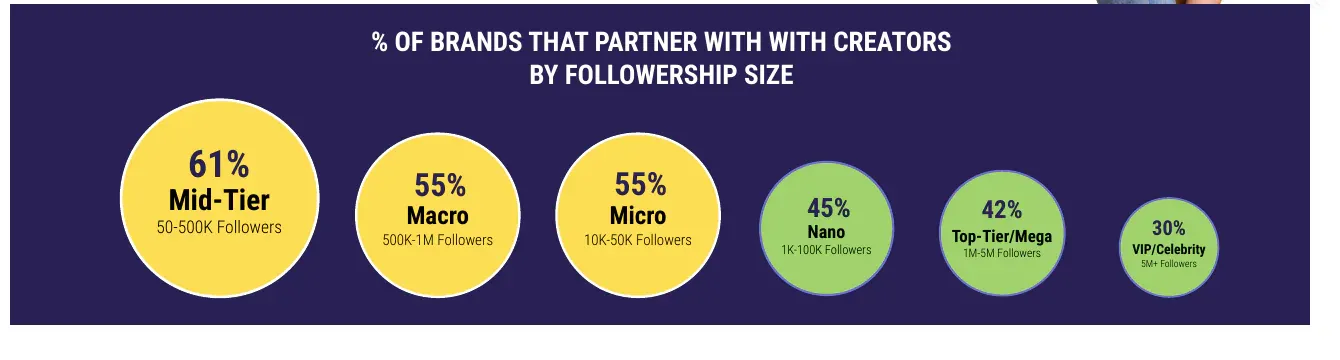
- 61% of brands partner with mid-tier creators of 50,000 to 500,000 followers (IAB, Nov 2025).
- Only 30% partner with VIP or celebrity accounts above 5 million followers (IAB, Nov 2025).
- Small brands are more likely than large brands to use nano creators, at 54% against 38% (IAB, Nov 2025).
- Creator reputation is a very important selection factor for 58% of brands (IAB, Nov 2025).
- Only 17% of consumers check a creator’s follower count before they engage (Sprout Social, Jul 2026).
How do brands plan 2026 budgets?
- 54% of ad buyers named creator and influencer partnerships among the ad types getting more focus (IAB, Sep 2026).
- 72.22% of marketers surveyed plan to raise influencer budgets by 50% or more in 2026 (Influencer Marketing Hub, May 2026).
- 65.9% of respondents expect payback within one month (Influencer Marketing Hub, May 2026).
- 31% included TikTok in their 2026 influencer plans, the most of any platform (Influencer Marketing Hub, May 2026).
- 66.3% run their programs entirely in-house (Influencer Marketing Hub, May 2026).
How are deals priced and paid?
- Three in four brands use flat-fee payment structures with creators (IAB, Nov 2025).
- 49% use performance-based pay (IAB, Nov 2025).
- 48% use retainers (IAB, Nov 2025).
- Promo or discount codes are the most-used measurement tool, at 45.9% of respondents (Influencer Marketing Hub, May 2026).
- About 55% of respondents who priced nano creators put them under $500 per deal (Influencer Marketing Hub, May 2026).
- Roughly 80% of answers for UGC creators sat under $500 (Influencer Marketing Hub, May 2026).
What worries brands about creator work?
- 40% of buyers rank overall ROI as their top KPI for creator campaigns (IAB, Nov 2025).
- 46% of brands already use AI in creator campaigns (IAB, Nov 2025).
- 95% of advertisers have concerns about using AI in creator marketing (IAB, Nov 2025).
- 44% of consumers are uncomfortable with brands using AI influencers (Sprout Social, Jul 2026).
Most brand deals come down to a written scope, a fee and a few rights terms. Drafting that paper once, from a template, is a common first step for a creator who gets a second offer. See the influencer marketing RFP page for one way to structure a request from the brand side.
How many creators work full time?
Most creators treat content as a second income. The numbers below separate full-time creators from hobbyists and from people who keep a day job.
What share of creators live on content?
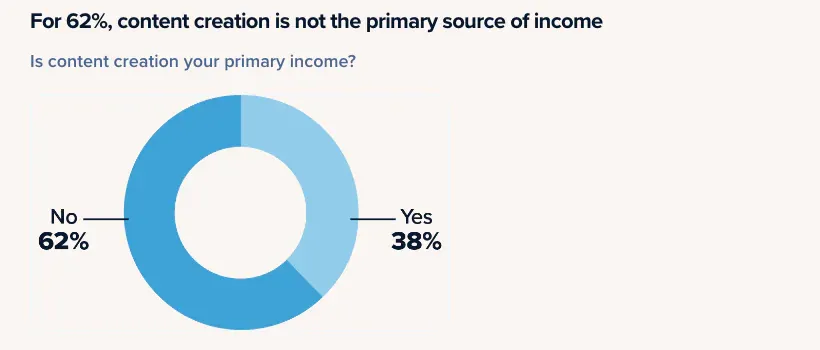
- 62% of surveyed creators say content creation is not their primary source of income, and 38% say it is (CreatorIQ, Jun 2026).
- Linktree found that 66% of creators call themselves part-time (Linktree, Apr 2022).
- Adobe found that six in ten creators hold full-time jobs, and for most of them creating is a hobby or side hustle (Adobe, Aug 2022).
- 17% of creators in Adobe’s study were business owners, and 39% hoped to become one (Adobe, Aug 2022).
How many hours do creators work?
- 63% of Stan creators spend up to 10 hours a week creating content (Stan, Jul 2026).
- 43% of Linktree’s creators spent 5 hours a week or less (Linktree, Apr 2022).
- 36% had been making content for a year or less (Linktree, Apr 2022).
- 53% of creators who made under $100 a year spent less than 5 hours a week on content (Linktree, Apr 2022).
- 48% of creators who made $100,000 to $500,000 a year spent more than 10 hours a week (Linktree, Apr 2022).
- 37% of early-stage Stan creators say avoiding burnout is a major challenge (Stan, Jul 2026).
Why do people start, and do they want to leave their jobs?
- 26% of Adobe’s creators were motivated by money, while 48% were motivated by freedom of expression (Adobe, Aug 2022).
- 57% of U.S. Gen Z social media users aged 13 to 26 said they would become an influencer if given the chance (Morning Consult, Oct 2023).
- 53% said they would quit their current job to be an influencer if it supported their lifestyle (Morning Consult, Oct 2023).
- 15% of that group already identified as influencers (Morning Consult, Oct 2023).
- 72% of creators have used AI tools to support their work (CreatorIQ, Jun 2026).
What contract and legal rules do creators face?
Creators sign platform terms, brand agreements and tax forms, and some states now add rules for children in paid content. The items below are reported as each source states them. They are not legal advice.
How often do contracts and payments cause friction?
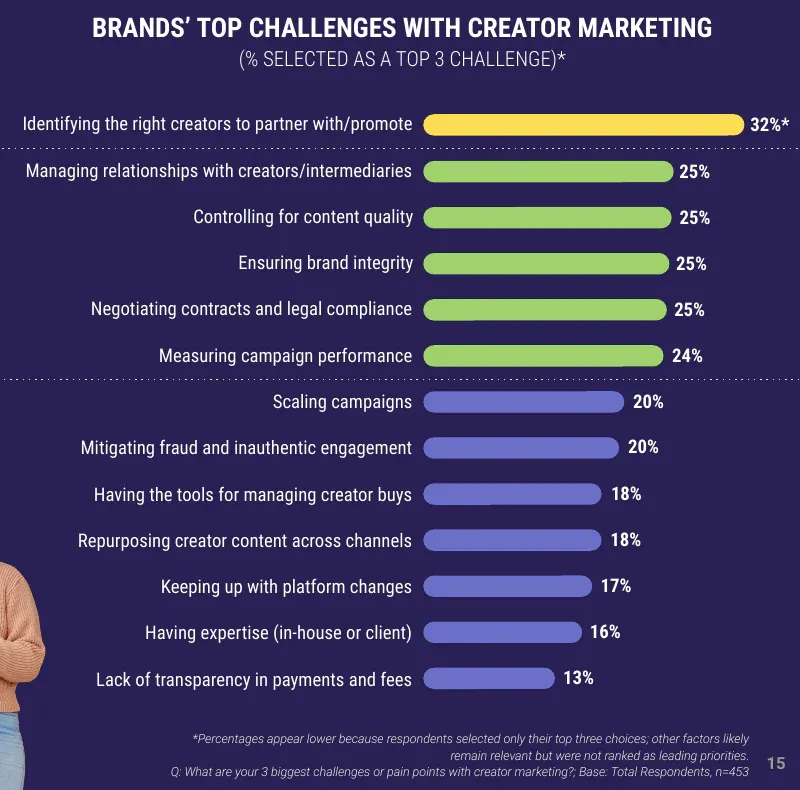
- 25% of brands list negotiating contracts and legal compliance among their top three creator marketing challenges (IAB, Nov 2025).
- 13% list a lack of transparency in payments and fees (IAB, Nov 2025).
What do the FTC and the IRS say about paid posts and income?
- The FTC sent a Notice of Penalty Offenses on endorsements to more than 700 companies in October 2021 (FTC, Oct 2021).
- The notice said they could face civil penalties of up to $43,792 per violation (FTC, Oct 2021).
- The FTC’s August 2024 final rule bars buying or selling fake indicators of social media influence, such as followers or views from bots or hijacked accounts, where the buyer knew or should have known they were fake (FTC, Aug 2024).
- A payment app or online marketplace must send a Form 1099-K when payments for goods or services top $20,000 across more than 200 transactions (IRS, Jun 2026).
What do state laws say about children in paid content?
- Minnesota counts a minor as working in content creation when at least 30% of a creator’s paid video in a 30-day window shows the minor (Minnesota Revisor of Statutes, Oct 2026).
- The second test is a platform pay threshold or at least $0.01 per view (Minnesota Revisor of Statutes, Oct 2026).
- The creator must set aside, in a trust account, a share of gross earnings equal to at least half the content percentage that includes the minor (Minnesota Revisor of Statutes, Oct 2026).
- Records must be kept until the minor reaches age 21 (Minnesota Revisor of Statutes, Oct 2026).
What do platform terms say about accounts and takedowns?
- YouTube may turn off monetization on channels with no upload or post for six months or more (YouTube Help, Oct 2026).
- A rejected YouTube Partner Program applicant can appeal within 21 days or reapply after 30 days (YouTube Help, Oct 2026).
- Patreon’s Trust and Safety team reviewed 103,041 creators in 2025 (Patreon, Mar 2026).
- Patreon processed 1,161 valid copyright notices in 2025 (Patreon, Mar 2026).
- It removed 3,165 accounts that year (Patreon, Mar 2026).
Brand work usually rests on a written scope, payment terms and a rights clause, so these rules are easier to follow when the paper is clear. For rights terms, see the intellectual property agreement template page.
Methodology and Sources
Statistics were selected for relevance to content creators and influencers, traced to the group that produced them, and checked against the source page or report on the day of writing. Each figure carries its publisher and the date of the data. Where a source is a platform describing its own program, or a company surveying its own users, the page says so by naming that source. Rules and thresholds on platform help pages were read in October 2026 and can change. The page is refreshed monthly.
Glossary
- Creator economy: the market of people who earn money from content, plus the platforms and brands that pay them.
- FTE: full-time equivalent, one unit of full-time work.
- GDP: gross domestic product.
- KPI: key performance indicator.
- Nano, micro, mid-tier, macro creators: size bands by follower count. IAB uses 1,000 to 100,000 for nano, 10,000 to 50,000 for micro, 50,000 to 500,000 for mid-tier and 500,000 to 1 million for macro.
- UGC: user-generated content, made by a creator for a brand to run on the brand’s channels.
- YPP: the YouTube Partner Program.
- DevEx: Roblox’s Developer Exchange, which turns earned Robux into cash.
- ROI: return on investment.
Sources
- Goldman Sachs Research, The creator economy could approach half-a-trillion dollars by 2027
- IAB, 2025 Creator Economy Ad Spend and Strategy Report (PDF)
- IAB, Creator Economy Ad Spend to Reach $37 Billion in 2025
- IAB, 2026 U.S. ad spend forecast
- IAB/PwC, Internet Advertising Revenue Report: Full Year 2025
- DataReportal, Digital 2026 Global Overview Report
- YouTube, U.S. Impact in 2025 (PDF)
- YouTube Blog, 2024 U.S. impact report
- Oxford Economics, YouTube’s Creator Economy Impact
- YouTube Help, Partner Program overview and eligibility
- YouTube Help, Shorts monetization policies
- Nielsen, May 2026 Gauge
- Pew Research Center, Americans’ Use of Social Media in 2026
- Pew Research Center, Teens, Social Media and Technology 2024
- Pew Research Center, America’s News Influencers
- Pew Research Center, News Influencers Fact Sheet
- CreatorIQ, The State of Creators
- Linktree, 2022 Creator Report
- Adobe, Future of Creativity study
- Stan, The State of the Creator Economy 2026
- Influencer Marketing Hub, Influencer Marketing Benchmark Report 2026
- Sprout Social, The 2026 Influencer Marketing Report
- Morning Consult, Gen Z interest in influencing
- Meta, Creator Fast Track
- TikTok, Creator Rewards Program
- Snapchat, About Snapchat’s Monetization Program
- Twitch, An Update to Several Streamer Payout Programs
- Spotify, $100 million payout
- Patreon, Connecting creators and their real fans in 2024
- Patreon, Transparency Report 2026
- Substack, 5 million
- Roblox, Q4 2025 shareholder letter
- Roblox, 2025 annual report on Form 10-K
- FTC, 2021 Notice of Penalty Offenses on endorsements
- FTC, 2024 final rule on fake reviews and testimonials
- IRS, Understanding your Form 1099-K
- Minnesota Revisor of Statutes, Section 181A.13