E-signature statistics show a tool that is no longer new. One vendor says it serves nearly two million customers, and most US real estate agents say they use it. The harder questions are how much money the market holds, how many signers quit before they finish, and how much fraud sits around the signing step.
This page answers those questions with numbers from the group that first produced each one: governments, regulators, trade groups, public company filings, and a few vendor surveys. Where a vendor ran its own survey, the text says so and names the sample. Where analysts disagree, the page shows each estimate next to its author instead of picking one.
The page covers adoption, market size, speed and cost against paper, completion rates, mobile signing, security and fraud, and how many countries have written e-signatures into law. It reports what each source says about the law. It does not give legal advice. For contract management and contract disputes, see the related pages linked at the end.
Key Takeaways
- Docusign reports more than 1.8 million customers and more than a billion users worldwide (Docusign Form 10-K, Mar 2026).
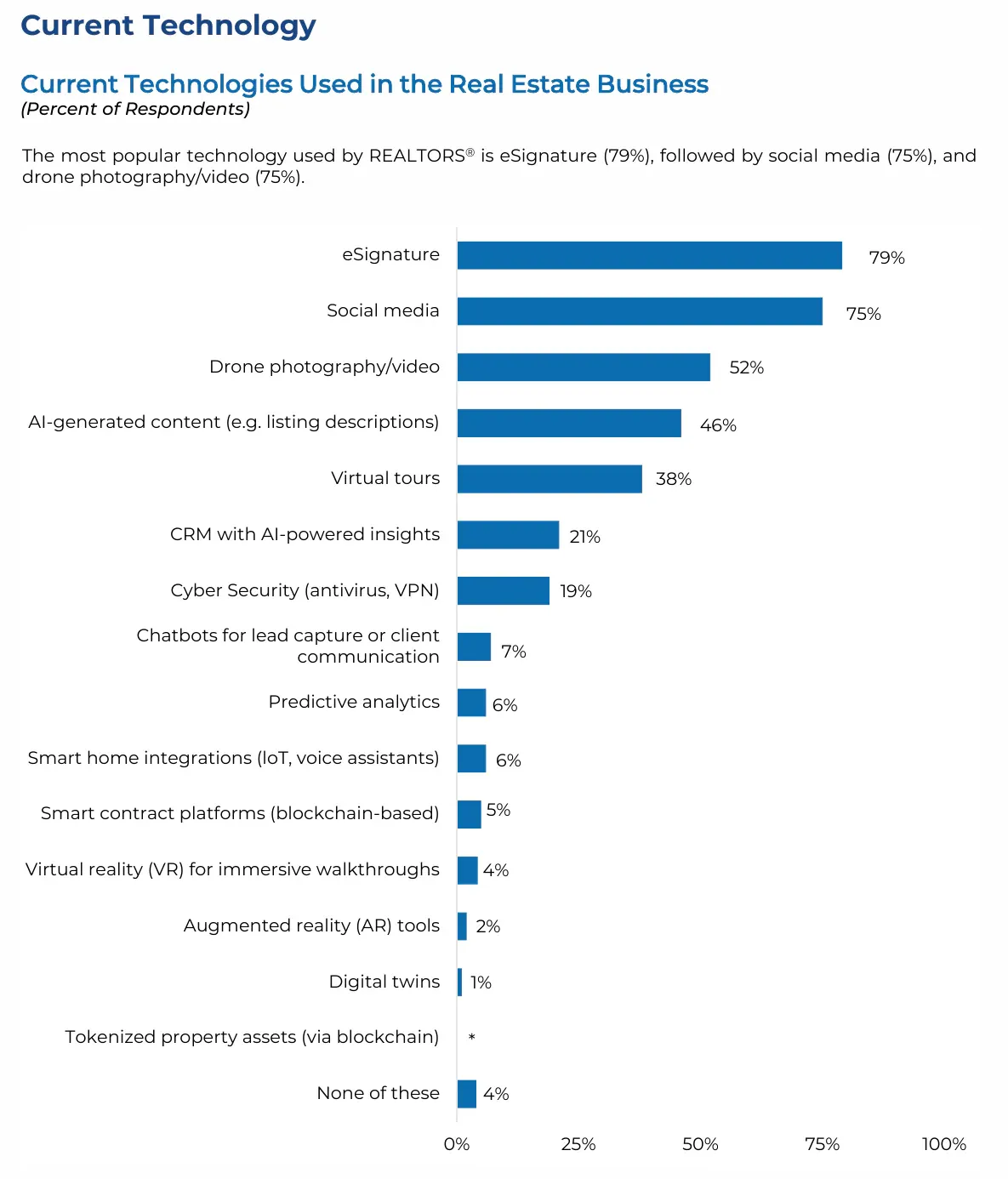
- 79% of US REALTORS use eSignature, the most used tool in the survey (National Association of REALTORS, Sep 2025).
- Only 22% of surveyed mortgage lenders have adopted electronic notes (Fannie Mae, Aug 2025).
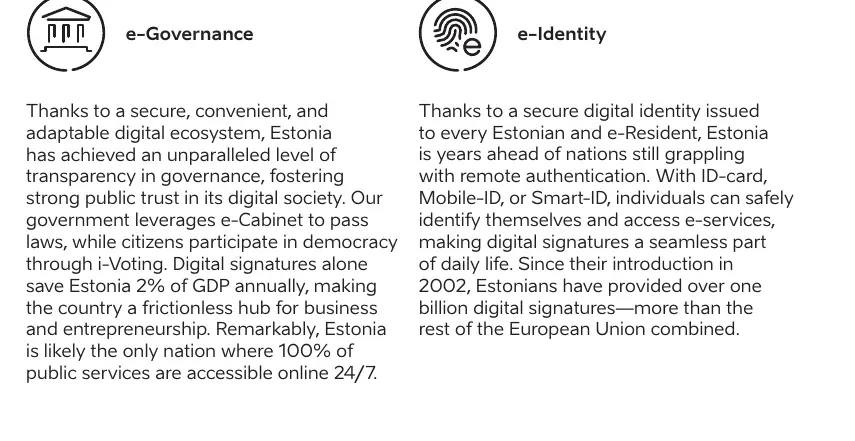
- Estonians have given more than one billion digital signatures since 2002 (e-Estonia, Apr 2025).
- Analysts put the 2025 digital signature market at about USD 7 billion (Grand View Research, Feb 2026) or USD 13.30 billion (MarketsandMarkets, Sep 2026).
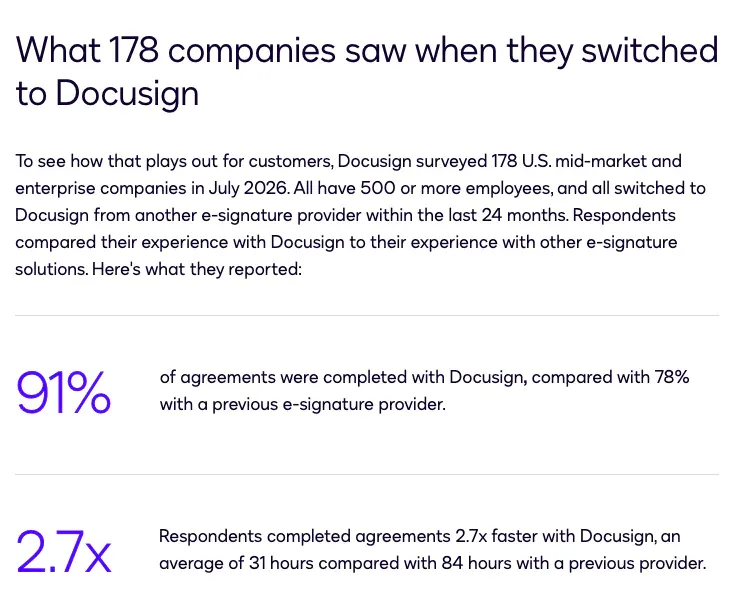
- In a Docusign survey of 178 switchers, 91% of agreements were completed with Docusign against 78% with the old provider (Docusign, Jul 2026).
- 40% of surveyed US business leaders say more than 10% of customers quit digital agreement or form steps (Docusign, Sep 2026).
- 24.0% of companies in a Dropbox Sign survey still collect signatures by print, sign, scan or email (Dropbox Sign, Oct 2026).
- 91% of US adults own a smartphone (Pew Research Center, Oct 2026).
- Internet crime losses reported to the FBI reached $20.877 billion in 2025 (FBI IC3, Apr 2026).
- Wire-transfer business email compromise attacks rose 88% in the second quarter of 2026 (APWG, Aug 2026).
- Deepfakes make up one in five biometric fraud attempts (Entrust, Jun 2026).
- The UNCITRAL model law on electronic commerce has shaped legislation in 88 states and 171 jurisdictions (UNCITRAL, Oct 2026).
Esignature Adoption Statistics: Who Signs Online in Business?
Adoption is broad but not total. Vendors report millions of accounts, trade groups report majority use, and surveys still find paper, fax and email sitting beside the software.
How big is the largest e-signature vendor?
Vendor filings are the best public count of accounts. They count customers, not signers, and one customer can be a whole company.
- Docusign counted about 280,000 direct enterprise and commercial customers, up from 260,000 a year earlier (Docusign Form 10-K, Mar 2026).
- Docusign had 1,205 customers paying more than $300,000 a year in annualized contract value (Docusign Form 10-K, Mar 2026).
- The company lists more than 1,100 active partner integrations with other business apps (Docusign Form 10-K, Mar 2026).
- International sales made up 29% of Docusign revenue in the year ended January 31, 2026 (Docusign Form 10-K, Mar 2026).
- Digital sales, meaning self-serve and online purchases, were 15% of Docusign revenue (Docusign Form 10-K, Mar 2026).
- By September 2026 the company said it served over 1.9 million customers in more than 180 countries (Docusign Investor Relations, Sep 2026).
How common are e-signatures in real estate and mortgages?
Real estate is the clearest case of a trade that moved from ink to screen, while mortgage closing lags because of the note, the notary and the investor. The NAR survey went to a random sample of 49,233 members and drew 1,241 usable answers. Fannie Mae polled 217 senior mortgage executives.
- Fannie Mae found that 75% of lenders are familiar with electronic mortgage notes, called eNotes (Fannie Mae, Aug 2025).
- 62% of lenders said they plan to use eNotes within two years (Fannie Mae, Aug 2025).
- The MERS eRegistry held 2,513,863 unique eNotes as of April 1, 2025 (Fannie Mae, Aug 2025).
- Among lenders that have not deployed eNotes, 52% said key business partners do not yet permit them (Fannie Mae, Aug 2025).
Do companies still use paper next to e-signatures?
Yes. Dropbox Sign asked 104 professionals at one AI conference in San Francisco on September 30 and October 1, 2026. The sample is small and skews toward tech firms, so read the results as a snapshot.
- On average, companies use 1.4 methods to collect signatures (Dropbox Sign, Oct 2026).
- 38.5% embed e-signature through an API in their own product or website (Dropbox Sign, Oct 2026).
- 6.7% still use fax or online fax (Dropbox Sign, Oct 2026).
How Far Do Governments Use Electronic Signatures?
Governments set the pace when they build signing into the ID card or the tax portal. Where the state does it, usage is high and the savings are easy to count.
What does Estonia report?
Estonia has issued digital signing rights to every resident since 2002. These are claims by the Estonian government’s own program.
- Estonia says digital signatures alone save the country 2% of GDP each year (e-Estonia, Apr 2025).
- Estonia says it is likely the only nation where 100% of public services can be reached online around the clock (e-Estonia, Apr 2025).
What do India and the EU report?
- India’s technology ministry said more than 300 agencies use the C-DAC e-Hastakshar eSign service (Ministry of Electronics and Information Technology, Apr 2026).
- 72% of EU adults aged 16 to 74 connected to a public authority website or app in 2025 (Eurostat, Dec 2025).
- 46% of EU adults used an electronic ID to reach public services in 2025 (Eurostat, Dec 2025).
- 25% used an electronic ID to reach services from businesses (Eurostat, Dec 2025).
How Big Is the Electronic Signature Market?
Nobody agrees on the size of this market, and the gap is the story. Research firms define the market in different ways and publish figures that differ by a factor of two for the same year. Treat each number as one firm’s model, not as a fact.
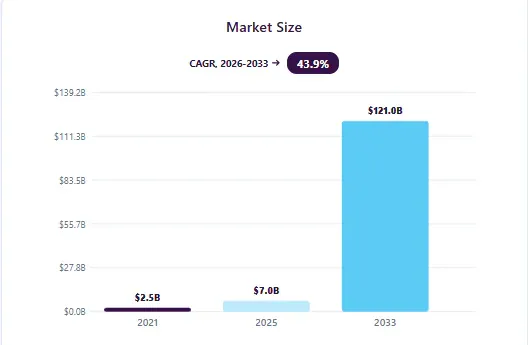
What do analysts forecast?
Most of these reports cover digital signatures, a wider market than e-signature software alone. The Mordor e-signature platform line and the Insight Partners line are the closest to the narrower software market.
- Grand View Research projects USD 9.4 billion in 2026 and USD 121.0 billion by 2033, a 43.9% yearly growth rate (Grand View Research, Feb 2026).
- Fortune Business Insights sizes the market at USD 9.85 billion in 2025 and forecasts USD 154.52 billion by 2034, a 35.40% rate (Fortune Business Insights, Aug 2026).
- Precedence Research puts it at USD 12.22 billion in 2025 and USD 291.10 billion by 2035, a 37.31% rate (Precedence Research, Sep 2026).
- MarketsandMarkets projects USD 17.68 billion in 2026 and USD 66.26 billion by 2031, a 30.2% rate (MarketsandMarkets, Sep 2026).
- Persistence Market Research values it at US$ 9.1 billion in 2026 and US$ 64.9 billion by 2033, a 32.4% rate (Persistence Market Research, Oct 2026).
- Straits Research puts the 2025 market at USD 11.54 billion and the 2034 market at USD 100.81 billion, a 27.23% rate (Straits Research, Oct 2026).
- Mordor Intelligence sizes the digital signatures market at USD 16.83 billion in 2026 and USD 47.19 billion in 2031, a 22.90% rate (Mordor Intelligence, Jan 2026).
- For e-signature platforms alone, Mordor Intelligence estimates USD 8.99 billion in 2026 and USD 30.46 billion in 2031, a 27.65% rate (Mordor Intelligence, Oct 2026).
- The Insight Partners values electronic signature software at US$ 4.46 billion in 2024 and US$ 35.71 billion by 2031, a 34.6% rate (The Insight Partners, Sep 2025).
Where does the money sit?
- North America held 32.3% of 2025 digital signature revenue in Grand View Research’s model (Grand View Research, Feb 2026).
- Fortune Business Insights gives North America a 38.00% share of 2025 (Fortune Business Insights, Aug 2026).
- Cloud deployment held 58% of the digital signature market in 2025 (Straits Research, Oct 2026).
- Mordor Intelligence puts cloud at 76.05% of the e-signature platform market in 2025 (Mordor Intelligence, Oct 2026).
- Large enterprises took 62.10% of that platform market, while small and mid-size firms are the fastest growing at a 28.75% yearly rate (Mordor Intelligence, Oct 2026).
- Banking, financial services and insurance held a 28.20% share of platform revenue (Mordor Intelligence, Oct 2026).
- Advanced electronic signatures made up an estimated 52% of global digital signature revenue (Persistence Market Research, Oct 2026).
- A second Mordor model has advanced signatures at 48.38% of revenue in 2025 (Mordor Intelligence, Jan 2026).
How is the leading vendor doing?
Public filings give a check on the forecasts. Docusign is the one major vendor that reports e-signature as its core business.
- Docusign’s total revenue for fiscal 2026 was $3.2 billion, up 8% from the year before (Docusign Investor Relations, Mar 2026).
- Its annual recurring revenue was $3,272 million on January 31, 2026, up 8.0% (Docusign Investor Relations, Mar 2026).
How Much Faster and Cheaper Is Signing Online, and Why Do Signers Quit?
Speed is the main selling point of signing online, and the numbers back it up, but the same data shows many people never finish. The work before the signature step is where time and signers get lost.
How much time does e-signing save?
The Docusign survey asked 178 US mid-market and enterprise firms, all with 500 or more employees, that had switched from another e-signature provider. It compares two e-signature tools, not e-signature against paper.
- Respondents finished agreements 2.7 times faster, at an average of 31 hours against 84 hours with the previous provider (Docusign, Jul 2026).
- Of the firms that measure return on investment, 99% said higher completion rates are one of the ways they judge it (Docusign, Jul 2026).
What does paper signing cost?
Few public bodies publish a clean cost. Tartu University in Estonia did, in a 2020 e-Estonia account.
- Tartu University, with 18,000 students, calculated it saves 12,190 euros each month by signing digitally instead of on paper (e-Estonia, Aug 2020).
- One signature in two copies takes about 15 minutes of staff time on paper (e-Estonia, Aug 2020).
- Of the monthly saving, 9,700 euros is working time (e-Estonia, Aug 2020).
- Printing accounts for 2,100 euros (e-Estonia, Aug 2020).
- Postage accounts for 390 euros (e-Estonia, Aug 2020).
A freelancer or small firm feels the same drag in smaller form: every client who needs a printed, signed copy adds a day. A plain free contract template that clients can sign on screen removes that step.
Do borrowers like electronic closings?
The CFPB ran a pilot in 2015 with seven lenders, four technology companies and more than 3,000 consumers, and about 1,200 surveys came back. The scores below are net positive scores, meaning positive answers minus negative ones.
- Borrowers who closed electronically scored 7 percentage points higher on perceived understanding than borrowers who used paper (CFPB, Aug 2015).
- They scored 17 points higher on how efficient the process felt (CFPB, Aug 2015).
- They scored 15 points higher on feeling empowered (CFPB, Aug 2015).
Where do signers drop off?
Docusign surveyed 100 senior US business leaders who run digital customer experiences.
- 49% named delays in collecting signatures as the most common process problem (Docusign, Sep 2026).
- 37% named fraud and identity verification worries (Docusign, Sep 2026).
- 28% said identity checks are the step with the highest abandonment, ahead of data entry, disclosures and payment (Docusign, Sep 2026).
What slows the sender down?
The sender side matters as much as the signer side. Dropbox Sign asked the 104 conference attendees where individual signature requests get stuck.
- 91.3% reported at least one friction point when sending requests one by one (Dropbox Sign, Oct 2026).
- 44.2% pointed to preparing documents and adding fields (Dropbox Sign, Oct 2026).
- 29.5% pointed to waiting for signatures and sending reminders (Dropbox Sign, Oct 2026).
Preparation is the part a template can fix. A reusable client service contract template fills in the fields once, so the send step takes minutes.
How Many People Sign on a Phone?
Phones are the default screen for most adults, so a signing flow that fails on a small display fails for most people. The best public data counts phone ownership, not signatures made on phones, and the page says so.
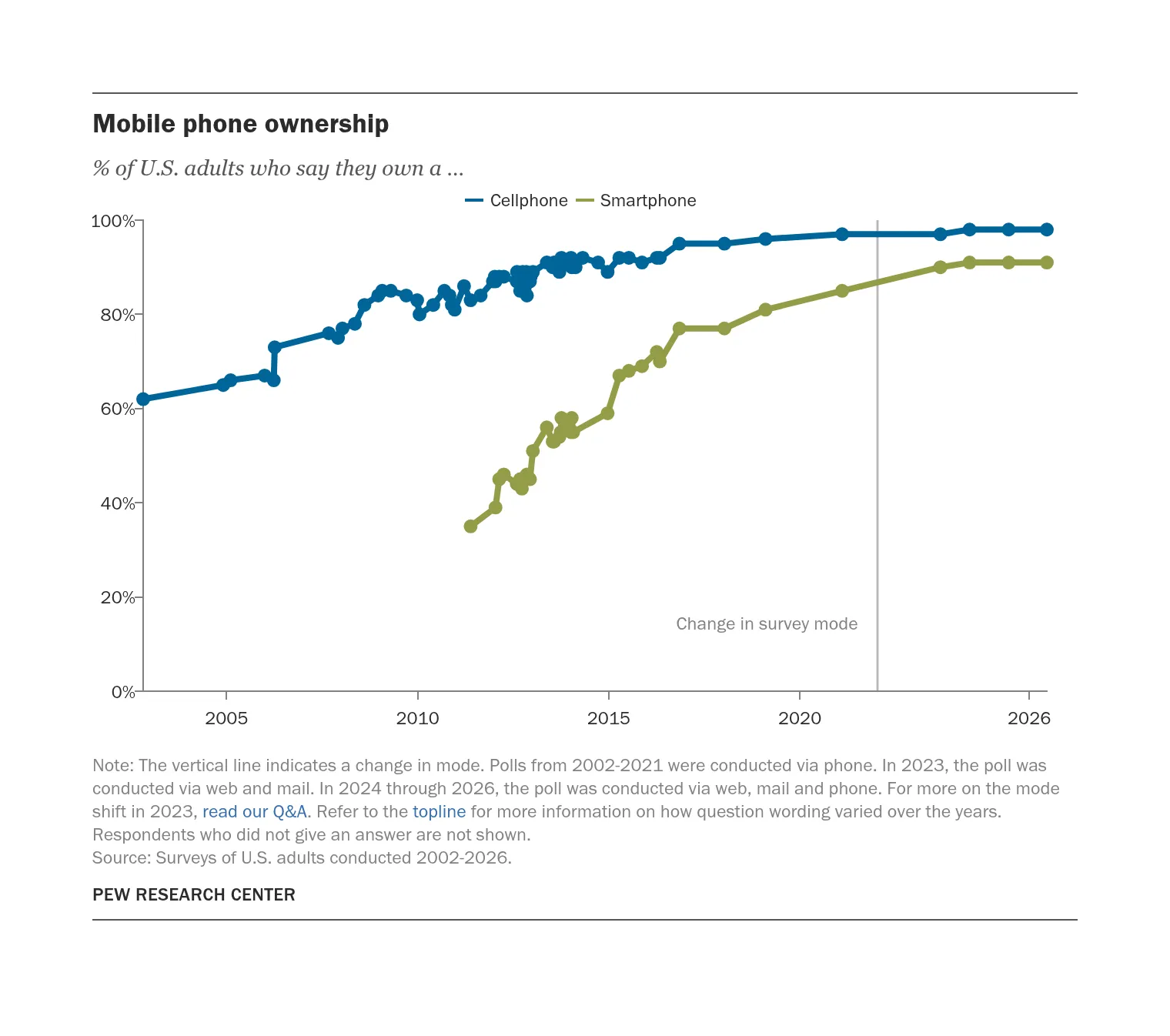
Who owns a smartphone?
- 98% of US adults own a cellphone of some kind (Pew Research Center, Oct 2026).
- 97% of adults aged 18 to 29 own a smartphone (Pew Research Center, Oct 2026).
- 79% of adults aged 65 and older own one (Pew Research Center, Oct 2026).
Who has only a phone to go online?
A signer with only a phone cannot switch to a laptop for a long form.
- 16% of US adults are smartphone-only internet users, meaning they own a smartphone but have no home broadband (Pew Research Center, Oct 2026).
- Among adults aged 18 to 29 the share is 24% (Pew Research Center, Oct 2026).
How strong is mobile access worldwide?
- There are 99 mobile broadband subscriptions for every 100 people in the world (ITU, Nov 2025).
- Mobile broadband makes up 89% of all mobile subscriptions, up from under 50% in 2015 (ITU, Nov 2025).
- 5G networks cover an estimated 55% of the world’s people (ITU, Nov 2025).
- About 6 billion people, three-quarters of the world, use the internet (ITU, Nov 2025).
What do digital signers expect from the screen?
- 18% of surveyed organizations named mobile responsiveness as a top expectation for digital onboarding and form signing (Docusign, Sep 2026).
How Much Fraud Surrounds Online Signing?
Fraud does not have to break the signature to hurt a signer. It targets the people, the email and the payment around the document, and the totals keep rising.
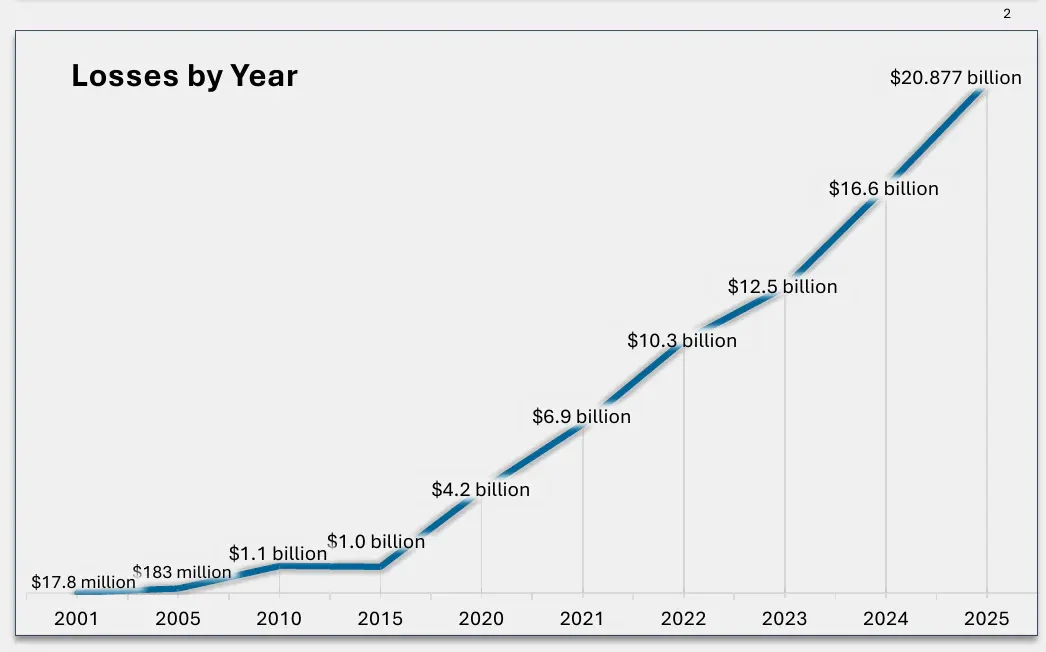
What does the FBI see?
- The IC3 received 1,008,597 complaints in 2025, the highest yearly count on the report’s 25-year chart (FBI IC3, Apr 2026).
- Reported losses rose 26% from 2024 (FBI IC3, Apr 2026).
- The average loss per complaint was $20,699 (FBI IC3, Apr 2026).
- Business email compromise cost victims $3,046,598,558, second to investment fraud (FBI IC3, Apr 2026).
- Cyber-enabled fraud caused 85% of all reported losses (FBI IC3, Apr 2026).
- People aged 60 and older lost $7.7 billion (FBI IC3, Apr 2026).
- The IC3 recovery team froze $507,042,623 across 3,574 domestic incidents (FBI IC3, Apr 2026).
What does the FTC see?
The FTC counts what consumers report, which overlaps with but is not the same as the FBI data.
- About $16 billion in fraud losses was reported to the FTC in 2025, the highest on record and about 25% above 2024 (Federal Trade Commission, Jun 2026).
- Imposter scams cost people $3.5 billion (Federal Trade Commission, Jun 2026).
- Business impersonators took nearly $1 billion (Federal Trade Commission, Jun 2026).
- Government impersonators took about $920 million (Federal Trade Commission, Jun 2026).
Do breaches start with people?
A fake request to sign is a people problem before it is a software problem.
- The human element was present in 62% of breaches in Verizon’s 2026 data (Verizon, Jun 2026).
- Social engineering was 16% of all breaches (Verizon, Jun 2026).
- Third-party involvement reached 48% of breaches (Verizon, Jun 2026).
Has an e-signature vendor been breached?
- Dropbox disclosed that on April 24, 2024 it learned of unauthorized access to the Dropbox Sign production environment (Dropbox Form 10-K, Feb 2026).
How Do Phishing and Fake Identities Threaten Signers?
Fake signature requests look like real ones, and identity checks are now a target too. The checks that stop fraud are also a place where honest signers give up.
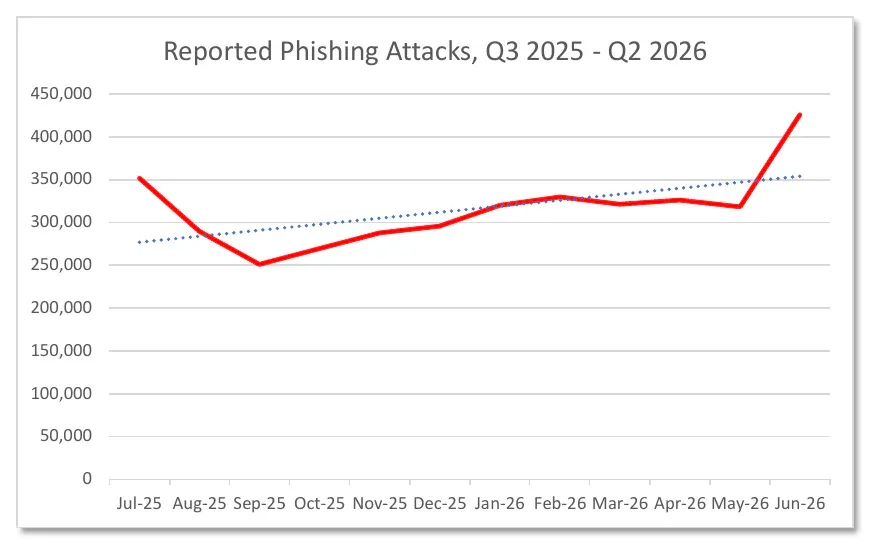
How many phishing attacks are there?
- APWG counted 1,069,681 phishing attacks in the second quarter of 2026, up 10.1% from the first (APWG, Aug 2026).
- June 2026 alone had 425,808 attacks, the most in any month since April 2023 (APWG, Aug 2026).
- Phishing campaigns targeted 552 brands in June (APWG, Aug 2026).
- Attackers tried to steal an average of $61,732 per wire-transfer BEC attempt, up 45% (APWG, Aug 2026).
- Text message phishing, called smishing, rose 40% from the first to the second quarter (APWG, Aug 2026).
How fast is identity fraud changing?
Entrust analyzed more than 1 billion identity verifications across 195 countries and over 30 industries. Sumsub reports from its own checks.
- Deepfake selfies rose 58% in 2025 (Entrust, Jun 2026).
- Injection attacks, which feed fake video into a verification step, rose 40% from a year earlier (Entrust, Jun 2026).
- About one in 50 forged documents is now AI-generated (Sumsub, Nov 2025).
How Many Countries Have Laws for Electronic Signatures?
Legal recognition is wide, and a wider set of rules is still being written. This section reports what each source says and draws no legal conclusion for any state or country.

How widely has the UN model law spread?
- Legislation based on or influenced by the UNCITRAL model law on electronic signatures has been adopted in 40 states and 42 jurisdictions (UNCITRAL, Oct 2026).
- The model law on electronic transferable records has been adopted in 13 states (UNCITRAL, Oct 2026).
What does the European Union say?
- The first EU rules on electronic signatures were the 1999 eSignature Directive (European Commission, Oct 2026).
- Since July 1, 2016, electronic signatures in the EU have been governed by the eIDAS Regulation (European Commission, Oct 2026).
- The European Parliament adopted the European Digital Identity Regulation on February 29, 2024 by 335 votes to 190, with 31 abstentions (European Commission, Feb 2024).
- The EU Digital Decade target is for 100% of EU citizens to have access to a digital ID by 2030 (European Commission, Feb 2024).
- Qualified trust services must pass a conformity assessment every 24 months (European Commission, Mar 2025).
What still holds back adoption?
- 40% of mortgage lenders named lack of uniform remote online notarization law across US states as a top challenge for full electronic closings (Fannie Mae, Aug 2025).
Methodology and Sources
Each number comes from the group that produced it: a regulator, statistics office, trade association, public filing, research firm or vendor survey. Roundup pages were used to find leads, never as sources. Every link was opened and the number was checked on the page or in the report text before it was used. Dates are the month the source published or last updated the data. Where a page shows no date, the month the page was read is given.
Three limits apply. Market forecasts come from firms that define the market in different ways, so they are shown side by side. Vendor surveys come from small samples of the vendor’s own customers or event attendees, and each is labeled. Phone ownership stands in for mobile signing because no public source counts signatures made on phones. Pages like this one are refreshed monthly.
For related reading, see the pages on contract management and freelance work.
Sources
- Anti-Phishing Working Group: https://docs.apwg.org/reports/apwg_trends_report_q2_2026.pdf
- Consumer Financial Protection Bureau: https://www.consumerfinance.gov/archive/newsroom/cfpb-study-finds-electronic-mortgage-closings-can-benefit-consumers
- Docusign: https://www.sec.gov/Archives/edgar/data/1261333/000126133326000044/docufy26annualreportformupa.pdf, https://www.sec.gov/Archives/edgar/data/1261333/000126133326000017/q426ex-991er.htm, https://investor.docusign.com/news-and-events/press-releases/news-details/2026/Docusign-Announces-Second-Quarter-Fiscal-2027-Financial-Results/default.aspx, https://www.docusign.com/blog/docusign-higher-and-faster-completion-rates, https://www.docusign.com/resources/research/State-of-Digital-Customer-Experience, https://www.docusign.com/blog/ai-reduce-customer-experience-friction, https://www.docusign.com/blog/digital-agreement-abandonment
- Dropbox: https://sign.dropbox.com/blog/trends-report-agreement-growth-at-work, https://www.sec.gov/Archives/edgar/data/1467623/000146762326000008/dbx-20251231.htm
- e-Estonia: https://e-estonia.com/wp-content/uploads/eestonia_guide_08-04-2025.pdf, https://e-estonia.com/e-governance-saves-money-and-working-hours
- Entrust: https://www.entrust.com/resources/reports/identity-fraud-report
- Eurostat: https://ec.europa.eu/eurostat/statistics-explained/index.php?title=Digital_economy_and_society_statistics_-_households_and_individuals
- European Commission: https://ec.europa.eu/digital-building-blocks/sites/spaces/DIGITAL/pages/467109069/What+is+eSignature, https://ec.europa.eu/digital-building-blocks/sites/spaces/EUDIGITALIDENTITYWALLET/pages/694487832/About+the+initiative, https://digital-strategy.ec.europa.eu/en/faqs/questions-answers-trust-services-under-european-digital-identity-regulation
- Fannie Mae: https://www.fanniemae.com/media/document/pdf/mlss-q2-2025-emortgage-adoption.pdf
- FBI Internet Crime Complaint Center: https://www.ic3.gov/AnnualReport/Reports/2025_IC3Report.pdf
- Federal Trade Commission: https://www.ftc.gov/news-events/news/press-releases/2026/06/ftc-data-show-people-reported-losing-3-point-5-billion-imposter-scams-2025
- Fortune Business Insights: https://www.fortunebusinessinsights.com/industry-reports/digital-signature-market-100356
- Grand View Research: https://www.grandviewresearch.com/industry-analysis/digital-signature-market-report
- ITU: https://www.itu.int/itu-d/reports/statistics/2025/10/15/ff25-subscriptions, https://www.itu.int/en/mediacentre/Pages/PR-2025-11-17-Facts-and-Figures.aspx
- MarketsandMarkets: https://www.marketsandmarkets.com/Market-Reports/digital-signature-market-177504698.html
- Ministry of Electronics and Information Technology, India: https://www.meity.gov.in/static/uploads/2026/04/46face7d48c8f6a97030f713ad5fdab4.pdf
- Mordor Intelligence: https://www.mordorintelligence.com/industry-reports/digital-signatures-market, https://www.mordorintelligence.com/industry-reports/global-e-signature-platform-market
- National Association of REALTORS: https://cms.nar.realtor/sites/default/files/2025-09/2025-realtors-technology-survey-report-09-18-2025.pdf
- Persistence Market Research: https://www.persistencemarketresearch.com/market-research/digital-signature-market.asp
- Pew Research Center: https://www.pewresearch.org/internet/fact-sheet/mobile/
- Precedence Research: https://www.precedenceresearch.com/digital-signature-market
- Straits Research: https://straitsresearch.com/report/digital-signature-market
- Sumsub: https://sumsub.com/newsroom/sumsubs-annual-report-fraud-shifts-to-complex-multi-step-schemes-in-2025-agentic-ai-scams-poised-to-surge-in-2026
- The Insight Partners: https://www.theinsightpartners.com/reports/electronic-signature-software-market
- UNCITRAL: https://uncitral.un.org/en/texts/ecommerce/modellaw/electronic_commerce/status, https://uncitral.un.org/en/texts/ecommerce/modellaw/electronic_signatures/status, https://uncitral.un.org/en/texts/ecommerce/modellaw/electronic_transferable_records/status
- Verizon: https://www.verizon.com/business/resources/executivebriefs/2026-dbir-executive-summary.pdf