Lawyer statistics tell one story from three angles: how many people hold a law license, where they work, and what the job pays. The US count has started to grow again after several flat years. Pay at the top is far above pay at the bottom. Most law offices are small.
This page pulls every number from the group that produced it: the Bureau of Labor Statistics, the American Bar Association, the Census Bureau, the National Conference of Bar Examiners, the Law School Admission Council and NALP, the legal career association. Each figure has a date and a link to the source. We report the numbers as the sources state them. They describe the profession and are not legal advice.
Different counts give different totals. The ABA counts licensed resident lawyers. The Bureau of Labor Statistics counts jobs, and its pay data leaves out the self-employed. We say which count each number uses.
Key Takeaways
- The US had 1,374,720 resident active lawyers in 2025. (American Bar Association, Dec 2025)
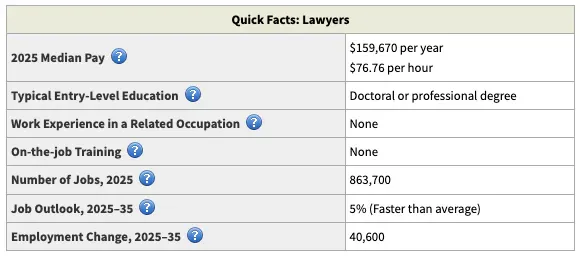
- The median lawyer earned $159,670 in May 2025, and the top 10 percent earned more than $351,600. (U.S. Bureau of Labor Statistics, Aug 2026)
- Lawyer jobs are projected to grow 5 percent from 2025 to 2035, faster than the average for all occupations. (U.S. Bureau of Labor Statistics, Aug 2026)
- Women were 41 percent of resident active lawyers and men 58 percent in 2025. (American Bar Association, Dec 2025)
- Lawyers of color were 23 percent of the profession in 2024, up from 12 percent in 2014. (American Bar Association, Nov 2024)
- Women held 29.55 percent of law firm partner seats and 52.09 percent of associate seats in 2025. (NALP, Mar 2026)
- US law schools enrolled 120,039 JD students in fall 2025, up 4 percent in a year. (American Bar Association, Dec 2025)
- Law school applicants were up 12.0 percent on the same date last year as of October 14, 2026. (LSAC, Oct 2026)
- 92.8 percent of the law class of 2025 had a job ten months after graduation, and 84.6 percent held a job that needs bar admission. (NALP, Aug 2026)
- The median first-year associate base salary was $200,000 on January 1, 2025. (NALP, May 2025)
- 76 percent of first-time test takers passed the bar exam in 2025. (NCBE, Spring 2026)
- 118,754 of the 165,491 US law offices with paid staff had fewer than five employees in 2023. (U.S. Census Bureau, Jun 2025)
- Lawyers working full time had median weekly earnings of $2,622 in 2025, against $1,204 for all full-time workers. (U.S. Bureau of Labor Statistics, Feb 2026)
- The July 2025 bar exam multiple-choice score was the highest July mean since 2013, leaving out 2020. (NCBE, Aug 2025)
How many lawyers are there in the United States?
The profession is bigger than it has ever been, and it is growing again after a long pause. The count depends on who is counting, so read the source line on each number.
What do attorney statistics say about the national headcount?
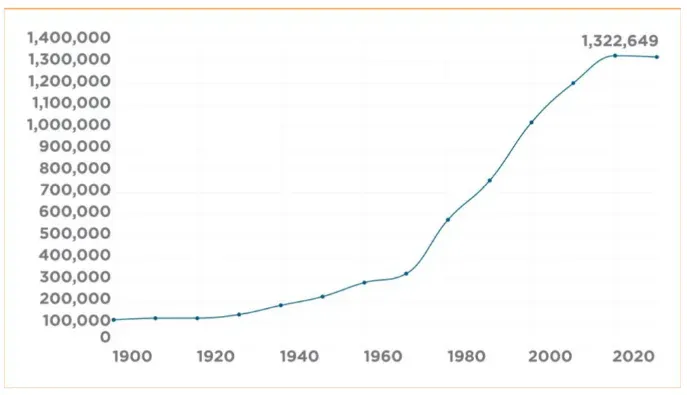
The ABA counted 1,374,720 resident active lawyers in 2025, a rise of 1.38 percent from 1,355,963 in 2024 (American Bar Association, Dec 2025).
- The count has grown by 73,363 lawyers, or 5.6 percent, over the last ten years. (American Bar Association, Dec 2025)
- The US had 1,022,462 lawyers in 2000 and 1,322,649 on January 1, 2024, an increase of 29 percent. (American Bar Association, Nov 2024)
- The lawyer count rose 793 percent from 1900 to 2000, from 114,460 to just over one million. (American Bar Association, Nov 2024)
- The Bureau of Labor Statistics counted 863,700 lawyer jobs in 2025, which is a jobs count and not a license count. (U.S. Bureau of Labor Statistics, Aug 2026)
- The Current Population Survey, a household survey, put employed lawyers at 1,146,000 in 2025. (U.S. Bureau of Labor Statistics, Feb 2026)
Which states have the most lawyers?
New York had 190,015 resident active lawyers in 2025, the most of any state (American Bar Association, Dec 2025).
- California followed with 181,048 lawyers. (American Bar Association, Dec 2025)
- Texas had 99,867 lawyers and Florida had 80,976. (American Bar Association, Dec 2025)
- The District of Columbia had 65,824 lawyers, more than Illinois had in 2025 at 61,945. (American Bar Association, Dec 2025)
- New York and California together held 28 percent of the nation’s lawyers in 2024. (American Bar Association, Nov 2024)
- New York had 9.59 lawyers per 1,000 residents in 2024 and South Carolina had 2.06, against 3.81 across the 50 states. (American Bar Association, Nov 2024)
Where is the lawyer population growing or shrinking?
Growth is uneven. Seven jurisdictions grew by more than 5 percent in one year, and four states shrank the most (American Bar Association, Dec 2025).
- Arkansas, Delaware, Idaho, Massachusetts, Oklahoma, Puerto Rico and Utah each grew by more than 5 percent in 2025. (American Bar Association, Dec 2025)
- Montana, Vermont, Wyoming and West Virginia had the biggest one-year declines. (American Bar Association, Dec 2025)
- The South grew 11 percent over ten years, while the Midwest fell 1.4 percent. (American Bar Association, Dec 2025)
- California holds 61 percent of the lawyers in the West, and Texas holds 21 percent of those in the South. (American Bar Association, Dec 2025)
- Twenty-four states had fewer lawyers in 2024 than ten years earlier, led by a 15 percent drop in Alabama. (American Bar Association, Nov 2024)
Where do lawyers work?
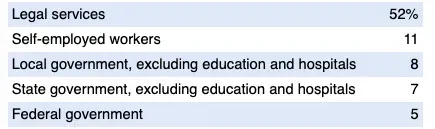
Most lawyers work for a law firm or for themselves, and the public sector is the second pillar. The settings below are shares of all lawyer jobs.
Which employers hire the most lawyers?
Legal services firms employ 52 percent of lawyers (U.S. Bureau of Labor Statistics, Aug 2026).
- Self-employed workers make up 11 percent of lawyer jobs. (U.S. Bureau of Labor Statistics, Aug 2026)
- Local government employs 8 percent, excluding education and hospitals. (U.S. Bureau of Labor Statistics, Aug 2026)
- State government employs 7 percent, excluding education and hospitals. (U.S. Bureau of Labor Statistics, Aug 2026)
- The federal government employs 5 percent. (U.S. Bureau of Labor Statistics, Aug 2026)
- Lawyers hold 0.5 percent of all US jobs. (U.S. Bureau of Labor Statistics, Aug 2026)
How many law offices are there?
The US had 165,491 law offices with paid employees in 2023, and they employed 1,093,331 people, lawyers and staff together (U.S. Census Bureau, Jun 2025).
- The wider legal services group (NAICS 5411) had 181,092 employer establishments. (U.S. Census Bureau, Jun 2025)
- Those same legal services had 274,000 businesses with no paid employees. (U.S. Census Bureau, May 2025)
How common are solo and small-firm lawyers?
Small is the normal size of a law office. The giant firms get the headlines, but they are a thin slice of offices. Solo lawyers are part of the wider self-employed workforce, covered in freelance statistics.
How big are most law offices?
Law offices with paid staff are mostly tiny, and the next size up is still small. In 2023, 24,921 offices had five to nine employees (U.S. Census Bureau, Jun 2025).
- 12,198 offices had 10 to 19 employees, and 6,619 had 20 to 49. (U.S. Census Bureau, Jun 2025)
- Only 14 law offices in the country had 1,000 or more employees. (U.S. Census Bureau, Jun 2025)
- Across all occupations, 5.8 percent of workers are self-employed, a bit over half the lawyer rate shown in Figure 2. (U.S. Bureau of Labor Statistics, Aug 2026)
Do new graduates start in small firms or solo?
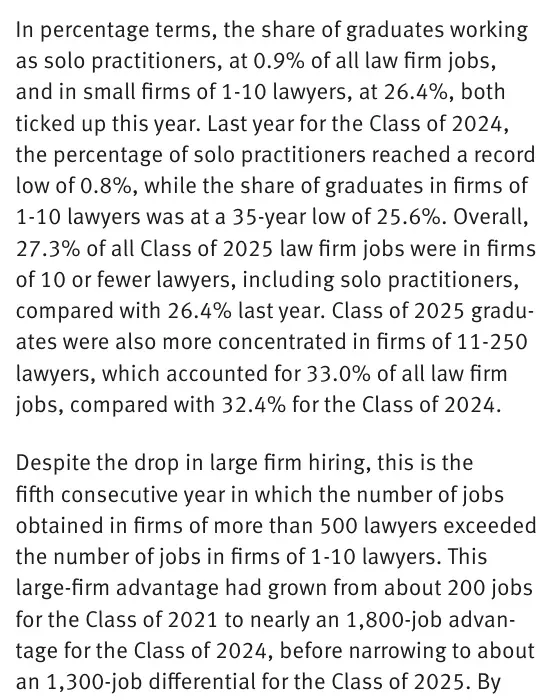
Few go solo, and a growing share join the smallest firms. Solo practitioners were 0.9 percent of Class of 2025 law firm jobs (NALP, Aug 2026).
- Firms of one to ten lawyers took 26.4 percent of private practice jobs among employed graduates. (NALP, Aug 2026)
- Firms of 11 to 250 lawyers held 33.0 percent of law firm jobs. (NALP, Aug 2026)
- Jobs in firms above 500 lawyers beat jobs in firms of one to ten lawyers by about 1,300 in the Class of 2025, down from nearly 1,800 a year earlier. (NALP, Aug 2026)
- Only 0.6 percent of the Class of 2023 went solo straight out of school, against 2.3 percent of the Class of 2013. (American Bar Association, Nov 2024)
How much do lawyers make, according to the Bureau of Labor Statistics?
Lawyer pay is high and wide. The gap between the 10th and 90th percentile is more than $273,000, and where a lawyer works moves the number as much as the job title.
What do lawyers earn at each percentile?
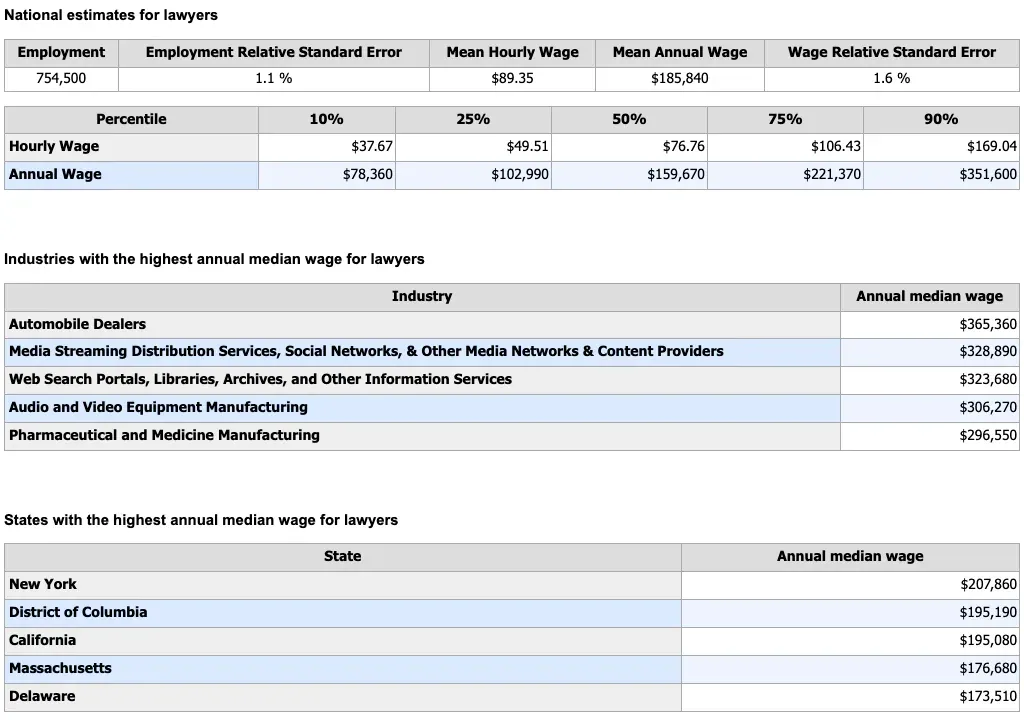
The lowest-paid tenth of lawyers earned less than $78,360 in May 2025 (U.S. Bureau of Labor Statistics, Aug 2026).
- The 25th percentile was $102,990 and the 75th percentile was $221,370. (U.S. Bureau of Labor Statistics, May 2026)
- The mean annual wage was $185,840, above the median because high earners pull it up. (U.S. Bureau of Labor Statistics, May 2026)
- The median hourly wage was $76.76. (U.S. Bureau of Labor Statistics, Aug 2026)
- Median pay for all legal occupations was $102,500, and for all US occupations it was $50,980. (U.S. Bureau of Labor Statistics, Aug 2026)
- These wage data exclude self-employed lawyers and partners in unincorporated firms, and they measure wages, not client fees. (U.S. Bureau of Labor Statistics, Aug 2026)
Who pays lawyers the most?
Federal government lawyers had the highest median wage among the large employers, at $178,380 in May 2025 (U.S. Bureau of Labor Statistics, Aug 2026).
- Legal services firms paid a median of $157,870. (U.S. Bureau of Labor Statistics, Aug 2026)
- Local government paid $131,390 and state government paid $115,330. (U.S. Bureau of Labor Statistics, Aug 2026)
- Automobile dealers paid lawyers the highest industry median, $365,360. (U.S. Bureau of Labor Statistics, May 2026)
Which states and cities pay lawyers the most?
New York had the highest state median lawyer wage at $207,860 in May 2025 (U.S. Bureau of Labor Statistics, May 2026).
- The District of Columbia was next at $195,190, and California was close behind at $195,080. (U.S. Bureau of Labor Statistics, May 2026)
- Massachusetts paid $176,680 and Delaware paid $173,510. (U.S. Bureau of Labor Statistics, May 2026)
- The San Jose area had the top metro median, $301,320. (U.S. Bureau of Labor Statistics, May 2026)
How does lawyer pay compare with other legal jobs and with weekly earnings data?
Paralegals had a median wage of $62,890 in May 2025, and judges and hearing officers had $132,800 (U.S. Bureau of Labor Statistics, Aug 2026).
- Arbitrators, mediators and conciliators had a median of $75,530. (U.S. Bureau of Labor Statistics, Aug 2026)
- Male full-time lawyers had median weekly earnings of $2,890 in 2025. (U.S. Bureau of Labor Statistics, Feb 2026)
- Female full-time lawyers had median weekly earnings of $2,321. (U.S. Bureau of Labor Statistics, Feb 2026)
- Average lawyer wages rose 19.2 percent from 2021 to 2023, the biggest two-year jump this century, according to the ABA’s reading of BLS data. (American Bar Association, Nov 2024)
Who are the lawyers in the US?
The profession is moving toward gender balance faster than toward racial balance. It is also older than the average workforce.
What share of lawyers are women?
Women were 36 percent of lawyers in 2014, 27 percent in 2000 and only 3 percent from 1950 to 1970 (American Bar Association, Nov 2024).
- The household survey found women were 42.9 percent of employed lawyers in 2025. (U.S. Bureau of Labor Statistics, Feb 2026)
- Women were just over 40 percent of all lawyers at law firms in 2025. (NALP, Mar 2026)
- Women held 26.5 percent of equity partner seats, a record, and 34.4 percent of non-equity partner seats. (NALP, Mar 2026)
- Women were 55.26 percent of law firm summer associates in 2025. (NALP, Mar 2026)
What do statistics about lawyers show on race and ethnicity?
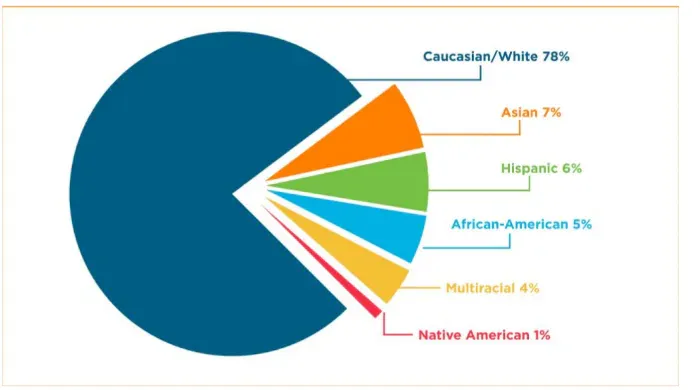
Race data covers only part of the field. The ABA’s figures come from 24 states, which hold 43 percent of lawyers (American Bar Association, Nov 2024).
- White lawyers were 78 percent, down from 88 percent in 2014. (American Bar Association, Nov 2024)
- Asian lawyers were 7 percent in 2024, up from 2 percent in 2014. (American Bar Association, Nov 2024)
- Black lawyers were 5 percent of the profession in both 2014 and 2024. (American Bar Association, Nov 2024)
- The household survey estimated that 9.2 percent of employed lawyers were Hispanic or Latino in 2025. (U.S. Bureau of Labor Statistics, Feb 2026)
- Partners of color were 12.67 percent of law firm partners, and Black partners were 2.42 percent. (NALP, Mar 2026)
- Associates of color fell 1.3 points to 30.20 percent, the first drop since 2010. (NALP, Mar 2026)
How old are lawyers?
The median employed lawyer was 46.4 years old in 2025, against 42.1 for all workers (U.S. Bureau of Labor Statistics, Feb 2026).
- About 162,000 employed lawyers were 65 or older, roughly one in seven. (U.S. Bureau of Labor Statistics, Feb 2026)
- The 25 to 34 age group had 241,000 employed lawyers, about one in five. (U.S. Bureau of Labor Statistics, Feb 2026)
How many lawyers are LGBTQ+, disabled or veterans?
Law firms reported that 4.90 percent of their lawyers were LGBTQ+ in 2025, the first fall since NALP began counting in 2004 (NALP, Mar 2026).
- Lawyers with disabilities were 3.06 percent of lawyers at reporting firms. (NALP, Mar 2026)
- Military veterans were 2.20 percent of lawyers at reporting firms. (NALP, Mar 2026)
How many people are going to law school?
Interest in law school is at a multi-year high, and it is still rising. That will feed the lawyer count for the next decade.
How many students are in US law schools?
The 196 ABA-approved law schools reported total enrollment of 145,116 in fall 2025 (American Bar Association, Dec 2025).
- Another 25,077 students were in LLM, master’s and certificate programs, up 6.3 percent. (American Bar Association, Dec 2025)
- The first-year class was 42,817 students, up 7.9 percent. (American Bar Association, Dec 2025)
- JD enrollment peaked at 147,525 in 2010. (American Bar Association, Nov 2024)
- Women were 55.1 percent of the incoming class. (American Bar Association, Dec 2025)
How many people apply, and how is the LSAT changing?
More than 76,000 people applied to law school in the 2024-25 cycle, the most since 2011 and up 18 percent (LSAC, Apr 2026).
- Applicants peaked in 2004, when more than 100,000 applied. (American Bar Association, Nov 2024)
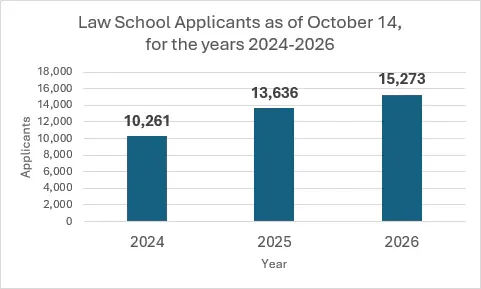
- By October 14, 2026, 15,273 people had applied for the 2026-27 cycle, 48.8 percent more than two years earlier. (LSAC, Oct 2026)
- Applications for that cycle were up 14.6 percent on the same date a year earlier. (LSAC, Oct 2026)
- Schools reported accepting 41,847 students with LSAT scores and 531 with GRE scores for fall 2025. (American Bar Association, Dec 2025)
Who is in the first-year class?
Students of color were 41.4 percent of the 2025 first-year class, a slight dip from 41.8 percent a year earlier (LSAC, Apr 2026).
- First-generation college graduates were 21.6 percent of 1Ls, down from 23.2 percent in 2021. (LSAC, Apr 2026)
- Pell Grant recipients were 25.8 percent of the class. (LSAC, Apr 2026)
- LGBTQ+ students were 14.4 percent of the class, up from 12 percent in 2021. (LSAC, Apr 2026)
Where do new law graduates work?
The graduating class of 2025 found jobs at near-record rates, but the mix is changing. Large firms and small firms grew their share while federal and public interest hiring fell.
What share of graduates find jobs?
The Class of 2025 had 36,206 graduates, down 7.0 percent from 38,937 in the Class of 2024 (NALP, Aug 2026).
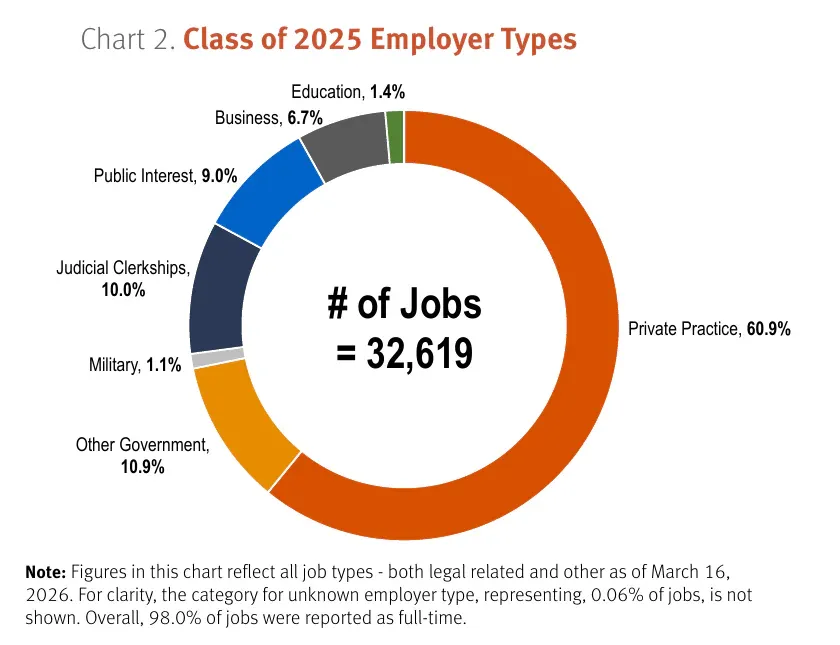
- Total jobs fell 7.7 percent to 32,619. (NALP, Aug 2026)
- 83.9 percent held full-time, long-term jobs that need bar admission. (NALP, Aug 2026)
- 5.9 percent held JD Advantage jobs, the lowest share since the Class of 2002. (NALP, Aug 2026)
- The unemployment rate, counting graduates who were seeking work and those who were not, was 5.5 percent. (NALP, Aug 2026)
- A record low 6.7 percent of employed graduates were seeking a different job. (NALP, Aug 2026)
Where do graduates work?
Private practice employed 60.9 percent of graduates in jobs, the largest share since the Class of 1990 (NALP, Aug 2026).
- Judicial clerkships took 10.0 percent of jobs and public interest took 9.0 percent. (NALP, Aug 2026)
- Business took 6.7 percent of jobs. (NALP, Aug 2026)
- Federal government jobs for graduates fell 37.0 percent, from nearly 1,100 to about 690. (NALP, Aug 2026)
- Firms of more than 500 lawyers took 33.2 percent of all law firm jobs, down from 34.2 percent. (NALP, Aug 2026)
Do outcomes differ by race and family background?
White graduates had a 94.4 percent employment rate, against 90.8 percent for graduates of color (NALP, Oct 2026).
- 87.1 percent of white graduates held jobs that need bar admission, against 81.6 percent of graduates of color. (NALP, Oct 2026)
- Black graduates had the lowest rate of bar-required jobs, 72.6 percent. (NALP, Oct 2026)
- First-generation college graduates had an 82.1 percent bar-required job rate, against 89.5 percent for graduates with a parent who holds a JD. (NALP, Oct 2026)
What do new lawyers earn?
Starting pay is lopsided. A large block of graduates earns between $60,000 and $100,000 while another large block earns the top law firm rate.
What do first-year law firm associates earn?
Large firms that lifted pay to $225,000 were still the minority in 2025. Only 32 percent of offices reported paying that amount (NALP, May 2025).
- Firms with more than 700 lawyers had a median first-year salary of $215,000. (NALP, May 2025)
- 45 percent of offices in firms of 701 or more lawyers paid $225,000. (NALP, May 2025)
- Austin, Boston, Houston, New York City, San Francisco and the Washington, DC area each had a $225,000 median start. (NALP, May 2025)
- Outside the big markets, the West had a $181,900 median and the South and Midwest had $160,000. (NALP, May 2025)
- Intellectual property associates had a median first-year salary of $225,000. (NALP, May 2025)
What did the Class of 2025 earn overall?
The national median salary hit a record $100,000, up 5.3 percent from $95,000 (NALP, Aug 2026).
- The mean salary was $128,412, up 2.0 percent. (NALP, Aug 2026)
- Salaries of $60,000 to $100,000 made up half of all reported salaries. (NALP, Aug 2026)
- A $225,000 salary was 21.5 percent of all reported salaries. (NALP, Aug 2026)
- Some large firms raised starting pay to $235,000 in June 2026. (NALP, Aug 2026)
How does pay differ by firm size and graduate background?
Median pay ran from $84,000 in firms of one to ten lawyers to $225,000 in firms of more than 500 lawyers (NALP, Aug 2026).
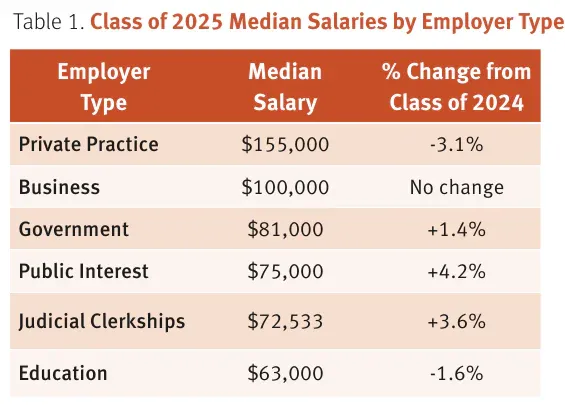
- The median private practice salary fell 3.1 percent to $155,000 as the mix of jobs shifted. (NALP, Aug 2026)
- Government jobs paid a median $81,000 and public interest jobs paid $75,000. (NALP, Aug 2026)
- Judicial clerkships paid $72,533 and education jobs paid $63,000. (NALP, Aug 2026)
- Median pay ran from $85,000 for Native American and Alaska Native graduates to $150,000 for Asian graduates. (NALP, Oct 2026)
- Graduates with a parent who holds a JD had a median of $115,000, against $95,000 for first-generation college graduates. (NALP, Oct 2026)
How hard is the bar exam?
Passing is the gate to the profession, and it got easier to clear in 2025. Most people who fail retake it, and repeaters pass at a much lower rate.
What is the bar exam pass rate?
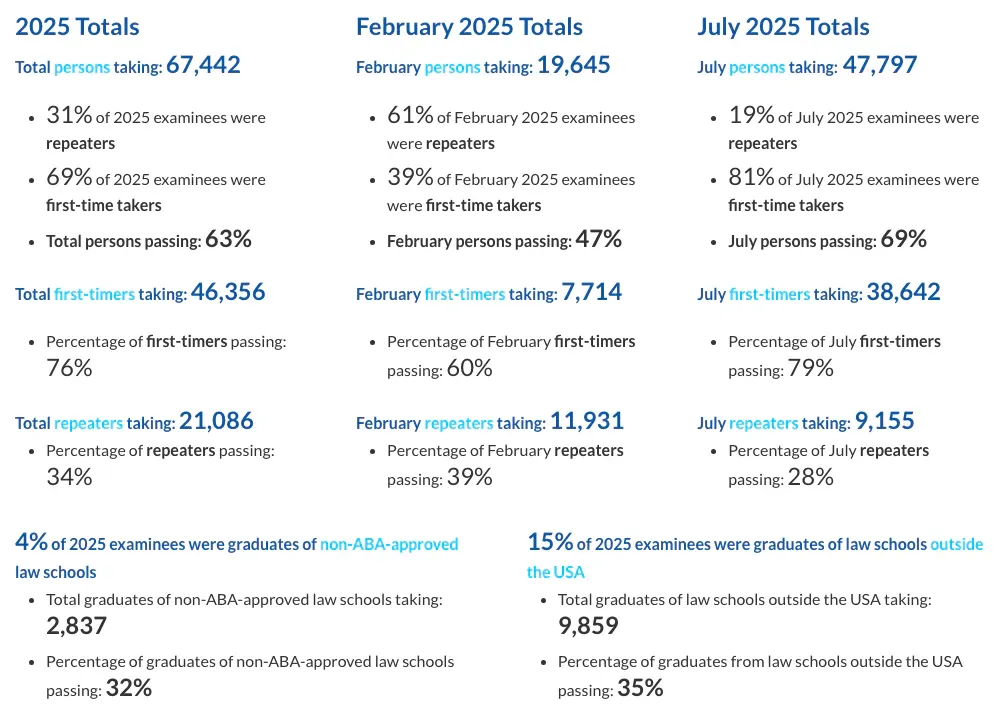
Jurisdictions reported 67,442 people taking the bar exam in 2025, with an overall pass rate of 63 percent (NCBE, Spring 2026).
- The February exam had 19,645 takers and a 47 percent pass rate. (NCBE, Spring 2026)
- The July exam had 47,797 takers and a 69 percent pass rate. (NCBE, Spring 2026)
- Repeaters passed at 34 percent. (NCBE, Spring 2026)
- The overall pass rate averaged 58 percent across jurisdictions in 2016. (NCBE, Spring 2026)
- The first-time pass rate averaged 69 percent in 2016 and 75 percent in 2024. (NCBE, Spring 2026)
Which states have the highest and lowest pass rates?
Minnesota had the highest first-time pass rate among the states in 2025, at 87 percent (NCBE, Spring 2026).
- Utah followed at 86 percent and Kansas at 84 percent. (NCBE, Spring 2026)
- California’s first-time rate rose to 69 percent from 64 percent in 2024. (NCBE, Spring 2026)
- Connecticut was at 63 percent and Vermont at 58 percent. (NCBE, Spring 2026)
- Puerto Rico had the lowest rate, 54 percent. (NCBE, Spring 2026)
Does where you studied law change the odds?
Graduates of non-ABA-approved schools were 4 percent of examinees, 2,837 people, and 32 percent of them passed (NCBE, Spring 2026).
- Graduates of law schools outside the US were 15 percent of examinees, or 9,859 people, and 35 percent passed. (NCBE, Spring 2026)
- February first-timers passed at 60 percent, while July first-timers passed at 79 percent. (NCBE, Spring 2026)
How did the multiple-choice section go in July 2025?
The national mean scaled score on the July 2025 Multistate Bar Examination was 142.4, up 0.6 from July 2024 (NCBE, Aug 2025).
- 46,959 examinees took the July 2025 MBE, about 6 percent fewer than the 49,844 in July 2024. (NCBE, Aug 2025)
- About 77 percent of July 2025 MBE examinees were likely taking the exam for the first time. (NCBE, Aug 2025)
What is the job outlook for lawyers?
Demand is expected to grow a little faster than the job market as a whole. Paralegals, by contrast, are expected to hold flat.
How many new lawyer jobs will there be?
BLS projects lawyer jobs to reach 904,300 by 2035 (U.S. Bureau of Labor Statistics, Aug 2026).
- About 28,700 openings a year are projected, mostly from workers who leave the field or move to other work. (U.S. Bureau of Labor Statistics, Aug 2026)
- Employment for all legal occupations is projected to grow 3 percent, the same as all occupations. (U.S. Bureau of Labor Statistics, Aug 2026)
- BLS says some routine legal work may be automated but does not expect that to reduce overall demand for lawyers. (U.S. Bureau of Labor Statistics, Aug 2026)
- Becoming a lawyer usually takes seven years of full-time study after high school. (U.S. Bureau of Labor Statistics, Aug 2026)
What is the outlook for entry-level and related jobs?
The entry-level market shrank in 2025. NALP says it lost about 2,700 jobs compared with the year before (NALP, Aug 2026).
- Public interest hiring of new graduates fell 14 percent, the first decrease since 2016. (NALP, Aug 2026)
- BLS projects paralegal and legal assistant jobs to dip 0.3 percent, or 1,100 jobs, from 2025 to 2035. (U.S. Bureau of Labor Statistics, Aug 2026)
- Paralegals and legal assistants held about 404,900 jobs in 2025. (U.S. Bureau of Labor Statistics, Aug 2026)
Methodology and Sources
We took every number from the organization that produced it: federal data from the Bureau of Labor Statistics and the Census Bureau, licensing and school counts from the American Bar Association, exam data from the National Conference of Bar Examiners, applicant data from the Law School Admission Council and graduate and law firm data from NALP. We opened each source page and checked the figure against it. Where one source rounds a number or uses a different count, we say so. Nothing here is a legal conclusion. This page is refreshed monthly.
Sources
- American Bar Association, Dec 2025
- American Bar Association, Nov 2024
- American Bar Association, Dec 2025
- American Bar Association, Nov 2024
- American Bar Association, Nov 2024
- LSAC, Oct 2026
- LSAC, Apr 2026
- NALP, Mar 2026
- NALP, Aug 2026
- NALP, May 2025
- NALP, Aug 2026
- NALP, Oct 2026
- NCBE, Spring 2026
- NCBE, Aug 2025
- NCBE, Spring 2026
- NCBE, Spring 2026
- U.S. Bureau of Labor Statistics, Aug 2026
- U.S. Bureau of Labor Statistics, Feb 2026
- U.S. Bureau of Labor Statistics, Feb 2026
- U.S. Bureau of Labor Statistics, Aug 2026
- U.S. Bureau of Labor Statistics, May 2026
- U.S. Bureau of Labor Statistics, Feb 2026
- U.S. Census Bureau, Jun 2025
- U.S. Census Bureau, May 2025
Glossary
- ABA: American Bar Association.
- BLS: Bureau of Labor Statistics, part of the US Department of Labor.
- CPS: Current Population Survey, a monthly household survey run by the Census Bureau for BLS.
- JD: Juris Doctor, the standard US law degree.
- LSAC: Law School Admission Council, which runs the LSAT and tracks applications.
- LSAT: Law School Admission Test.
- MBE: Multistate Bar Examination, the multiple-choice part of the bar exam.
- NALP: the National Association for Law Placement, a legal career association.
- NCBE: National Conference of Bar Examiners, which writes the bar exam.
- OEWS: Occupational Employment and Wage Statistics, the BLS wage survey.