Law firm marketing statistics show a simple pattern. Clients search online, compare a few firms and hire the one that answers first. Most firms still market without a budget, a tracking plan or a fast intake process.
This page collects primary data from bar associations, regulators, survey firms and ad platforms. Every figure links to the report that first published it, with the date. Some surveys cover local businesses in general, and the UK data covers England and Wales. Each one is labeled where it appears.
Use the page to benchmark your own firm: budget, cost per lead, review count and reply time. The Key Takeaways come first. Each section after that answers one question about how law firms get clients. Updated October 2026.
Key Takeaways
- Only 33% of 500 law firms answered a secret shopper email in 2024, down from 40% in 2019 (Clio, Oct 2024).
- 25% of law firms answer an online lead form in under 5 minutes, up from 13% in 2021, and 26% never answer (Hennessey Digital, Jun 2025).
- 72% of legal consumers move on if a firm does not reply within 24 hours, up from 66% a year earlier (Scorpion, Aug 2025).
- Only 11% of respondents hired the first attorney they contacted (Martindale-Avvo, Nov 2024).
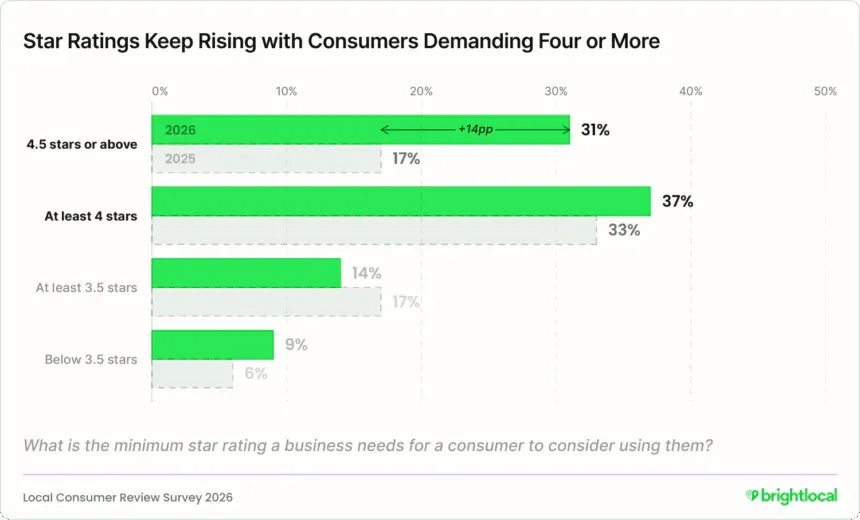
- 31% of consumers will only use a business rated 4.5 stars or higher, up from 17% a year earlier (BrightLocal, Feb 2026).
- Attorney and legal services advertisers pay $131.63 per lead from search ads, against a $66.69 average across industries (WordStream by LocaliQ, Jun 2026).
- Legal services advertising reached an estimated $2.5 billion in the US in 2024 (American Tort Reform Association, Mar 2025).
- 68.01% of US Google searches ended without a click in the first four months of 2026 (SparkToro, Jun 2026).
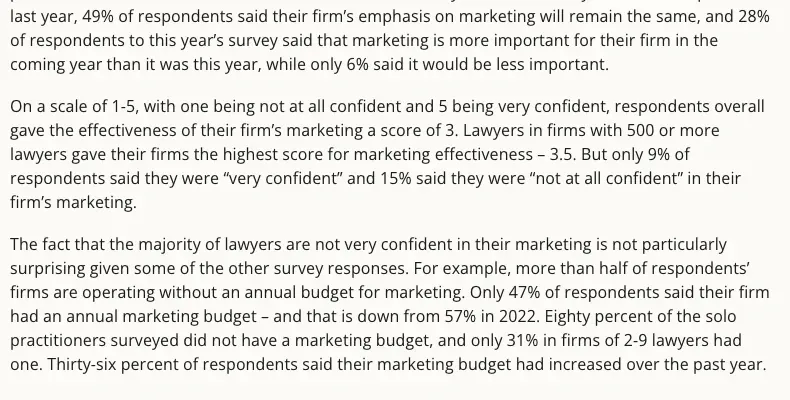
- Only 47% of lawyers surveyed said their firm had an annual marketing budget, down from 57% in 2022 (ABA TechReport 2023, Jan 2024).
- The fastest growing law firms spend a median 16.5% of revenue on marketing, against 5% for firms that do not grow (Hinge Marketing, Jul 2024).
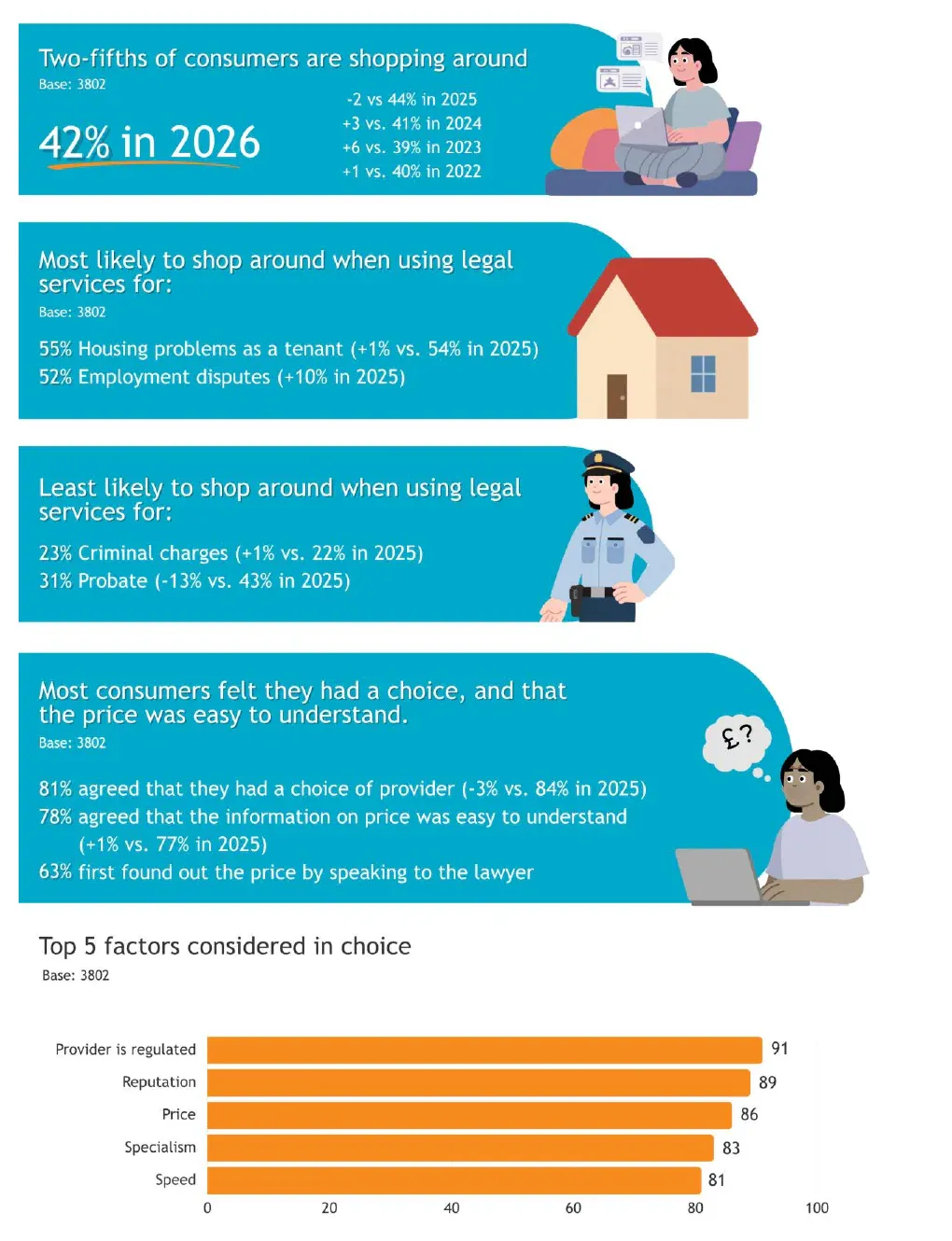
- 42% of legal consumers in England and Wales shopped around before choosing a provider in 2026, against 22% to 30% before 2022 (Legal Services Consumer Panel, Jul 2026).
- 69% of individuals and 79% of small businesses looked at their solicitor’s website before hiring (Solicitors Regulation Authority, Oct 2023).
- Civil penalties under the FTC’s Consumer Review Rule can reach $53,088 per violation (Federal Trade Commission, Dec 2025).
Budgets and Staffing: Most Firms Market Without a Plan
A marketing budget is a decision, and most small firms have not made it. The firms that grow fastest spend more, hire help and check the results.
How much do law firms spend on marketing?
Most solo lawyers spend without a budget: 80% of the solo practitioners surveyed did not have one (ABA TechReport 2023, Jan 2024).
- Only 31% of firms with 2 to 9 lawyers had an annual marketing budget (ABA TechReport 2023, Jan 2024).
- 36% of respondents said their marketing budget had increased over the past year (ABA TechReport 2023, Jan 2024).
- Firms with above-average productivity spend 41% more on marketing, and Clio links this to a 21% increase in profitability (Clio, Oct 2024).
- 74% of marketing leaders at firms with 51 to 100 attorneys said their budgets had increased after inflation, against 44% at firms with more than 500 attorneys (Legal Marketing Association and Above the Law, Jun 2025).
Who runs marketing at a law firm?
Lawyers still do much of it themselves: 58% of respondents said attorneys perform marketing activities in their firms (ABA TechReport 2023, Jan 2024).
- Internal marketing staff are involved in 32% of firms, including over 92% of respondents from firms with 100 or more lawyers (ABA TechReport 2023, Jan 2024).
- External consultants are used by 18% of respondents’ firms, and 19% say administrative staff handle marketing (ABA TechReport 2023, Jan 2024).
- Website design is the task firms most often hand to an outside agency, at 42% (ABA TechReport 2023, Jan 2024).
- 28% hire outside help for SEO and 27% for social media (ABA TechReport 2023, Jan 2024).
- 76% of solo attorneys and 63% of small firm attorneys personally manage and create content for their firm’s website (ABA Solo and Small Firm TechReport 2024, Apr 2025).
Do law firms track marketing results?
Mostly no: only about 20% of respondents said they receive regular reports of marketing performance (ABA TechReport 2023, Jan 2024).
- Respondents rated the effectiveness of their firm’s marketing 3 out of 5, and only 9% were “very confident” (ABA TechReport 2023, Jan 2024).
- 43% of respondents’ firms do not use an external agency, and 47% have no internal marketing team (ABA TechReport 2023, Jan 2024).
- Larger firms rate their confidence in their marketing strategy 3.3 out of 5, against 2.7 for solo and small firms (ABA TechReport 2024, Apr 2025).
- Only 15% of no-growth firms expressed high confidence in their marketing metrics, against almost 35% of high-growth firms (Hinge Marketing, Jul 2024).
- Four out of five high-growth firms still report only some or low proficiency with marketing metrics (Hinge Marketing, Mar 2025).
Which marketing activities do firms rate as most effective?
Written content comes first: a majority of marketing leaders ranked written content development as the single most important activity (Legal Marketing Association and Above the Law, Jun 2025).
- More than half of the leaders who called directories and awards ineffective ranked them the least useful activity of all (Legal Marketing Association and Above the Law, Jun 2025).
- High-growth firms ranked SEO as their second-highest marketing priority, behind content creation (Hinge Marketing, Mar 2025).
- High-growth firms get almost 25% more leads from online sources than no-growth firms, and online leads make up almost a third of their total (Hinge Marketing, Jul 2024).
Paid Ads: Legal Clicks Cost More and Convert Less
Lawyers pay the highest price per click in the benchmark, and they get fewer leads per click than most trades. Spending keeps rising as the biggest advertisers bid on the same searches.
What do search ads cost law firms?
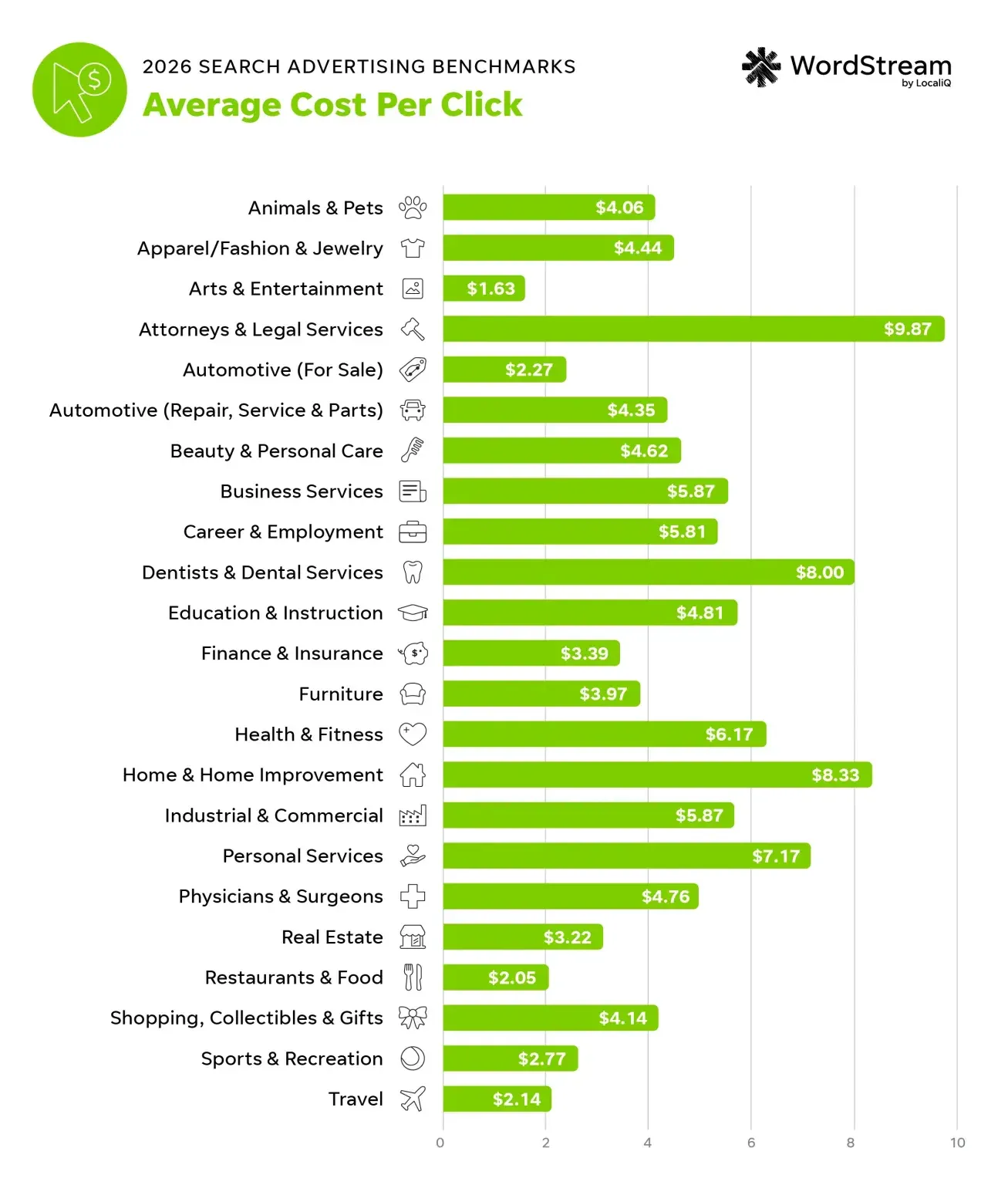
Attorneys and legal services advertisers pay an average $9.87 per click, against $5.42 across all industries (WordStream by LocaliQ, Jun 2026).
- Click-through rate for legal ads averages 5.87%, against 6.64% across industries (WordStream by LocaliQ, Jun 2026).
- Conversion rate for legal ads averages 5.55%, against 8.18% across industries (WordStream by LocaliQ, Jun 2026).
- Fewer than 10% of lawyers surveyed said their firms used YouTube, pay-per-click or radio to market their practices (ABA TechReport 2023, Jan 2024).
- Among firms that hire an outside agency, 8% do so for AdWords and pay-per-click (ABA TechReport 2023, Jan 2024).
How much does the legal industry spend on advertising?
Spending on all legal services ads rose about 39% between 2020 and 2024 (American Tort Reform Association, Mar 2025).
- Digital ad volume fell by more than 50% while digital spending rose 84%, which the report ties to rising ad costs (American Tort Reform Association, Mar 2025).
- Morgan & Morgan spent an estimated $218 million on ads in 2024, about 8% of all legal services ads (American Tort Reform Association, Mar 2025).
- Legalzoom.com was the next largest advertiser, at an estimated $60 million (American Tort Reform Association, Mar 2025).
- Radio ads for legal services peaked at more than 6.8 million in 2024, up more than 261% from 2017 (American Tort Reform Association, Mar 2025).
- Spending on outdoor ads such as billboards rose more than 260% from 2017 (American Tort Reform Association, Mar 2025).
SEO for Lawyers: Search, Maps and AI Answers
Search is still where legal shoppers start. But the results page is changing, and a ranking no longer guarantees a visit.
Where do legal consumers start their search?
Even with a referral in hand, 75% of legal consumers still check a firm online before calling (Scorpion, Aug 2025).
- 51% of legal consumers stop looking after the fifth search result (Scorpion, Aug 2025).
- 86% of consumers use online resources when handling a legal matter (Martindale-Avvo, Dec 2023).
- 70% read online content before deciding whether to engage an attorney (Martindale-Avvo, Dec 2023).
- In an earlier survey of 6,300 people, 43% listed Google searches as part of their research (Martindale-Avvo, Jan 2020).
- 36% of those respondents used attorney websites as a resource, against 9% for print advertising and 5% for TV or radio (Martindale-Avvo, Jan 2020).
What affects how a law firm page ranks on Google?
Longer pages rank higher: the top ten results for lawyer queries averaged 2,000 words, and position one never fell below 1,324 words (Hennessey Digital, Jan 2022).
- 65% of law firms use WordPress, and Hennessey found no correlation between the CMS and average position (Hennessey Digital, Jan 2022).
- lawyers.findlaw.com ranked in all 200 cities studied for “[Location] car accident lawyer” queries, at an average position of 3.57 (Hennessey Digital, Jan 2022).
- Only one website ranked for more than 10 different locations (Hennessey Digital, Jan 2022).
- A keyword in the business name is the third-largest influence on local pack and Maps rankings in Whitespark’s 2026 survey of local SEO experts (Whitespark, Dec 2025).
- Being open when the user searches is the fifth most influential local ranking factor, and a visible address is seventh (Whitespark, Dec 2025).
How are zero-click results and AI answers changing clicks?
In 2024, 60.45% of US Google searches ended without a click, and the 2026 figure is higher (SparkToro, Jun 2026).
- About 45% of Google searches were zero-click ten years ago (SparkToro, Jun 2026).
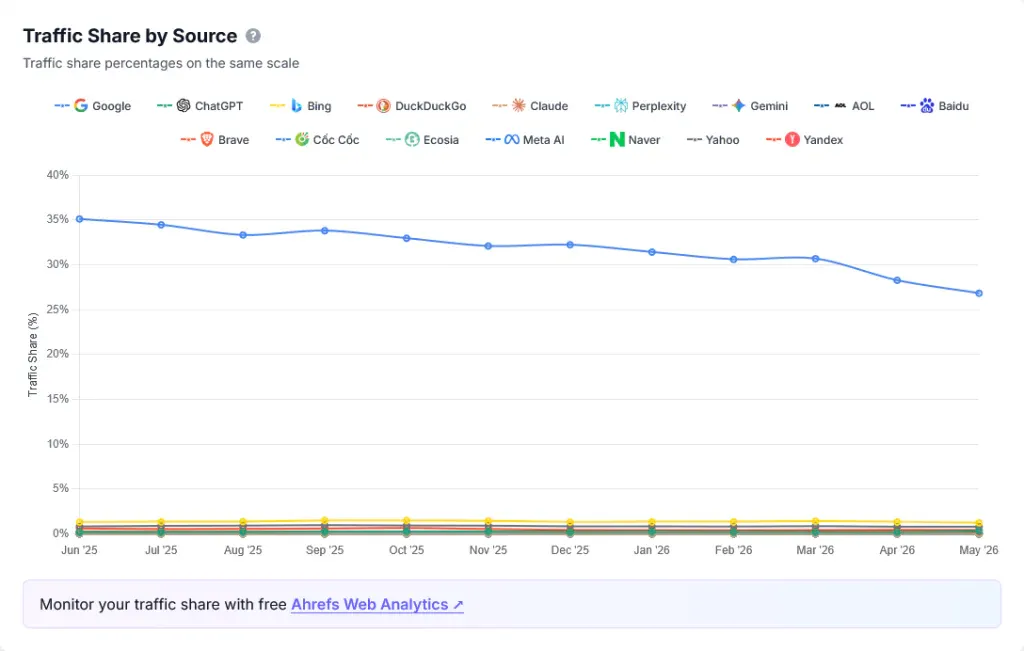
- Google’s share of traffic to the tracked sites fell 8 percentage points from June 2025 to May 2026, a drop of about 22% (SparkToro, Jun 2026).
- AI Overviews now appear on more than 20% of searches (SparkToro, Jun 2026).
- An AI Overview correlates with a 58% lower average click-through rate for the top-ranking page (Ahrefs, Feb 2026).
- Use of ChatGPT and similar tools for local recommendations rose from 6% to 45% in a year, making it the third most popular source of business recommendations (BrightLocal, Feb 2026).
- Only 35% of small and midsize businesses have a Google Business Profile (BrightLocal, Feb 2026).
How much do people search for law firms by name?
Morgan & Morgan drew an estimated 402,100 monthly branded searches in December 2025, the most of any personal injury firm in Hennessey’s study (Hennessey Digital, Feb 2026).
- Franklin Azar was next at an estimated 96,900 monthly branded searches (Hennessey Digital, Feb 2026).
Online Reviews: The Bar Keeps Rising
A review is the first proof a stranger sees. Ratings, volume and recency all count, and the bar moved up in a single year.
Do legal consumers read reviews before they call?
62% of people researching lawyers check up to five different review sites (Scorpion, Aug 2025).
- 55% read six or more reviews (Scorpion, Aug 2025).
- Consumers weigh the average star rating highest at 54.1% and the number of reviews at 53.7% (Martindale-Avvo, Dec 2023).
- 40.1% weigh how recent the reviews are (Martindale-Avvo, Dec 2023).
- 46% of consumers who got a referral checked the lawyer’s reviews before making contact (Martindale-Avvo, Jan 2020).
- 41% of all consumers now say they always read reviews when browsing for a business, up from 29% (BrightLocal, Feb 2026).
What star rating do consumers expect?
68% of consumers will only use a business rated four or more stars, up from 55% in 2025 (BrightLocal, Feb 2026).
- 53% of legal consumers will not consider a firm rated below four stars, up from 42% in 2024 (Scorpion, Aug 2025).
- Only 10% of consumers say they will use only five-star businesses (BrightLocal, Feb 2026).
- 37.5% of consumers named negative online reviews as a reason not to hire a lawyer (Martindale-Avvo, Dec 2023).
- One third of legal consumers see awards and recognition as a sign of quality, and 43% value case studies or success stories (Scorpion, Aug 2025).
How many reviews does a firm need, and how recent?
47% of consumers will not use a business with fewer than 20 reviews (BrightLocal, Feb 2026).
- Only 9% would use a business with five or fewer reviews (BrightLocal, Feb 2026).
- 74% look for reviews written in the last three months (BrightLocal, Feb 2026).
- 32% look for reviews from the last two weeks, up from 20% a year earlier (BrightLocal, Feb 2026).
- Review recency is the 11th most influential local pack and Maps ranking factor (Whitespark, Dec 2025).
Should firms ask for reviews and answer them?
89% of consumers expect business owners to respond to reviews (BrightLocal, Feb 2026).
- 80% say they are likely to use a business that responds to all of its reviews (BrightLocal, Feb 2026).
- Templated or generic responses make 50% of consumers unlikely to choose a business (BrightLocal, Feb 2026).
- 19% expect a reply to their review on the same day, up from 6% a year earlier (BrightLocal, Feb 2026).
- 83% of people asked to leave a review went on to leave one (BrightLocal, Feb 2026).
- 11% of consumers were offered an incentive to write a positive review, which BrightLocal says would draw a fine under the FTC’s rule (BrightLocal, Feb 2026).
How Consumers Choose a Lawyer: They Compare a Few and Decide Fast
People compare a short list, decide within days and weigh price and reputation. A firm that is slow or silent drops out early.
How many firms do people contact before they hire?
65% of legal consumers contact two to five firms before deciding (Scorpion, Aug 2025).
- 75% contact no more than five firms (Scorpion, Aug 2025).
- 78.9% of consumers who hired a lawyer contacted more than one attorney first (Martindale-Avvo, Dec 2023).
- Among consumers in England and Wales who shopped around, the most common number of providers looked at was three, at 42% (Legal Services Consumer Panel, Jul 2024).
- Shopping around is highest for housing problems as a tenant, at 55%, and lowest for criminal charges, at 23% (Legal Services Consumer Panel, Jul 2026).
How fast do people decide?
42% of legal consumers decide in less than four days (Scorpion, Aug 2025).
- 50% made a hiring decision within a week of learning they needed a lawyer, and 3 in 10 hired within 3 days (Martindale-Avvo, Dec 2023).
- 69% of consumers in England and Wales took a week or less to choose a provider (Legal Services Consumer Panel, Jul 2026).
- 84.8% of consumers planning to talk to a lawyer called their matter extremely or somewhat urgent (Martindale-Avvo, Dec 2023).
- About 80% want to meet in person before committing to a hire (Martindale-Avvo, Dec 2023).
What matters most when people pick a lawyer?
A regulated provider, a good reputation and a fair price lead the list, at 91%, 89% and 86% (Legal Services Consumer Panel, Jul 2026).
- Specialism came next at 83% and speed at 81% (Legal Services Consumer Panel, Jul 2026).
- Being regulated, being a specialist and explaining things clearly would raise trust for 90%, 89% and 88% of consumers (Legal Services Consumer Panel, Jul 2025).
- Cost is the top reason not to hire, at 46.6%, followed by slow response at 46.2% (Martindale-Avvo, Dec 2023).
- The hiring rate among consumers who set out to hire a lawyer fell from 52.8% in 2022 to 33.7% in 2023 (Martindale-Avvo, Dec 2023).
- 95% of consumers in England and Wales were confident in their choice, and 73% rated the service good value for money (Legal Services Consumer Panel, Jul 2026).
Referrals and Directories: Word of Mouth Still Gets Checked Online
Referrals still start many hires. But the referred firm gets checked online, and some referrals go to a rival.
How much do referrals drive new clients?
Over half of SRA-regulated firms ranked repeat business or word of mouth as their most important source of new instructions (Solicitors Regulation Authority, Oct 2023).
- Referrals from third parties and website enquiries ranked first for only 9% and 8% of those firms (Solicitors Regulation Authority, Oct 2023).
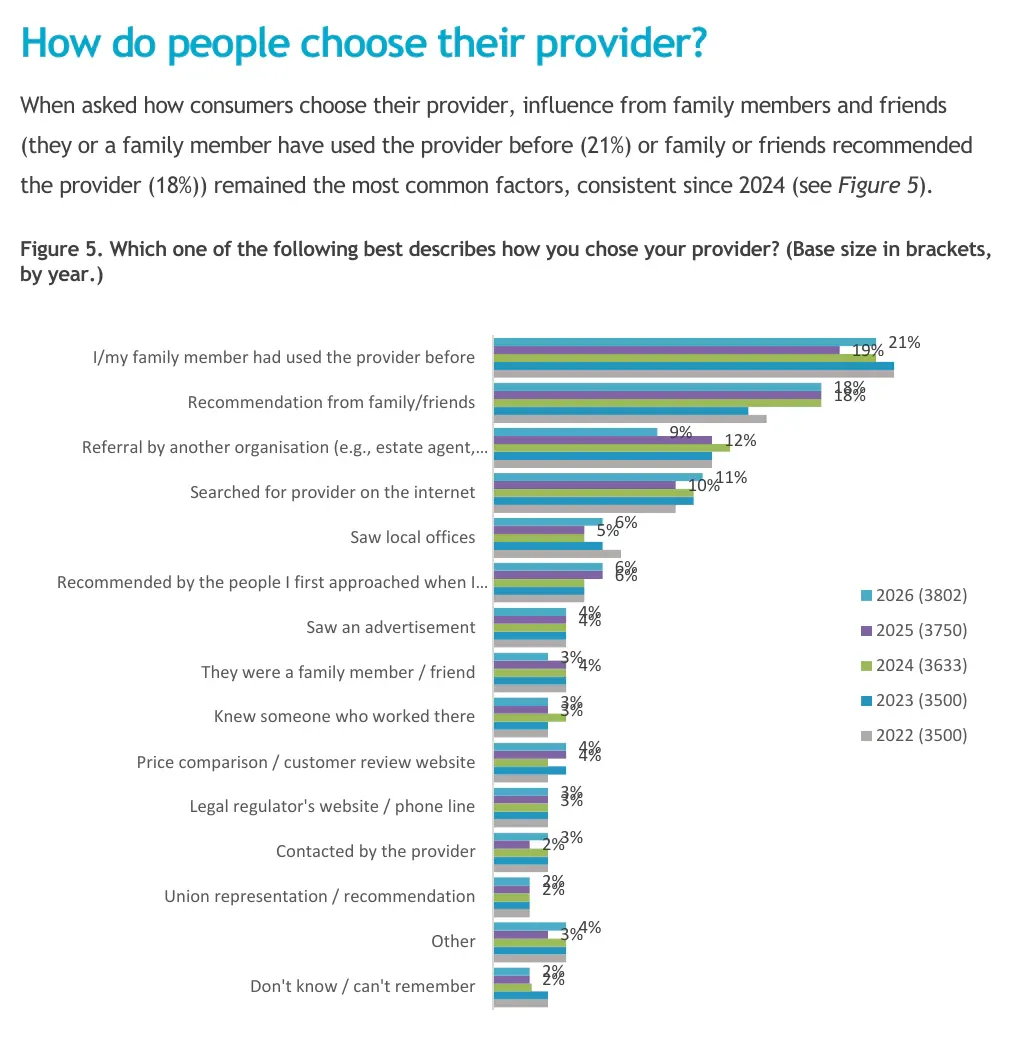
- Past use by the consumer or a family member was the most common way people chose a provider, at 21%, and a family or friend recommendation followed at 18% (Legal Services Consumer Panel, Jul 2026).
- 39.0% of consumers got an attorney recommendation, and 61.0% got none (Martindale-Avvo, Dec 2023).
- Of consumers who got a recommendation, only 41% hired the recommended attorney, and 32% chose someone else (Martindale-Avvo, Jan 2020).
- 45% of people who got a referral checked the recommended firm’s website before making contact (Martindale-Avvo, Jan 2020).
Do legal directories and comparison sites matter?
Few consumers use them: 8% of individuals and 11% of small businesses used online customer review websites when searching for a solicitor (Solicitors Regulation Authority, Oct 2023).
- 6% of individuals and 5% of small businesses used online price comparison tools (Solicitors Regulation Authority, Oct 2023).
- Only 4% of SRA-regulated firms supply price and service information to price comparison websites (Solicitors Regulation Authority, Oct 2023).
- 33% of lawyers surveyed had claimed their Avvo profile, and 61% of them did so to be more discoverable by search engines (ABA TechReport 2023, Jan 2024).
Law Firm Websites: Most Firms Have One, Few Use It to Convert
A site is the default proof that a firm exists. Most sites say who the lawyers are, but fewer say what a case costs or what happens next.
How many law firms have a website?
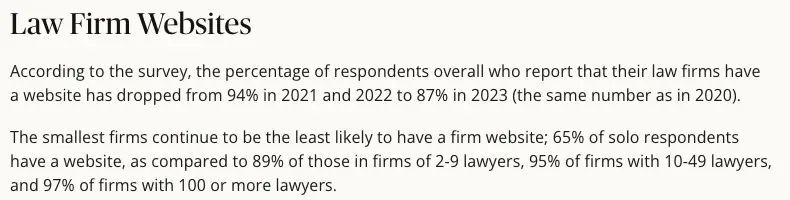
87% of respondents’ firms had a website in 2023, down from 94% in 2021 and 2022 (ABA TechReport 2023, Jan 2024).
- By the next survey the share was 90%, against 94% in 2022, and 100% of firms with 100 or more attorneys had a site (ABA TechReport 2024, Apr 2025).
- Solo firms with a website rose from 53% in 2021 to 70% in 2024 (ABA Solo and Small Firm TechReport 2024, Apr 2025).
- 88% of SRA-regulated firms said they have a website, and 11% said they do not (Solicitors Regulation Authority, Oct 2023).
What do law firm websites include?
Lawyer profiles are near universal: 96% of firm sites include partner profiles (ABA TechReport 2023, Jan 2024).
- 54% include legal articles written in-house, down from 62% in 2022, and only 15% include consumer guides written in-house (ABA TechReport 2023, Jan 2024).
- The most common information firms collect through their sites is names, at 90%, then phone numbers, at 73%, and email addresses, at 42% (ABA TechReport 2023, Jan 2024).
- Just 30% of law firm websites give clear guidance on the hiring process, and 14% show pricing information (Clio, Oct 2024).
- 48% of legal consumers reject websites with poor visuals, and 30% actively look for dynamic content such as videos (Scorpion, Aug 2025).
- Consumers say the information they find most helpful in choosing a lawyer is responsiveness at 61.5%, then pricing and fees at 56.8% (Martindale-Avvo, Dec 2023).
A clear next step usually ends in paperwork. A page that explains the fee and the steps works better when a plain agreement is ready to send, such as an attorney retainer agreement or a lawyer engagement letter.
Do law firm websites help people book and chat?
Only 15% of respondents’ websites let a prospect schedule an initial consultation (ABA TechReport 2023, Jan 2024).
- 23% of solo firms and 18% of small firms offer online scheduling through their websites (ABA Solo and Small Firm TechReport 2024, Apr 2025).
- 81% of respondents’ firms do not offer live chat, and 53% do not offer clients a secure client portal (ABA TechReport 2023, Jan 2024).
- 51% of legal consumers would not hire a firm that has no online chat, and 65% prefer firms with secure client portals (Scorpion, Aug 2025).
- 61% of the law firm sites Hennessey checked had a chat feature in 2024, and 10% offered texting as a contact option (Hennessey Digital, Jun 2024).
- 51% of clients find chatbots useful for exploring legal options, but 67% still want to be able to speak with a human (Clio, Oct 2024).
Are law firm sites mobile friendly and secure?
74% of respondents said their firm’s website is mobile friendly, and another 20% did not know (ABA TechReport 2023, Jan 2024).
- Only 44% said their site used SSL security, and 48% did not know (ABA TechReport 2023, Jan 2024).
Do websites win clients?
35% of respondents reported a client retaining their firm directly through its website, up from 25% in 2022 (ABA TechReport 2023, Jan 2024).
- One third of respondents’ firms have a blog, and 29% of those firms say clients retained them directly or by referral from it (ABA TechReport 2023, Jan 2024).
- 41% of SRA-regulated firms with a website believe only 1% to 15% of their clients used it before instructing them (Solicitors Regulation Authority, Oct 2023).
- 72% of individuals who wanted price information and looked at their solicitor’s website found it, and 23% looked but could not (Solicitors Regulation Authority, Oct 2023).
- 57% of consumers said their bill was a fixed fee, and 10% said it was hourly (Legal Services Consumer Panel, Jul 2025).
Social Media, Video and Email: Wide Reach, Thin Use
Lawyers post where other lawyers are. Clients are on YouTube and Facebook, and many notice a feed that has gone quiet.
Which social platforms do law firms use?
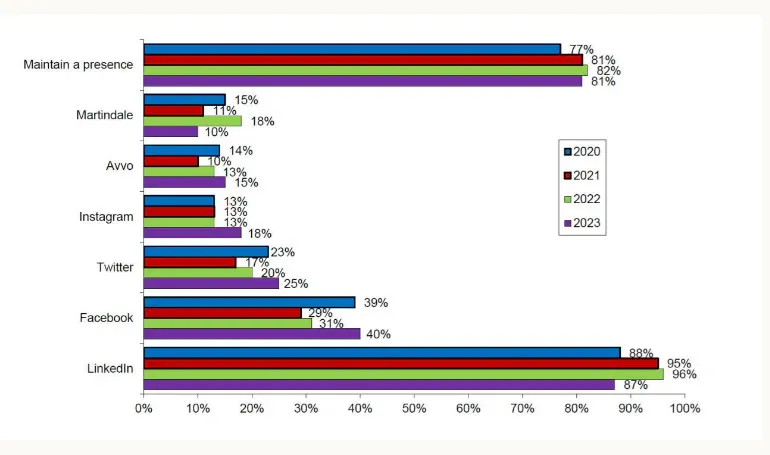
80% of respondents’ firms use social media as a marketing tool, down from 89% in 2022 (ABA TechReport 2024, Apr 2025).
- LinkedIn is the main platform at 76%, followed by Facebook at 53% (ABA TechReport 2024, Apr 2025).
- Among firms with a social presence in 2023, 83% were on LinkedIn, 57% on Facebook and 33% on Twitter (ABA TechReport 2023, Jan 2024).
- 70% of solo attorneys maintain a LinkedIn presence and 63% a Facebook presence (ABA Solo and Small Firm TechReport 2024, Apr 2025).
- 31% of lawyers who use social media for professional purposes report a client retaining them through it, directly or by referral (ABA TechReport 2023, Jan 2024).
Where are potential clients online?
84% of US adults say they ever use YouTube, and 71% use Facebook (Pew Research Center, Nov 2025).
- Half of US adults use Instagram, and 37% use TikTok, up from 21% in 2021 (Pew Research Center, Nov 2025).
- Neglected social feeds lead 49% of prospects, and 53% of those in Gen X and older groups, to dismiss a firm outright (Scorpion, Aug 2025).
How common are video, email and offline channels?
30% of respondents’ firms produce video to market the practice, up from 24% in 2020 (ABA TechReport 2023, Jan 2024).
- 52% of potential clients look for videos that explain a law firm’s services before deciding (Scorpion, Aug 2025).
- Email marketing is used by 32% of respondents’ firms, and 66% of those that use it send client alerts (ABA TechReport 2023, Jan 2024).
- 35% of firms sponsor or attend events, 16% use print marketing and 12% use direct mail (ABA TechReport 2023, Jan 2024).
Intake and Response Time: Where Legal Marketing Money Is Lost
A lead costs real money, and a slow reply wastes it. The data shows that fast answers are rarer than they should be.
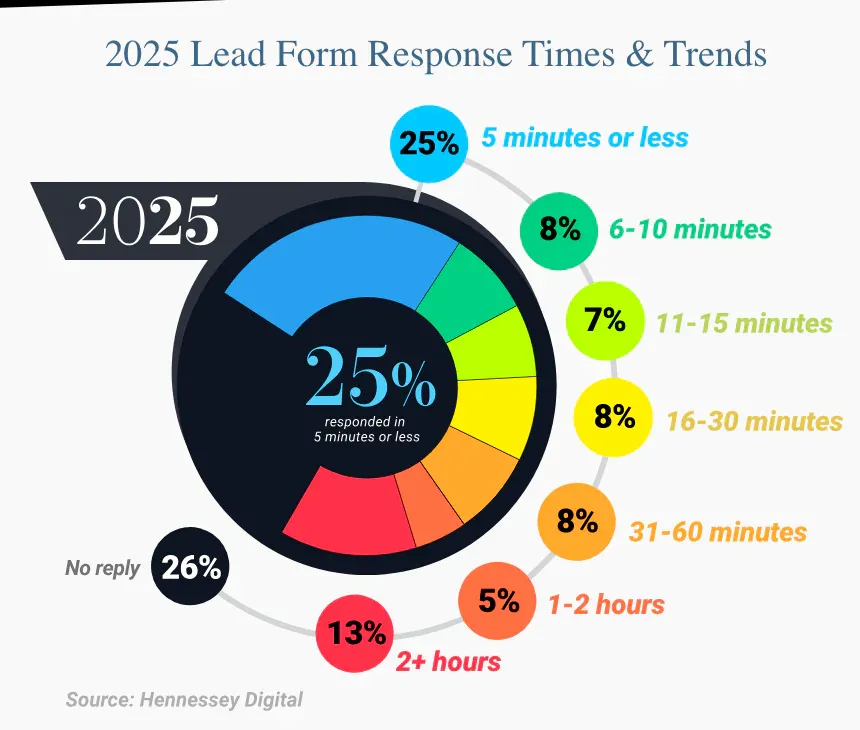
How fast do law firms answer online leads?
The median response time to online leads was 13 minutes in 2025 (Hennessey Digital, Jun 2025).
- 74% of law firms responded within seven days, against 59% in 2021 (Hennessey Digital, Jun 2025).
- 33% responded within 10 minutes, and 56% within the hour (Hennessey Digital, Jun 2025).
- In 2024, 27% of firms did not respond to the inquiry at all (Hennessey Digital, Jun 2024).
- 93% of the email replies Hennessey received in 2024 were personalized (Hennessey Digital, Jun 2024).
- In 2022, only 17% of firms replied within 10 minutes and 13% used all four contact methods tracked (Hennessey Digital, Apr 2022).
How many calls and emails go unanswered?
Only 40% of firms answered a secret shopper’s phone call in 2024, down from 56% in 2019 (Clio, Oct 2024).
- 48% of firms were essentially unreachable by phone (Clio, Oct 2024).
- Of the firms that replied to email, 84% did so within eight hours (Clio, Oct 2024).
- Just 18% of email replies gave clear next steps or cost information, and only 2% referenced similar cases (Clio, Oct 2024).
- On the phone, 41% of firms offered rate information, 12% gave cost estimates and 36% explained the legal process (Clio, Oct 2024).
- 73% of secret shoppers were unlikely to recommend the firms they contacted, though 39% said they would recommend firms they spoke with directly (Clio, Oct 2024).
- Firms with online client intake tools have 50% more incoming potential clients and earn 50% more revenue on average (Clio, Oct 2024).
Clear next steps and a stated fee are what the secret shoppers rarely got. A ready fee agreement is the simplest way to give them, and it can go out with the first reply.
How long will a prospect wait?
Over a third of legal consumers expect a same-day callback (Scorpion, Aug 2025).
- Over 80% of consumers will contact another attorney if they do not hear back in 48 hours (Martindale-Avvo, Dec 2023).
- 40.4% will contact another attorney if they do not hear back in 24 hours, and 18.6% would wait 8 hours or less (Martindale-Avvo, Dec 2023).
- Text messaging as a reply method grew only 5% from 2021 to 2025, which Hennessey ties to stricter consent rules for business texts (Hennessey Digital, Jun 2025).
Glossary
- AI Overview: an AI-written summary that Google shows above the normal search results.
- Branded search: a search that includes a firm’s or lawyer’s name.
- CMS: content management system, the software that runs a website, such as WordPress.
- CPC: cost per click, what an advertiser pays when someone clicks an ad.
- CPL: cost per lead, what an advertiser pays for each contact from an ad.
- CTR: click-through rate, the share of people who see an ad or result and click it.
- CVR: conversion rate, the share of clicks that become leads.
- Intake: the steps from a first contact to a signed client.
- Local pack: the map and the three or so local listings Google shows for a local search.
- Secret shopper: a researcher who contacts firms while posing as a client.
- SEO: search engine optimization, the work of earning visibility in search results.
- SME and SMB: small and medium-sized enterprise, or small and midsize business.
- SRA: the Solicitors Regulation Authority, the regulator of solicitors in England and Wales.
- SSL: the security layer behind HTTPS web addresses.
- Zero-click search: a search that ends without a click to any website.
Methodology and Sources
Each figure comes from the organization that ran the survey or study, and each link goes to the report or page that holds the number. Stats were pulled from bar association tech surveys, a regulator, a consumer panel, ad and search platform data, and original studies by legal marketing firms. Several of those firms sell marketing services, and the American Tort Reform Association is an advocacy group, so those figures are named as their own estimates. Survey groups differ: BrightLocal asked US consumers about local businesses in general, Martindale-Avvo surveyed people who had used its own legal sites, and the Legal Services Consumer Panel and the Solicitors Regulation Authority cover England and Wales. Older studies are marked with their dates and used only where no newer figure exists. This page reports statistics and is not legal advice. It is refreshed monthly.
Sources
- ABA TechReport 2023: 2023 Websites & Marketing TechReport, American Bar Association
- ABA TechReport 2024: 2024 Websites and Marketing TechReport, American Bar Association
- ABA Solo and Small Firm TechReport 2024, American Bar Association
- Clio, Legal Trends Report press release, October 2024
- Hinge Marketing, 5 Takeaways from the 2024 High Growth Study, Law Firm and Legal Services Edition
- Hinge Marketing, The State of Legal Marketing in 2025
- Legal Marketing Association and Above the Law, 2025 Legal Marketing Decision-Makers Survey
- WordStream by LocaliQ, 2026 Search Advertising Benchmarks
- American Tort Reform Association, Legal Services Advertising in the United States 2020 to 2024
- SparkToro, In 2026, Less than One Third of Google Searches Still Send a Click
- Ahrefs, Update: AI Overviews Reduce Clicks by 58%
- Whitespark, 7 Local Search Ranking Factors That May Challenge Your Current Thinking
- BrightLocal, Local Consumer Review Survey 2026
- Scorpion, 2025 Legal Consumer Insights Report
- Martindale-Avvo, Understanding the Legal Consumer 2023
- Martindale-Avvo, Three Things to Know About Legal Consumers
- Martindale-Avvo, How Do Clients Research and Find Their Attorneys
- Legal Services Consumer Panel, How consumers are choosing legal services 2026
- Legal Services Consumer Panel, 2025 Tracker Survey press release
- Legal Services Consumer Panel, How consumers are choosing legal services 2024
- Solicitors Regulation Authority, Year Three Evaluation of the SRA Transparency Rules
- Hennessey Digital, 2025 Lead Form Response Time Study
- Hennessey Digital, 2024 Lead Form Response Time Study
- Hennessey Digital, 2022 Law Firm Response Time Study
- Hennessey Digital, 2022 State of Law Firm Website Rankings
- Hennessey Digital, 2025 Branded Organic Search Traffic Study
- Pew Research Center, Americans’ Social Media Use 2025
- Federal Trade Commission, A warning letter (or ten) for businesses: comply with the FTC’s Consumer Review Rule