Gig economy statistics tell two stories at once. Many people try gig work, far fewer live on it, and the rules for pay and worker status are changing faster than the data.
This page covers app and platform work: rides, delivery, errands and online marketplaces. It puts the share of workers, growth, market size, earnings, hours, worker classification, benefits and protections in one place. Every figure links to the group that produced it, with the date of the data. General freelancer pay, invoicing and self-employed income are covered on other pages.
Many of the newest items are legal changes. This page reports them as the sources state them. It is not legal advice, and a statistic about a court case or a law does not tell you how that rule applies to your own work.
Key Takeaways
- One in five U.S. adults did some gig activity in the prior month. 20% of adults performed gig activities, most of them not on an app (Federal Reserve, May 2025).
- 16% of Americans have ever earned money on an online gig platform (Pew Research Center, Dec 2021).
- The World Bank puts online gig workers at 154 million to 435 million, or 4.4% to 12.5% of the global labor force (World Bank, Sep 2023).
- Uber had 9.7 million monthly drivers and couriers in Q4 2025, who took home more than $24 billion in that quarter (Uber, Feb 2026).
- Over 9 million people dashed for DoorDash in 2025, earning over $20 billion in total (DoorDash, Feb 2026).
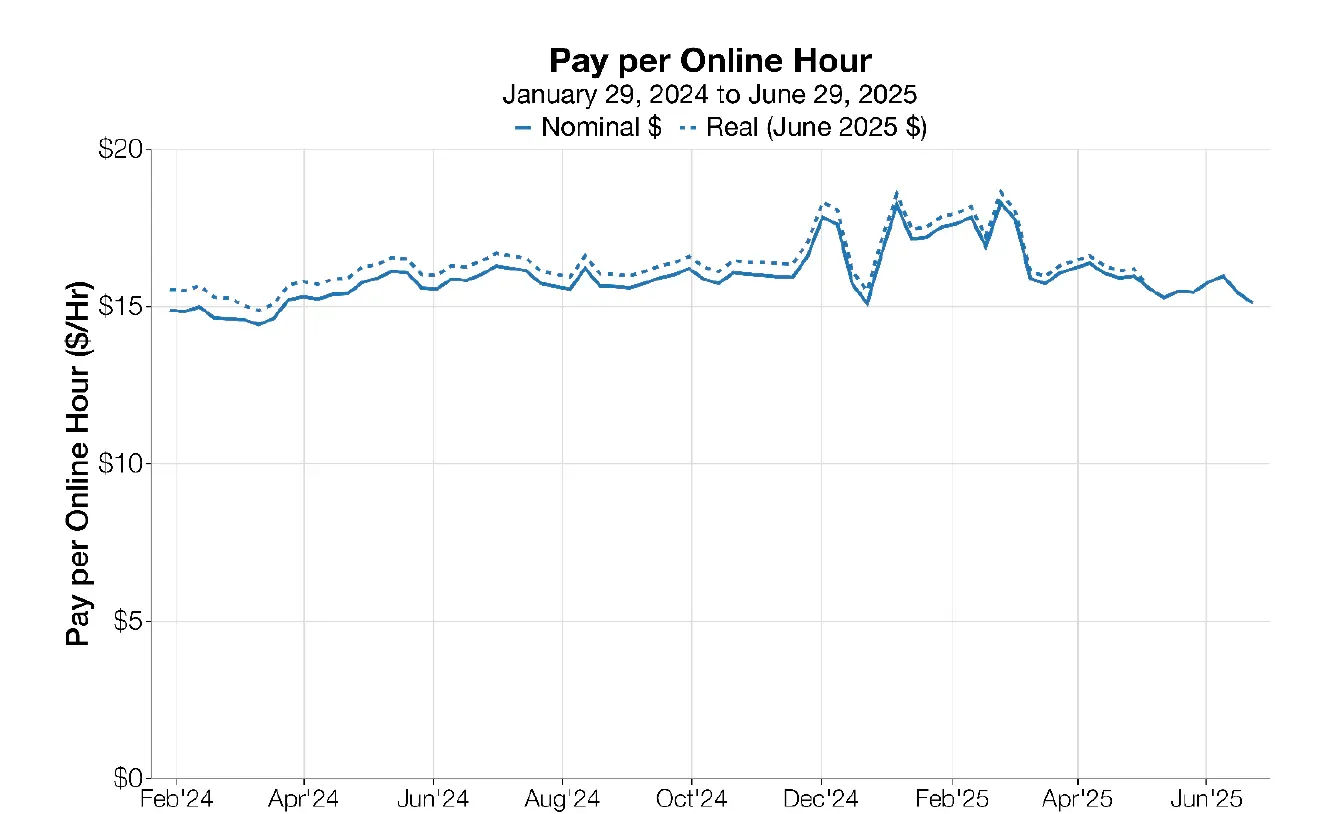
- Seattle delivery workers averaged $15.98 an hour for time logged on, before tips (Seattle Office of Labor Standards, Apr 2026).
- Rideshare customer prices rose nearly 10% in 2025, while driver gross pay per hour rose 4.1% (Gridwise, Mar 2026).
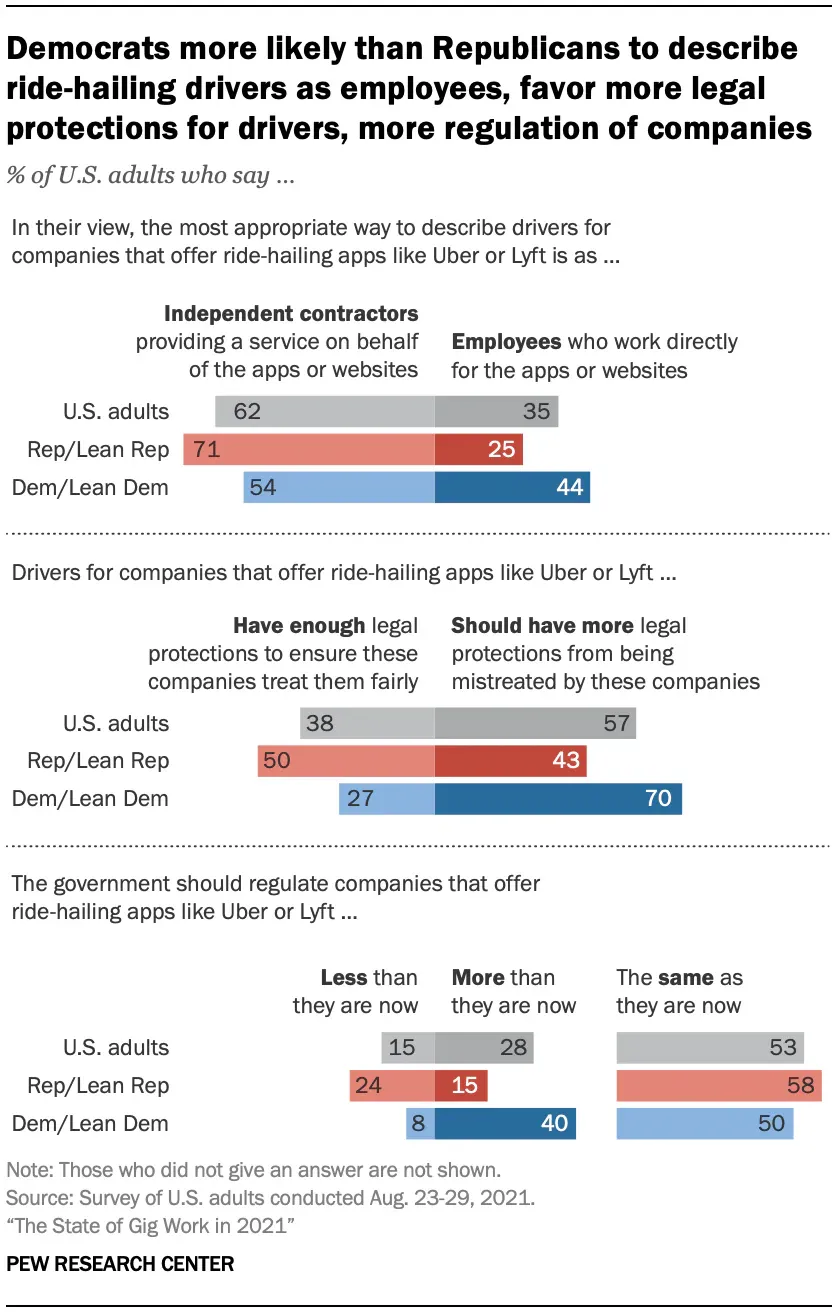
- 62% of Americans call ride-hailing drivers independent contractors, and 35% call them employees (Pew Research Center, Dec 2021).
- The ILO adopted the first global convention on platform work in June 2026, and it covers workers whatever their status (ILO, Jun 2026).
- Massachusetts set a $32.50 an hour pay standard for Uber and Lyft drivers in a $175 million settlement (Massachusetts Attorney General, Jun 2024).
- Brazil counted 1.7 million people working through digital platforms in Q3 2024, or 1.9% of private-sector workers (IBGE, Oct 2025).
- Mexico moved 1.2 million platform workers into social security in 2025 (Government of Mexico, Aug 2025).
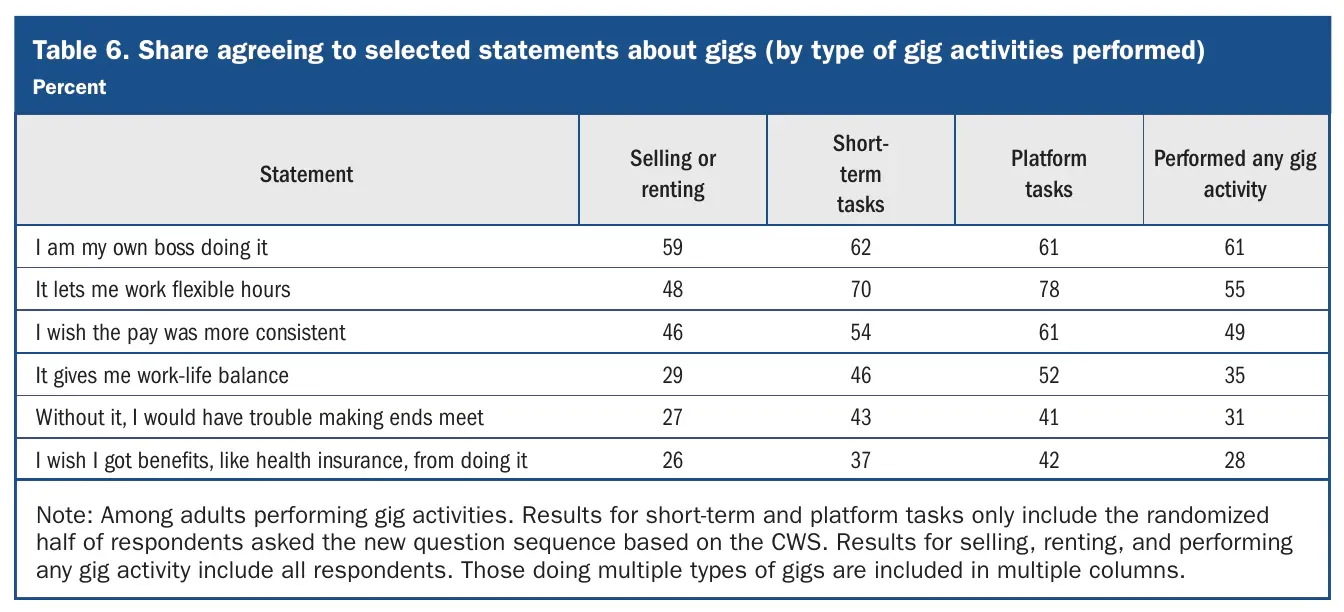
- 28% of U.S. gig workers wish they got benefits such as health insurance from gig work (Federal Reserve, May 2025).
- The EU platform work directive applies its employment presumption from 2 December 2026 (EUR-Lex, Oct 2024).
How Many Americans Do Gig Work?
The answer depends on the definition. Selling used clothes online and driving for an app both count as gig work in some surveys, so check what a number measures before you quote it.
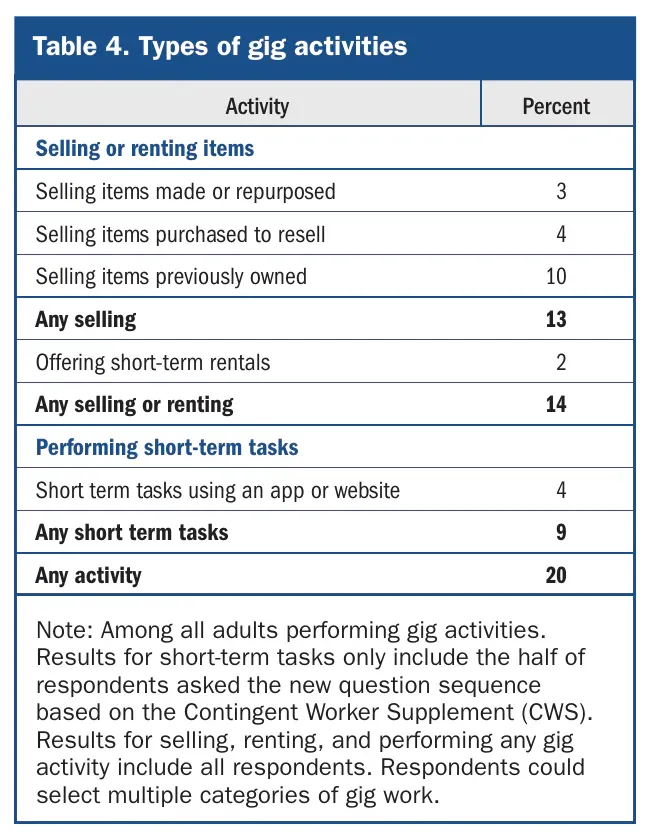
What kinds of gig work do Americans do?
Most gig activity is selling things, not working through an app. 13% of adults sold items in the prior month, and most sellers said this included previously owned items such as used clothing (Federal Reserve, May 2025).
- 9% did short-term tasks such as handyman or driving work (Federal Reserve, May 2025).
- 4% did short tasks they found through an app or website, such as ride-sharing or delivery (Federal Reserve, May 2025).
- 3% sold things they made, and 2% offered short-term rentals (Federal Reserve, May 2025).
How many people have earned money on a gig platform?
In Pew’s 2021 survey, 9% of U.S. adults had earned money on an online gig platform in the past year, made up of 4% who were doing it at the time and 5% who had done it earlier that year (Pew Research Center, Dec 2021).
- 7% had ever made restaurant or store deliveries through a delivery app (Pew Research Center, Dec 2021).
- 5% had ever driven for a ride-hailing app (Pew Research Center, Dec 2021).
- 3% had ever used a personal vehicle to deliver packages through an app or website (Pew Research Center, Dec 2021).
Is gig work a main job or a side job?
For most people it is a side job. Only 21% of people who did gig activities called gig work their main job (Federal Reserve, May 2025).
- 51% of gig workers had a main job that was not a gig (Federal Reserve, May 2025).
- 31% of current or recent platform workers said gig work was their main job in the past year, which equals 3% of all U.S. adults (Pew Research Center, Dec 2021).
- 28% of people who did gig activities said they were not working for pay or profit, even though they earned money from gigs (Federal Reserve, May 2025).
Do official labor statistics track app-based work?
Not yet in a published release. The July 2023 supplement to the Current Population Survey asked about digital platform (app-based) work, but the Bureau of Labor Statistics left those estimates out of its November 2024 release and said it plans to publish them later (U.S. Bureau of Labor Statistics, Nov 2024).
Gig Economy Workers Statistics: Who Does Platform Work?
Gig work in U.S. surveys skews young, Hispanic and lower income. It is also a common fit for students and parents who need flexible hours.
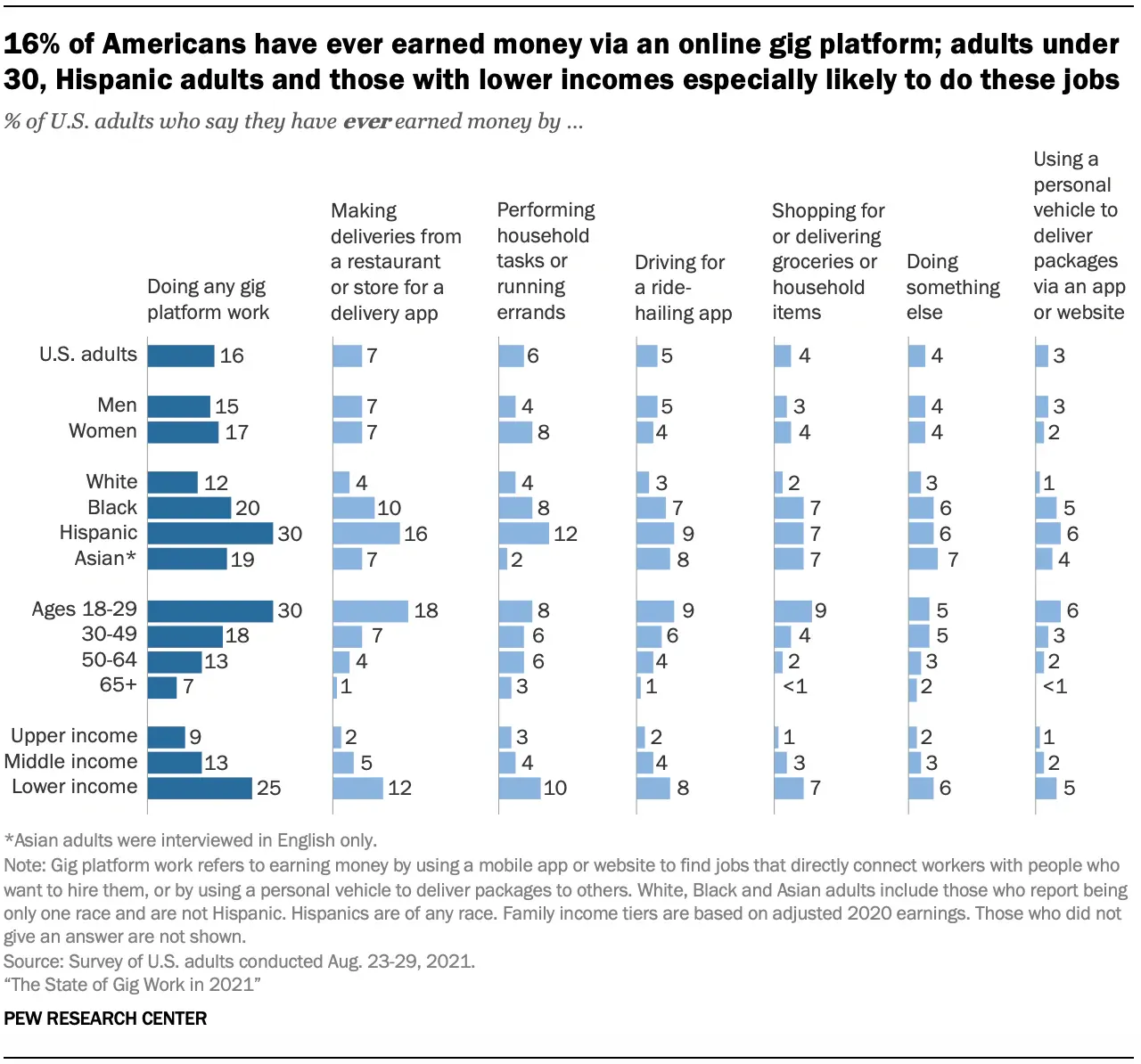
How does gig work vary by age?
Younger adults do the most of it. 26% of adults ages 18 to 29 did a gig activity in 2024, compared with 12% of adults 60 and older (Federal Reserve, May 2025).
- 30% of adults ages 18 to 29 have ever earned money on a gig platform, against 18% of adults 30 to 49 (Pew Research Center, Dec 2021).
- 13% of adults 50 to 64 and 7% of adults 65 and older have done so (Pew Research Center, Dec 2021).
- More than half of online gig workers worldwide are under 30 (World Bank, Sep 2023).
Which groups are more likely to do gig work?
Hispanic adults stand out in both surveys. 24% of Hispanic adults did gig activities in 2024, compared with 19% of White adults, 19% of Black adults and 17% of Asian adults (Federal Reserve, May 2025).
- 30% of Hispanic adults have ever earned money on a gig platform, against 20% of Black adults, 19% of Asian adults and 12% of White adults (Pew Research Center, Dec 2021).
- 30% of students and 26% of parents of young children did gig work, compared with 19% of non-students (Federal Reserve, May 2025).
- 21% of men and 19% of women did gig activities (Federal Reserve, May 2025).
How does income shape who relies on gig work?
Lower-income adults are far more likely to have tried it. 25% of lower-income adults have ever earned money on a gig platform, compared with 13% of middle-income and 9% of upper-income adults (Pew Research Center, Dec 2021).
- 42% of lower-income current or recent platform workers said it was their main job over the past year, equal to 7% of all lower-income adults (Pew Research Center, Dec 2021).
- 71% of lower-income current or recent gig workers said the money was at least important for meeting basic needs, against 45% of middle-income workers (Pew Research Center, Dec 2021).
- 31% of gig workers said they would have trouble making ends meet without gig income (Federal Reserve, May 2025).
Gig Economy Growth Statistics: How Fast Are Platforms Growing?
Growth is real but uneven. Ride and delivery platforms keep adding trips and earners, while some online freelance marketplaces are shrinking.
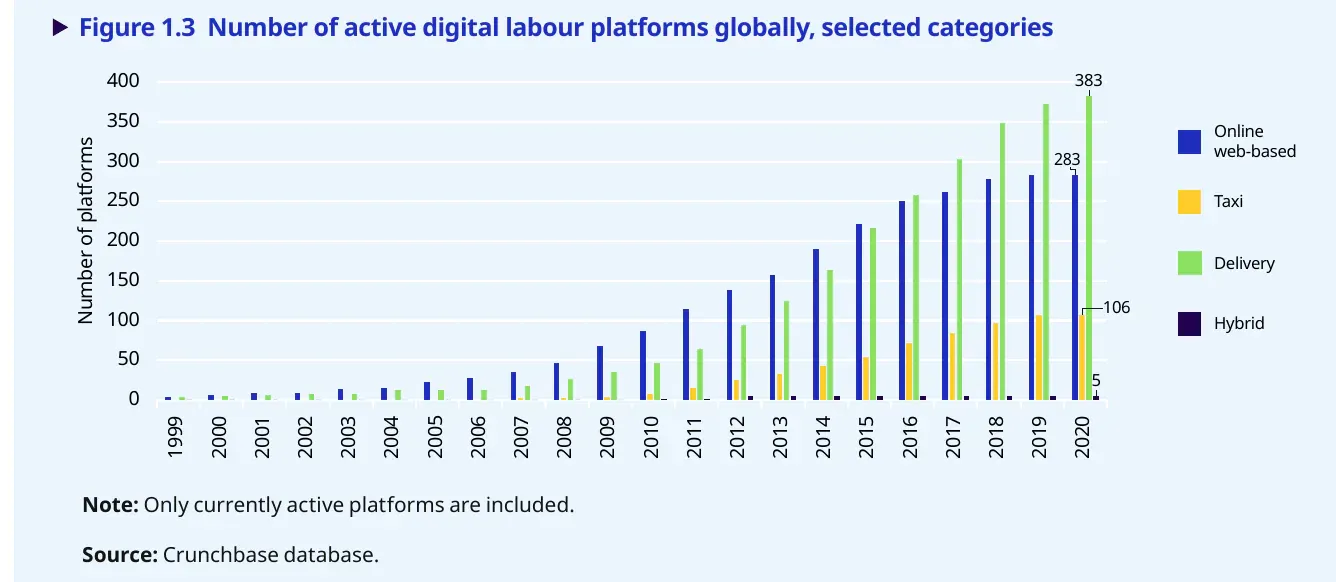
How many digital labour platforms exist?
The count has grown fivefold in a decade. Online web-based and location-based (taxi and delivery) platforms rose from 142 in 2010 to over 777 in 2020 (ILO, Feb 2021).
- Delivery had 383 platforms, online web-based work had 283 and taxi had 106 in January 2021 (ILO, Feb 2021).
- The number of online web-based platforms tripled over the decade, while taxi and delivery platforms grew almost tenfold (ILO, Feb 2021).
How big have the ride and delivery platforms become?
Uber alone booked $193.5 billion in 2025, up 19% from the year before (Uber, Feb 2026).
- Uber facilitated 13.6 billion trips in 2025, up 20% (Uber, Feb 2026).
- Uber’s CEO said more than 40 million trips are completed every day (Uber, Feb 2026).
- Lyft reported 945.5 million rides in 2025, up 14% (Lyft, Feb 2026).
- Lyft driver hours grew year over year for 12 consecutive quarters and have nearly doubled since the start of 2023 (Lyft, Feb 2026).
- DoorDash grew Marketplace gross order value 27% in 2025, or 23% without the Deliveroo acquisition (DoorDash, Feb 2026).
- Instacart orders grew 15% to 338.8 million in 2025, and gross transaction value grew 11% to $37.2 billion (Instacart, Feb 2026).
Are online freelance marketplaces growing too?
Not all of them. Upwork’s platforms enabled $4.0 billion of gross services volume in 2025, but its active clients fell 6% to 785,000 (Upwork, Feb 2026).
Is platform work growing outside the United States?
Yes, in several countries that measure it. Brazil had 1.3 million platform workers in Q4 2022, and the count grew 25.4% by Q3 2024 (IBGE, Oct 2025).
- India’s NITI Aayog estimated 7.7 million gig workers in 2020-21 and projected 23.5 million by 2029-30 (NITI Aayog, Jun 2022).
- Brazil’s Center-West and North regions grew by more than 50% between 2022 and 2024, while the Southeast grew 17.0% (IBGE, Oct 2025).
How Many Gig Workers Are There Worldwide?
Nobody counts global gig work the same way. Estimates run from thousands in one city to hundreds of millions worldwide depending on the method, so always state the method.
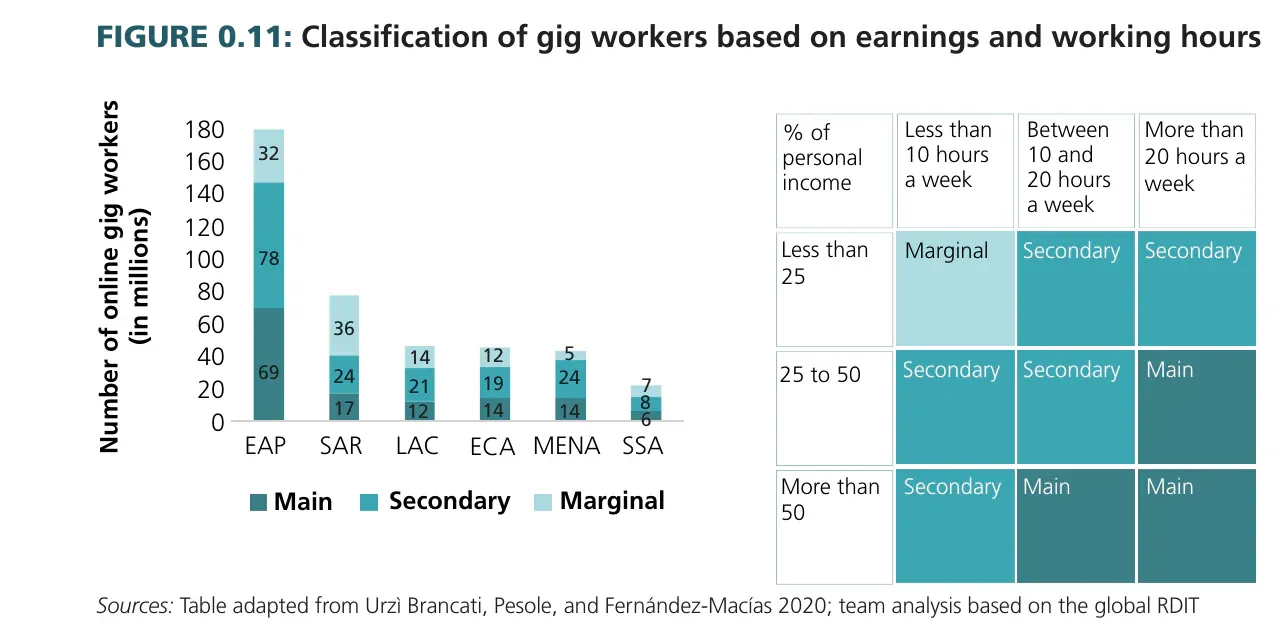
How does the World Bank split online gig workers?
Its 17-country survey, which excludes North America, estimates 132.5 million main, 173.7 million secondary and 106.2 million marginal online gig workers (World Bank, Sep 2023).
- For two in three online gig workers, gig work is a secondary occupation or done only sometimes (World Bank, Sep 2023).
- An earlier World Bank study in 2015 had estimated 48 million online gig workers (World Bank, Sep 2023).
How many platform workers are in the EU?
Platform work employed more than 28 million people in the EU in 2021, according to the European Parliament’s research service (European Parliament, Apr 2024).
- The same source projected the number would reach 43 million by 2025 (European Parliament, Apr 2024).
What do national and city counts show?
Counts that rely on administrative data are smaller and more exact. Seattle’s labor office counted 92,801 workers covered by its pay ordinance across the five largest delivery platforms in 18 months (Seattle Office of Labor Standards, Apr 2026).
- New York City’s labor agency counts 80,000 delivery workers (NYC DCWP, Jan 2026).
- Over 85% of Seattle app-based workers worked on only one app, for an average of 12 hours a week per app (Seattle Office of Labor Standards, Apr 2026).
- In Brazil, 53.7% of platform workers live in the Southeast region (IBGE, Oct 2025).
- In India, about 47% of gig work is in medium-skilled jobs, 31% in low-skilled jobs and 22% in high-skilled jobs (NITI Aayog, Jun 2022).
How Much Do Gig Workers Earn and How Many Hours Do They Work?
Per-trip pay looks fine until you count the time spent waiting. The best recent data comes from cities that force platforms to report it.
What do delivery workers earn per hour?
Pay depends on whether you count only active time or all time logged on. Seattle’s average base payment per engaged hour was $30.12 after subtracting mileage costs (Seattle Office of Labor Standards, Apr 2026).
- Pay for time online rose from $15.29 to $16.29 an hour between the first half of 2024 and the first half of 2025 (Seattle Office of Labor Standards, Apr 2026).
- Pay for time online ranged from $12.09 to $25.37 an hour depending on the company (Seattle Office of Labor Standards, Apr 2026).
- Before the ordinance, an outside analysis put pay for time online as low as $3.17 an hour (Seattle Office of Labor Standards, Apr 2026).
- New York City’s delivery minimum pay rate rises to $22.13 an hour before tips from 1 April 2026 (NYC DCWP, Jan 2026).
- The city says workers have taken home an extra $1.2 billion since it began enforcing the rate in 2023 (NYC DCWP, Jan 2026).
How is pay changing for rideshare and delivery drivers?
Platforms took more per trip in 2025. Platform fees per rideshare trip jumped over 33% (Gridwise, Mar 2026).
- Average rideshare bonus pay per quarter rose 32.9%, from $238.97 in Q4 2024 to $317.65 in Q4 2025 (Gridwise, Mar 2026).
- Rideshare tips hit a record $1.58 per trip, while delivery tips slipped to $4.16 per trip in Q4 2025 (Gridwise, Mar 2026).
- Delivery driver work hours rose 17.2% from Q4 2024 to Q4 2025, while gross pay per hour rose 3.2% (Gridwise, Mar 2026).
- Delivery tip frequency in Seattle fell from 92.8% in December 2023 to 44.1% in February 2024 (Gridwise, Mar 2026).
- In New York City it fell from 86.9% in November 2023 to 56.6% in January 2024 (Gridwise, Mar 2026).
What do online platform workers earn worldwide?
Much less than local ride and delivery workers. Average hourly earnings on online web-based platforms were $3.4, and half of those workers earned less than $2.1 an hour (ILO, Feb 2021).
- Freelance platform workers averaged $7.6 an hour, and microtask workers averaged $3.3 (ILO, Feb 2021).
- Online web-based workers put in 27 hours in a typical week, about eight of them unpaid (ILO, Feb 2021).
How many hours do gig workers work?
Few work full time at it. 96% of people who did gig activities said they usually spent less than 35 hours a week on them (Federal Reserve, May 2025).
- 70% spent less than 5 hours a week on gig activities (Federal Reserve, May 2025).
- 36% of current or recent platform workers worked 10 hours or more in a typical week, including waiting time, and 8% worked more than 30 hours (Pew Research Center, Dec 2021).
- Among workers who depend on the income, 46% spent at least 10 hours a week, compared with 24% of those who do not (Pew Research Center, Dec 2021).
Why do people take gig jobs?
Money first, flexibility second. 56% of current or recent platform workers named saving up extra money as a major reason, and 52% named covering gaps or changes in income (Pew Research Center, Dec 2021).
- 49% said being able to control their own schedule was a major reason (Pew Research Center, Dec 2021).
- 58% said the money was essential (23%) or important (35%) for meeting basic needs, and 39% said it was nice to have but not needed (Pew Research Center, Dec 2021).
- 49% of gig workers wish the pay was more consistent, rising to 61% among people who work through an app or website (Federal Reserve, May 2025).
Are Gig Workers Employees or Independent Contractors?
The label decides who pays for insurance, sick days and overtime. Courts and lawmakers are answering it differently, and the answer often depends on the platform and the place.
What do Americans and gig workers think?
Gig workers mostly agree with the public. 65% of platform workers see themselves as independent contractors, and 28% see themselves as employees (Pew Research Center, Dec 2021).
- 71% of Republicans and Republican leaners call ride-hailing drivers independent contractors, against 54% of Democrats and Democratic leaners (Pew Research Center, Dec 2021).
- 57% of Americans say ride-hailing drivers should have more legal protection from mistreatment, while 38% say they have enough (Pew Research Center, Dec 2021).
- 53% want government rules for ride-hailing companies kept as they are, 28% want more regulation and 15% want less (Pew Research Center, Dec 2021).
Where does the U.S. federal rule stand?
It is in flux. The Department of Labor published a final rule on 10 January 2024 that took effect on 11 March 2024 (U.S. Department of Labor, Jan 2024).
- On 26 February 2026 the Department announced a proposed rule to replace it, with comments open until 28 April 2026 (U.S. Department of Labor, Feb 2026).
- The SBA’s Office of Advocacy said the Department’s proposal to rescind the 2024 rule would save small businesses an estimated $2.31 billion over 10 years (SBA Office of Advocacy, Mar 2026).
- DoorDash tells investors that the vast majority of Dashers are independent contractors (DoorDash, Feb 2026).
How have U.S. states and courts handled it?
California voters backed contractor status for app drivers. Proposition 22 passed with 58.6% of the vote, and on 25 July 2024 all seven justices of the state Supreme Court held that its driver-classification section does not conflict with the state constitution (California Supreme Court, Jul 2024).
- Prop 22 requires 120% of the local minimum wage for each hour a driver spends driving, but not for time spent waiting (California Legislative Analyst’s Office, Nov 2020).
- Uber and Lyft agreed to pay a combined $328 million in back pay to New York drivers (New York Attorney General, Nov 2023).
- That settlement set a minimum of $26 an hour for drivers outside New York City (New York Attorney General, Nov 2023).
How are courts and lawmakers abroad ruling?
New Zealand’s Supreme Court held in November 2025 that four Uber drivers were employees, and all five judges reached that result (Employment New Zealand, Nov 2025).
- The majority gave no weight to contract language that disguises the real relationship, and it separated negotiated contracts from “take it or leave it” ones (Employment New Zealand, Nov 2025).
- The EU directive on platform work was adopted on 23 October 2024 and presumes an employment relationship where facts show direction and control (EUR-Lex, Oct 2024).
- The European Parliament’s research service said 5.5 million EU platform workers were potentially wrongly categorised as self-employed (European Parliament, Apr 2024).
- The ILO convention does not require platform workers to be classed as employees, and it does not ban self-employment (ILO, Jun 2026).
- Australia’s first minimum standards order for on-demand delivery workers started on 17 August 2026, with pay based on an hourly rate of at least $31.30 (Fair Work Ombudsman, Aug 2026).
In a contractor relationship, the written agreement is where scope, pay terms and termination are set out. A freelance contract usually covers those points.
What Pay Floors and Benefits Do Gig Workers Get?
Protections now come from place, not from the platform. The U.S. has no national floor for gig workers, so state, city and foreign rules fill the gap.
How many gig workers have health insurance?
Most do, mainly through another source. 88% of gig workers had health insurance, against 92% of adults who did no gig work (Federal Reserve, May 2025).
- 53% of gig workers had employer-provided coverage, against 56% of non-gig adults (Federal Reserve, May 2025).
- 42% of people who work through an app or website wish they got benefits such as health insurance (Federal Reserve, May 2025).
- 55% of platform gig workers said they were doing okay or living comfortably, against 75% of adults with no gig work (Federal Reserve, May 2025).
- 42% of platform gig workers had savings to cover three months of expenses, against 56% of other adults (Federal Reserve, May 2025).
- 46% of current or recent platform workers said companies had been unfair on benefits, while 50% said they had been fair (Pew Research Center, Dec 2021).
What do U.S. state and city rules require?
Several places now set pay and leave rules. Massachusetts guarantees minimum pay, paid sick leave, occupational accident insurance and health care stipends for Uber and Lyft drivers (Massachusetts Attorney General, Jun 2024).
- Prop 22 in California includes a quarterly health care subsidy for qualifying drivers and occupational accident insurance (California Supreme Court, Jul 2024).
- New York drivers earn one hour of paid sick leave for every 30 hours worked, up to 56 hours a year, under the 2023 settlements (New York Attorney General, Nov 2023).
- Washington State rideshare drivers have had minimum per mile, per minute and per trip rates, paid sick time and workers’ compensation since 1 January 2023 (Washington Labor and Industries, Jan 2023).
- From 26 January 2026, New York City grocery delivery apps such as Instacart must pay workers at least $21.44 an hour before tips (NYC DCWP, Jan 2026).
- Ontario’s Digital Platform Workers’ Rights Act, in force since 1 July 2025, gives platform workers the right to at least the general minimum wage (Government of Ontario, Jul 2025).
What protections exist outside the United States?
Singapore, India and Mexico have all added social security for platform workers. Singapore’s Platform Workers Act started on 1 January 2025 with CPF contributions, injury compensation and a framework for representation (Singapore Ministry of Manpower, Dec 2024).
- More than 8,000 older Singapore platform workers had opted in to higher CPF contributions as of December 2024 (Singapore Ministry of Manpower, Dec 2024).
- India’s Code on Social Security requires aggregators to pay 1% to 2% of annual turnover, capped at 5% of what they pay workers, into a social security fund (Government of India PIB, Dec 2025).
- Mexico’s IMSS pilot to enrol platform workers such as drivers and couriers began on 1 July 2025 (IMSS, Jul 2025).
- The ILO convention names social security, safety and health, and protection from violence and harassment among its topics (ILO, Jun 2026).
What Problems Do Gig Workers Report?
Rude treatment, safety worries and unclear pay lead the list. Regulators now treat misleading earnings claims as a legal issue, not just a complaint.
How often do gig workers feel unsafe or mistreated?
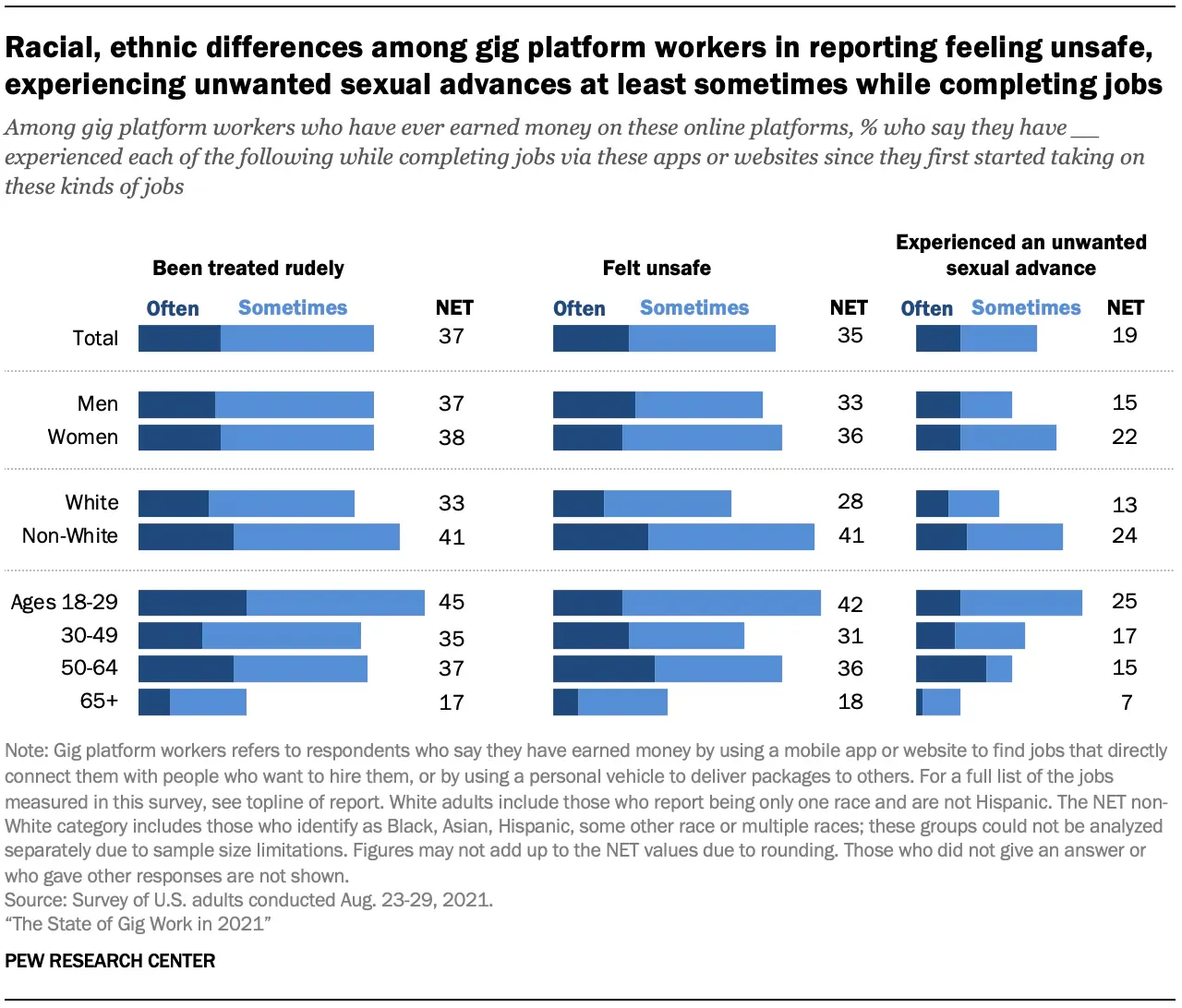
37% of people who have ever done gig platform work say they were treated rudely at least sometimes, and 13% say it happened often (Pew Research Center, Dec 2021).
- 35% say they often or sometimes felt unsafe while completing jobs (Pew Research Center, Dec 2021).
- 41% of non-White gig workers felt unsafe at least sometimes, against 28% of White gig workers (Pew Research Center, Dec 2021).
- About one in five say they got unwanted sexual advances, 7% often and 12% sometimes, and women reported it more than men, 22% against 15% (Pew Research Center, Dec 2021).
- 42% of workers ages 18 to 29 felt unsafe at least sometimes (Pew Research Center, Dec 2021).
Do gig workers understand how they are paid?
Many do not. 52% of people who have earned money on gig platforms understand how the companies set their pay “not too well” or “not at all well”, while 44% understand it at least somewhat (Pew Research Center, Dec 2021).
- 78% of people who have ever earned money this way call their own experience at least somewhat positive, and 17% call it negative (Pew Research Center, Dec 2021).
- 72% of current or recent workers said job assignment was fair, and 64% said pay was fair (Pew Research Center, Dec 2021).
- Ontario’s law makes operators tell workers in writing within 24 hours what they will be paid and what tips were collected (Government of Ontario, Jul 2025).
What have regulators done about misleading pay claims?
The FTC took action against Lyft over deceptive claims about how much drivers could earn per hour, and the proposed settlement includes a $2.1 million civil penalty (FTC, Oct 2024).
- The FTC earlier returned more than $60 million to Amazon Flex drivers whose tips were illegally withheld (FTC, Oct 2024).
- The FTC is sending 640,038 payments totaling more than $23.8 million to Grubhub drivers and diners harmed by deceptive claims, including claims about driver earnings (FTC, Aug 2026).
- A New York City report found that app design tricks by DoorDash and Uber lowered workers’ tip earnings by $550 million (NYC DCWP, Jan 2026).
- The ILO convention calls for transparent use of automated systems and access to review when those systems affect workers (ILO, Jun 2026).
Pay, tips, deductions and how work is assigned are the terms that cause disputes. A service agreement usually states them in writing.
Glossary
- Gig economy: work found through apps, websites or short-term deals instead of an ongoing job.
- Platform work: gig work arranged through a digital app or website, such as ride-hailing, delivery, errands or online freelancing.
- Location-based platform: an app that matches workers to tasks done in person, such as rides and delivery.
- Online web-based platform: a website that matches workers to tasks done online, such as design, writing or data work.
- Independent contractor: a worker who runs their own business and is not an employee of the company that hires them.
- Misclassification: treating a worker as an independent contractor when the law would class them as an employee.
- Engaged time: time spent on an active ride or delivery, not including time waiting for a job.
- Pay for time online: pay spread over all the time a worker is logged on, including waiting time, as Seattle’s labor office defines it.
- CPF: Singapore’s Central Provident Fund, a mandatory savings scheme for housing, retirement and health.
- ILO: the International Labour Organization, the United Nations agency for labor standards.
- NPRM: notice of proposed rulemaking, the step where a U.S. agency publishes a proposed rule for public comment.
- OLS: Seattle’s Office of Labor Standards.
- DCWP: New York City’s Department of Consumer and Worker Protection.
Methodology and Sources
Each figure comes from the group that produced it: government agencies and regulators, courts, the International Labour Organization, the World Bank, survey researchers such as Pew, company filings and results releases, and one private data company (Gridwise) for its own driver data. Roundup pages are not used. Every link was opened and the figure checked on the page before it was included, and each item is dated to the period the source reports. Survey and platform data are not directly comparable: definitions of gig work differ across the Federal Reserve, Pew, the World Bank and national agencies, and company figures describe a company’s own platform. Legal items are reported as the source states them and are not legal advice. This page is reviewed and refreshed every month.
Sources
- California Legislative Analyst’s Office, Nov 2020
- California Supreme Court, Jul 2024
- DoorDash, Feb 2026
- DoorDash, Feb 2026
- EUR-Lex, Oct 2024
- Employment New Zealand, Nov 2025
- European Parliament, Apr 2024
- FTC, Oct 2024
- FTC, Aug 2026
- Fair Work Ombudsman, Aug 2026
- Federal Reserve, May 2025
- Government of India PIB, Dec 2025
- Government of Mexico, Aug 2025
- Government of Ontario, Jul 2025
- Gridwise, Mar 2026
- Gridwise, Mar 2026
- IBGE, Oct 2025
- ILO, Jun 2026
- ILO, Feb 2021
- ILO, Jun 2026
- IMSS, Jul 2025
- Instacart, Feb 2026
- Lyft, Feb 2026
- Lyft, Feb 2026
- Massachusetts Attorney General, Jun 2024
- NITI Aayog, Jun 2022
- NYC DCWP, Jan 2026
- New York Attorney General, Nov 2023
- Pew Research Center, Dec 2021
- Pew Research Center, Dec 2021
- SBA Office of Advocacy, Mar 2026
- Seattle Office of Labor Standards, Apr 2026
- Singapore Ministry of Manpower, Dec 2024
- U.S. Bureau of Labor Statistics, Nov 2024
- U.S. Department of Labor, Jan 2024
- U.S. Department of Labor, Feb 2026
- Uber, Feb 2026
- Uber, Feb 2026
- Upwork, Feb 2026
- Washington Labor and Industries, Jan 2023
- World Bank, Sep 2023